NAG-002561 · Accepted whole
Eventual cylinders; F8LA-P1
Proper direct image on historical ordinary compact tests
Open in the English reader · PDF page 1817
Statement · exact TeX
\begin{lemma}[Eventual cylinders; F8LA-P1]\label[lemma]{lem:cylinder}
There is \(H>a\) such that all bounded cells lie below \(H\), and every
unbounded cell has the form
\[
 \sigma\cap\{t>H\}=Q_\sigma\times(H,\infty),
\]
where \(Q_\sigma\subset B\) is a compact polytope. For an unbounded
\(n\)-cell, \(\dim Q_\sigma=n-1\), and
\[
 N_\sigma=N_{Q_\sigma}\oplus\Z e_t.
 \tag{2.1}
\]
In fact \(\pi|_{L_\sigma}\) has rank \(n-1\) on the whole unbounded
cell, not just on its tail.
\end{lemma}
Full selected proof · exact TeX
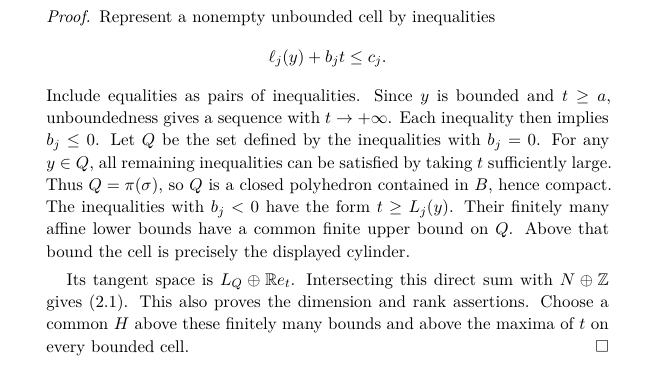
\begin{proof}
Represent a nonempty unbounded cell by inequalities
\[
 \ell_j(y)+b_jt\leq c_j.
\]
Include equalities as pairs of inequalities. Since \(y\) is bounded
and \(t\geq a\), unboundedness gives a sequence with \(t\to+\infty\).
Each inequality then implies \(b_j\leq0\).
Let \(Q\) be the set defined by the inequalities with \(b_j=0\).
For any \(y\in Q\), all remaining inequalities can be satisfied by
taking \(t\) sufficiently large. Thus \(Q=\pi(\sigma)\), so \(Q\)
is a closed polyhedron contained in \(B\), hence compact. The
inequalities with \(b_j<0\) have the form \(t\geq L_j(y)\).
Their finitely many affine lower bounds have a common finite upper
bound on \(Q\). Above that bound the cell is precisely the displayed
cylinder.

Its tangent space is \(L_Q\oplus\R e_t\). Intersecting this direct sum
with \(N\oplus\Z\) gives (2.1). This also proves the dimension and rank
assertions. Choose a common \(H\) above these finitely many bounds and
above the maxima of \(t\) on every bounded cell.
\end{proof}
Typeset reader excerpt
Typed proof inputs
- BASE-LINEAR · standing context or base
- BASE-LINEAR · standing context or base (requires)
- BASE-REAL · standing context or base
- BASE-REAL · standing context or base (requires)
Proof map
Verified map inputs · NAG-002561
No addressable selected proof input is recorded in this projection.
Standing context and base inputs
BASE-LINEARBASE-REAL