NAG-002571 · Accepted whole
Purity and regularity; F8GP-3
Proper direct image on historical ordinary compact tests
Open in the English reader · PDF page 1840
Statement · exact TeX
\begin{lemma}[Purity and regularity; F8GP-3]\label[lemma]{lem:purity}
The space \(V_0\) is nonempty and pure of dimension \(n\).
The function \(f_0\) is a non-zero-divisor in its affinoid algebra.
Every nonempty \(V_{0,S}\) is pure of dimension \(n\).
\end{lemma}
Full selected proof · exact TeX
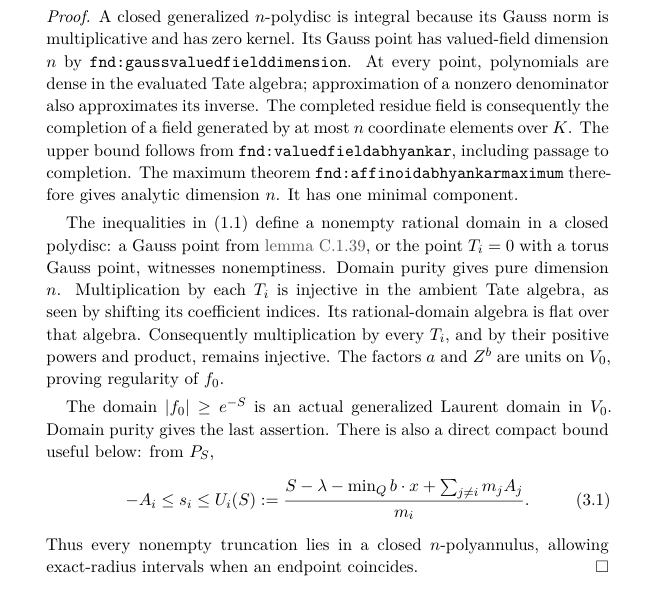
\begin{proof}
A closed generalized \(n\)-polydisc is integral because its Gauss
norm is multiplicative and has zero kernel. Its Gauss point has
valued-field dimension \(n\) by
\tagname{fnd:gaussvaluedfielddimension}.
At every point, polynomials are dense in the evaluated Tate algebra;
approximation of a nonzero denominator also approximates its inverse.
The completed residue field is consequently the completion of a field
generated by at most \(n\) coordinate elements over \(K\).
The upper bound follows from
\tagname{fnd:valuedfieldabhyankar}, including passage to completion. The maximum theorem
\tagname{fnd:affinoidabhyankarmaximum} therefore gives analytic
dimension \(n\). It has one minimal component.

The inequalities in (1.1) define a nonempty rational domain in a
closed polydisc: a Gauss point from \cref{lem:image}, or the point
\(T_i=0\) with a torus Gauss point, witnesses nonemptiness.
Domain purity gives pure dimension \(n\).
Multiplication by each \(T_i\) is injective in the ambient Tate
algebra, as seen by shifting its coefficient indices.
Its rational-domain algebra is flat over that algebra.
Consequently multiplication by every \(T_i\), and by their positive
powers and product, remains injective. The factors \(a\) and \(Z^b\)
are units on \(V_0\), proving regularity of \(f_0\).

The domain \(|f_0|\geq e^{-S}\) is an actual generalized Laurent
domain in \(V_0\). Domain purity gives the last assertion.
There is also a direct compact bound useful below: from \(P_S\),
\[
 -A_i\leq s_i\leq
 U_i(S):=
 \frac{S-\lambda-\min_Q b\cdot x+\sum_{j\ne i}m_j A_j}{m_i}.
 \tag{3.1}
\]
Thus every nonempty truncation lies in a closed \(n\)-polyannulus,
allowing exact-radius intervals when an endpoint coincides.
\end{proof}
Typeset reader excerpt
Typed proof inputs
- NAG-000182 · selected whole (sealed whole native proof)
- NAG-001576 · selected whole (sealed whole native proof)
- NAG-001577 · selected whole (sealed whole native proof)
- NAG-001587 · selected whole, export unavailable (sealed whole native proof)
- NAG-001588 · selected whole (sealed whole native proof)
- NAG-001591 · selected whole (sealed whole native proof)
- NAG-001832 · selected whole, export unavailable (sealed whole native proof)
- NAG-002293 · selected whole (sealed whole native proof)
- NAG-002570 · selected whole (earlier independently reviewed native proof in this batch)
- NAG-000182 · selected whole
- NAG-000182 · selected whole (requires)
- NAG-001576 · selected whole
- NAG-001576 · selected whole (requires)
- NAG-001577 · selected whole
- NAG-001577 · selected whole (requires)
- NAG-001587 · selected whole, export unavailable
- NAG-001587 · selected whole, export unavailable (requires)
- NAG-001588 · selected whole
- NAG-001588 · selected whole (requires)
- NAG-001591 · selected whole
- NAG-001591 · selected whole (requires)
- NAG-001832 · selected whole, export unavailable
- NAG-001832 · selected whole, export unavailable (requires)
- NAG-002293 · selected whole
- NAG-002293 · selected whole (requires)
- NAG-002570 · selected whole
- NAG-002570 · selected whole (requires)
Reader cross-references
Proof map
Verified map inputs · NAG-002571
AND · joint registered proof inputs
- NAG-000182 · Multiplicativity of the weighted Gauss norm · accepted whole
- NAG-001576 · Points of an arbitrary-radius rational presentation · accepted whole
- NAG-001577 · Bounded and geometric rational factorization · accepted whole
- NAG-001587 · Result 3.22.3 · accepted whole; PDF destination
- NAG-001588 · Residual dimension of a Gauss field · accepted whole
- NAG-001591 · Dimension as a maximum over analytic points · accepted whole
- NAG-001832 · Result 2.38.2 · accepted whole; PDF destination
- NAG-002293 · Purity of affinoid domains · accepted whole
- NAG-002570 · Actual source image; F8GP-2 · accepted whole
NAG-002571 · Purity and regularity; F8GP-3 · Chapter argument