NAG-002574 · Accepted whole
The three cell cases; F8GP-6
Proper direct image on historical ordinary compact tests
Open in the English reader · PDF page 1842
Statement · exact TeX
\begin{proposition}[The three cell cases; F8GP-6]
\label[proposition]{prop:coeff}
The coefficients before common refinement are as follows.
\begin{enumerate}[label=(\roman*),leftmargin=*]
\item If \(J=\varnothing\), the image is bounded, has dimension \(n\),
and has coefficient \(\delta(L_\sigma)\).
\item If \(J=\{j\}\), let \(M_{\widehat j}\) be \(M\) with its
\(j\)-th column removed and put
\[
 \delta_j=
 [\,\operatorname{span}_{\R}(M_{\widehat j})\cap\Z^r:
                                  M_{\widehat j}\Z^{n-1}\,].
\]
The image has dimension \(n\), is unbounded, and has coefficient
\(m_j\delta_j\). For \(n=1\), the empty-lattice index is one.
\item If \(|J|\geq2\), the image has rank \(n-|J|+1<n\);
it contributes zero to \(C_0\).
\end{enumerate}
Coincident image pieces are counted by summing their coefficients.
Moreover, one may take
\[
       H=\lambda+\max_{x\in Q}b\cdot x+1                 \tag{4.2}
\]
as a common strict upper bound for all bounded image cells and a
cylindrical-tail threshold for the unbounded image cells.
\end{proposition}
Full selected proof · exact TeX
\begin{proof}
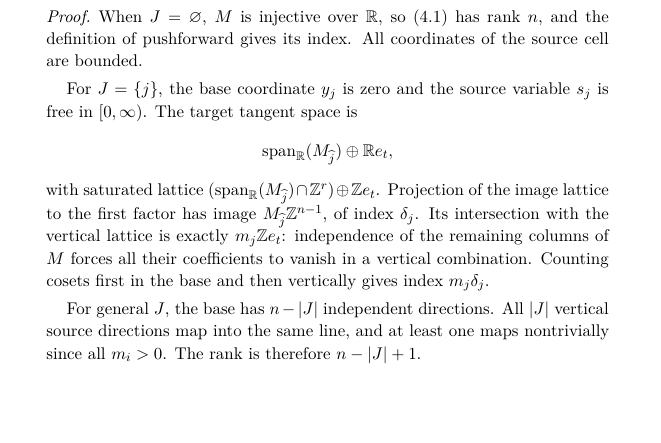
When \(J=\varnothing\), \(M\) is injective over \(\R\), so (4.1)
has rank \(n\), and the definition of pushforward gives its index.
All coordinates of the source cell are bounded.

For \(J=\{j\}\), the base coordinate \(y_j\) is zero and the source
variable \(s_j\) is free in \([0,\infty)\).
The target tangent space is
\[
 \operatorname{span}_{\R}(M_{\widehat j})\oplus\R e_t,
\]
with saturated lattice
\((\operatorname{span}_{\R}(M_{\widehat j})\cap\Z^r)
 \oplus\Z e_t\).
Projection of the image lattice to the first factor has image
\(M_{\widehat j}\Z^{n-1}\), of index \(\delta_j\).
Its intersection with the vertical lattice is exactly
\(m_j\Z e_t\): independence of the remaining columns of \(M\)
forces all their coefficients to vanish in a vertical combination.
Counting cosets first in the base and then vertically gives index
\(m_j\delta_j\).

For general \(J\), the base has \(n-|J|\) independent directions.
All \(|J|\) vertical source directions map into the same line, and
at least one maps nontrivially since all \(m_i>0\).
The rank is therefore \(n-|J|+1\).

On every bounded cell, \(s_i\leq0\), so
\(t\leq\lambda+\max_Q b\cdot x\).
On a cell with unique vertical branch \(j\), its image lies above
the lower graph
\[
 t=\lambda+\sum_{i\ne j}\epsilon_i m_i y_i+b\cdot x,
\]
where \(y_i\leq0\) whenever \(\epsilon_i=1\).
This lower graph is everywhere at most
\(\lambda+\max_Q b\cdot x\). Above (4.2), any \(t\) is obtained
by choosing \(s_j\geq0\). The image is thus a vertical cylinder
there. Common refinements may be taken after cutting at this
same height, without introducing a new larger threshold.
\end{proof}
Typeset reader excerpt
Typed proof inputs
- NAG-002179 · selected whole (sealed whole native proof)
- NAG-002573 · selected whole (earlier independently reviewed native proof in this batch)
- NAG-002179 · selected whole
- NAG-002179 · selected whole (requires)
- NAG-002573 · selected whole
- NAG-002573 · selected whole (requires)
Proof map
Verified map inputs · NAG-002574
AND · joint registered proof inputs
- NAG-002179 · Primitive vectors and saturated lattices · accepted whole
- NAG-002573 · A proper finite polyhedral pushforward; F8GP-5 · accepted whole
NAG-002574 · The three cell cases; F8GP-6 · Chapter argument