NAG-002575 · Accepted whole
Persistence under covers and perturbations; F8GP-7
G Stable inertia and original-field models
Open in the English reader · PDF page 2022
Statement · exact TeX
\begin{theorem}[Persistence under covers and perturbations; F8GP-7]
\label{thm:cover}
Let \(p:V=\M(B)\to V_0=\M(A_0)\) be finite with its canonical
module norm, and suppose \(B\) is a locally free \(A_0\)-module
of constant positive rank \(e\). Assume \(V\) is pure of dimension
\(n\). Let \(u_0,u_1,\ldots,u_r\in B^\times\) satisfy
\[
                         |u_j(z)|=1
                  \quad\text{for every }z\in V.             \tag{5.1}
\]
For
\[
 f=p^*f_0\,u_0,\qquad
 g_\ell=p^*g_{0,\ell}\,u_\ell,\qquad
 V_S=\{|f|\geq e^{-S}\},
\]
the function \(f\) is regular, every nonempty \(V_S\) is pure of
dimension \(n\), and one single chain
\[
                              C=eC_0                      \tag{5.2}
\]
satisfies
\[
 \boxed{\quad
 \Trop_{(g,f),V_S}(\mathcal O_{V_S})
                        =C|_{\{t\leq S\}}
 \quad}                                                    \tag{5.3}
\]
for every real \(S\).
The same bound (4.2) applies. Neither separability, reducedness of
\(V\), nor global freeness of \(B\) is required.

A concrete sufficient condition for (5.1) is
\(u_j=1+\varepsilon_j\) with
\(\norm{\varepsilon_j}<1\) in a specified complete submultiplicative
affinoid norm on \(B\).
\end{theorem}
Full selected proof · exact TeX
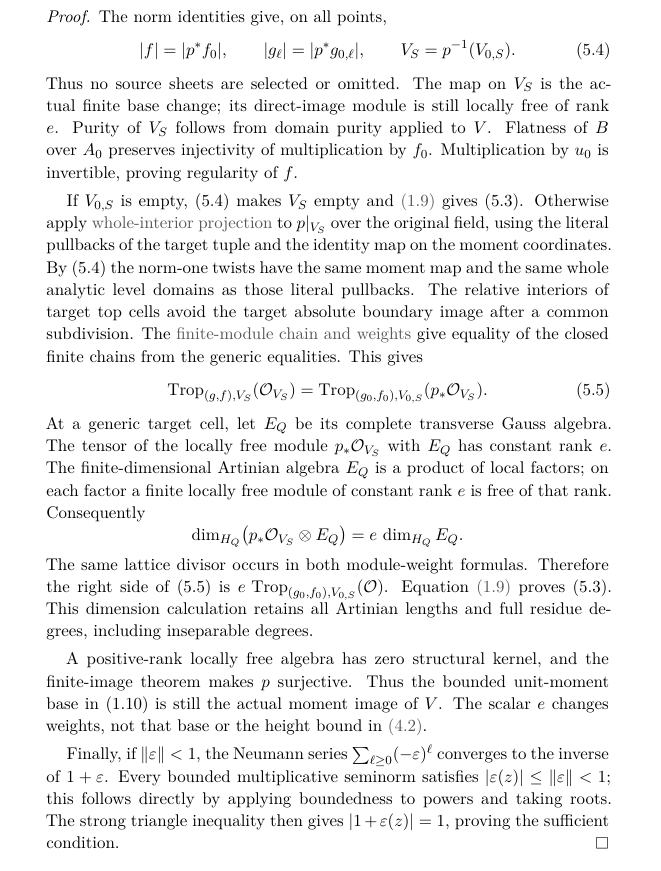
\begin{proof}
The norm identities give, on all points,
\[
 |f|=|p^*f_0|,\qquad |g_\ell|=|p^*g_{0,\ell}|,\qquad
 V_S=p^{-1}(V_{0,S}).                                     \tag{5.4}
\]
Thus no source sheets are selected or omitted.
The map on \(V_S\) is the actual finite base change; its direct-image
module is still locally free of rank \(e\).
Purity of \(V_S\) follows from domain purity applied to \(V\).
Flatness of \(B\) over \(A_0\) preserves injectivity of multiplication
by \(f_0\). Multiplication by \(u_0\) is invertible, proving
regularity of \(f\).

If \(V_{0,S}\) is empty, (5.4) makes \(V_S\) empty and
\hyperref[fnd:nag002568:closed-cutoff-identity]{(1.9)} gives (5.3).
Otherwise apply \hyperref[v037:analytic:interiorcycle]{whole-interior projection}
to \(p|_{V_S}\) over the original field, using the literal pullbacks
of the target tuple and the identity map on the moment coordinates.
By (5.4) the norm-one twists have the same moment map and the same
whole analytic level domains as those literal pullbacks. The relative interiors of target top cells avoid the target absolute
boundary image after a common subdivision. The \hyperref[fnd:nag002405:global-finite-module-chain-weights]{finite-module chain and weights}
give equality of the closed finite chains from the generic equalities.
This gives
\[
 \Trop_{(g,f),V_S}(\mathcal O_{V_S})
       =\Trop_{(g_0,f_0),V_{0,S}}(p_*\mathcal O_{V_S}).
 \tag{5.5}
\]
At a generic target cell, let \(E_Q\) be its complete transverse
Gauss algebra. The tensor of the locally free module
\(p_*\mathcal O_{V_S}\) with \(E_Q\) has constant rank \(e\).
The finite-dimensional Artinian algebra \(E_Q\) is a product of
local factors; on each factor a finite locally free module of
constant rank \(e\) is free of that rank. Consequently
\[
 \dim_{H_Q}\bigl(p_*\mathcal O_{V_S}\otimes E_Q\bigr)
                           =e\,\dim_{H_Q}E_Q.
\]
The same lattice divisor occurs in both module-weight formulas.
Therefore the right side of (5.5) is
\(e\,\Trop_{(g_0,f_0),V_{0,S}}(\mathcal O)\).
Equation \hyperref[fnd:nag002568:closed-cutoff-identity]{(1.9)} proves (5.3).
This dimension calculation retains all Artinian lengths and full
residue degrees, including inseparable degrees.

A positive-rank locally free algebra has zero structural kernel,
and the finite-image theorem makes \(p\) surjective. Thus the
bounded unit-moment base in (1.10) is still the actual moment image
of \(V\). The scalar \(e\) changes weights, not that base or the
height bound in \hyperref[prop:coeff]{(4.2)}.

Finally, if \(\norm{\varepsilon}<1\), the Neumann series
\(\sum_{\ell\geq0}(-\varepsilon)^\ell\) converges to the inverse
of \(1+\varepsilon\). Every bounded multiplicative seminorm satisfies
\(|\varepsilon(z)|\leq\norm{\varepsilon}<1\); this follows directly
by applying boundedness to powers and taking roots.
The strong triangle inequality then gives
\(|1+\varepsilon(z)|=1\), proving the sufficient condition.
\end{proof}
Typeset reader excerpt
Typed proof inputs
- NAG-002575 · selected whole
Proof map
Verified map inputs · NAG-002575
No addressable selected proof input is recorded in this projection.
NAG-002575 · Persistence under covers and perturbations; F8GP-7 · Chapter argument