NAG-002599 · Accepted whole
An original-ring symmetric insertion
Proper direct image on historical ordinary compact tests
Open in the English reader · PDF page 1903
Statement · exact TeX
\begin{lemma}[An original-ring symmetric insertion]
\label{cand:f5sub:originalsymmetric}
Let \(q\) be a closed node of \(\mathcal X_s\), and let \(\ell\)
be the common length of its split geometric tubes.
For \(\delta\in\Gamma\) with \(0<\delta\leq\ell/2\), there is a
projective semistable modification of \(\mathcal X\), an isomorphism
away from \(q\), inserting precisely \(\delta,\ell-\delta\) in each
geometric tube over \(q\). A coincident pair is counted once.
The modification preserves \(D\) and all old vertices and is the
blowup of an explicit finite-type ideal on \(\mathcal X\).
\end{lemma}
Full selected proof · exact TeX
\begin{proof}
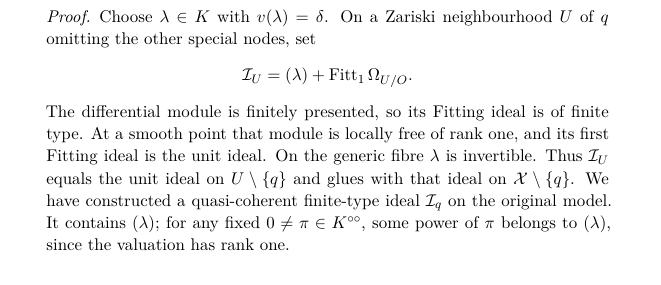
Choose \(\lambda\in K\) with \(v(\lambda)=\delta\).
On a Zariski neighbourhood \(U\) of \(q\) omitting the other special
nodes, set
\[
                 \mathcal I_U=(\lambda)
                    +\operatorname{Fitt}_1\Omega_{U/O}.
\]
The differential module is finitely presented, so its Fitting ideal
is of finite type. At a smooth point that module is locally free
of rank one, and its first Fitting ideal is the unit ideal.
On the generic fibre \(\lambda\) is invertible.
Thus \(\mathcal I_U\) equals the unit ideal on \(U\setminus\{q\}\)
and glues with that ideal on \(\mathcal X\setminus\{q\}\).
We have constructed a quasi-coherent finite-type ideal
\(\mathcal I_q\) on the original model.
It contains \((\lambda)\); for any fixed
\(0\ne\pi\in K^{\circ\circ}\), some power of \(\pi\) belongs to
\((\lambda)\), since the valuation has rank one.

Extend to \(O'=L^\circ\).
Differentials and Fitting ideals commute with coefficient extension
and the indicated etale charts
(Stacks tags \stacks{04BX}, \stacks{0C3D}, \stacks{0C3E}).
The ideal in every selected chart is \((\lambda,x_e,y_e)\).
Blowup commutes with these flat base changes by \stacks{0805}.
The accepted \dep{cand:symmetricnodeblowup} applies because
\(c_e=a_e/\lambda^2\in O'\). Its three actual torsion-free charts are
\[
 O'[u,z]/(uz-c_e),\qquad
 O'[x,w]/(xw-\lambda),\qquad
 O'[y,w']/(yw'-\lambda).
\]
We reuse that calculation, including its gluing and component count.
It inserts two smooth geometric projective lines if \(2\delta<\ell\),
and one if \(2\delta=\ell\), at exactly the asserted radii.
They form a chain between the two old branch ends.

Shrink each auxiliary pointed etale neighbourhood so its fibre over
each selected node in either target is exactly the specified rational
point. These charts cover the exceptional fibre.
With the unchanged complement, they prove flatness and local finite
presentation as in \dep{cand:nodefittinginsertion}, using
\stacks{036K} and \stacks{036N}. Nodality descends through the finite
faithfully flat coefficient extension by \stacks{0C5E}.
The actual global blowup is projective by \stacks{02NS};
composition over the affine base is projective by \stacks{0C4P}.
Quasi-compactness, separatedness and local finite presentation give
finite presentation. Replacing each geometric edge by a connected
chain preserves geometric connectedness and reducedness.
The generic fibre is unchanged, and the smooth marking is disjoint
from the centre.

This constructs the integral model before using geometric vertex
invariance. The Fitting ideal is defined even at a nonsplit node
and when both branches belong to one global component.
\end{proof}
Typeset reader excerpt
Typed proof inputs
- NAG-002053 · selected whole (selected native whole)
- NAG-002099 · selected whole (selected native whole)
- NAG-002100 · selected whole
- NAG-002220 · selected whole (selected native whole)
- NAG-002222 · selected whole (selected native whole)
- NAG-002262 · selected whole (selected native whole)
Reader cross-references
Proof map
Verified map inputs · NAG-002599
AND · joint registered proof inputs
- NAG-002053 · All lifts of a finite set of nodes · accepted whole Exact source window 581–588
- The standing unramified coefficient lift is actual finite free étale with the same value group; point and branch splitting supplies the indicated rational pointed étale charts.
- NAG-002099 · A symmetric subdivision of a nodal annulus · accepted whole Exact source window 649–662
- Apply explicit symmetric charts over the complete original extension L with v(a_e)≥2v(λ). The retained proof covers the equality central unit chart and the strict two-component case.
- NAG-002100 · An intrinsic centre at a split node · accepted whole Exact source window 663–666
- The source says as in the local split-node chart proof. Its algebraically closed global statement is not invoked over L. Actual étale chart checking and the cited locality criteria carry the proof.
- NAG-002220 · Result 4.39.1 · accepted whole Exact source window 590–600
- Use the exact pointed formal-étale tube and annular ends, counting the two branch ends even if their component labels coincide.
- NAG-002222 · Formal smooth and nodal tube closures · accepted whole Exact source window 590–600
- Use the exact pointed formal-étale tube and annular ends, counting the two branch ends even if their component labels coincide.
- NAG-002262 · Integral Galois descent for unramified coefficients · accepted whole Exact source window 581–588
- The standing unramified coefficient lift is actual finite free étale with the same value group; point and branch splitting supplies the indicated rational pointed étale charts.
NAG-002599 · An original-ring symmetric insertion · Chapter argument