NAG-002606 · Accepted whole
Normalization does not repair the generic graph
Proper direct image on historical ordinary compact tests
Open in the English reader · PDF page 1890
Statement · exact TeX
\begin{proposition}[Normalization does not repair the generic graph]
\label{cand:f5sub:normalgraphcounterexample}
Let \(k\) be any field, \(O=k[[\pi]]\), and \(K=k((\pi))\),
with its usual complete discrete absolute value.
On \(\mathbf P^1_O\), with affine coordinate \(T\), set
\[
 \mathcal X_1=\operatorname{Bl}_{(T,\pi^2)}\mathbf P^1_O,
 \qquad
 \mathcal X_2=\operatorname{Bl}_{(T-\pi,\pi^2)}\mathbf P^1_O, \tag{4}
\]
extending each ideal by the unit ideal near infinity.
These are projective semistable models of \(\mathbf P^1_K\).
The schematic closure \(\mathcal G\) of their generic identity graph
has an open neighbourhood of the pair of special nodes equal to
\(\operatorname{Spec}R\), with
\[
 R=\frac{O[T,u,v]}
 {(Tu-\pi^2,\ (T-\pi)v-\pi^2,\ uv+\pi u-\pi v)}.          \tag{5}
\]
The domain \(R\) is normal, but
\[
                   R/\pi R=k[T,u,v]/(Tu,Tv,uv).         \tag{6}
\]
At the origin this special fibre has three geometric branches
and is not nodal. The normalization of \(\mathcal G\) is therefore
not a semistable model.
\end{proposition}
Full selected proof · exact TeX
\begin{proof}
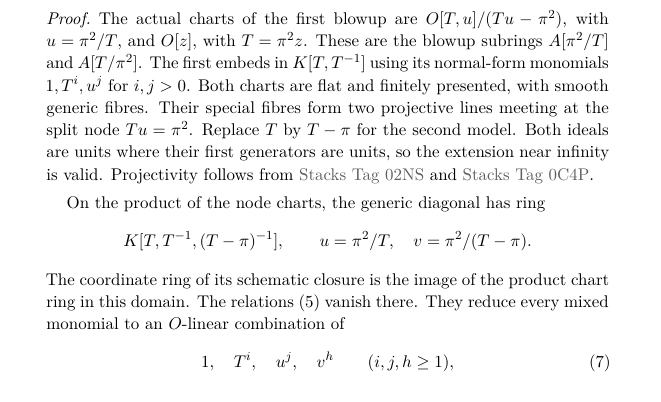
The actual charts of the first blowup are
\(O[T,u]/(Tu-\pi^2)\), with \(u=\pi^2/T\), and \(O[z]\),
with \(T=\pi^2z\). These are the blowup subrings
\(A[\pi^2/T]\) and \(A[T/\pi^2]\).
The first embeds in \(K[T,T^{-1}]\) using its normal-form
monomials \(1,T^i,u^j\) for \(i,j>0\).
Both charts are flat and finitely presented, with smooth generic
fibres. Their special fibres form two projective lines meeting
at the split node \(Tu=\pi^2\).
Replace \(T\) by \(T-\pi\) for the second model.
Both ideals are units where their first generators are units,
so the extension near infinity is valid. Projectivity follows
from \stacks{02NS} and \stacks{0C4P}.

On the product of the node charts, the generic diagonal has ring
\[
 K[T,T^{-1},(T-\pi)^{-1}],\qquad
                  u=\pi^2/T,\quad v=\pi^2/(T-\pi).
\]
The coordinate ring of its schematic closure is the image of the
product chart ring in this domain. The relations (5) vanish there.
They reduce every mixed monomial to an \(O\)-linear combination of
\[
                  1,\quad T^i,\quad u^j,\quad v^h
                          \qquad (i,j,h\geq1),          \tag{7}
\]
since \(Tu=\pi^2\), \(Tv=\pi v+\pi^2\) and
\(uv=\pi v-\pi u\) decrease total degree in \(T,u,v\).
The elements (7) are linearly independent in \(K(T)\):
the \(u\)-terms have sole poles at \(0\), the \(v\)-terms at
\(\pi\), and the polynomial part is regular at both.
Comparing principal parts at these distinct points eliminates
all \(u\)- and \(v\)-coefficients, and then the polynomial
coefficients. Thus (5) is exactly the image ring, a domain
free over \(O\) on (7). Reduction gives (6).

Put \(\mathfrak n=(\pi,T,u,v)\).
After inverting \(\pi\) we have the displayed smooth \(K\)-algebra.
At a prime containing \(\pi\) but not \(T\), the local ring is
a localization of \(O[T,T^{-1},(T-\pi)^{-1}]\).
At a prime containing \(\pi\) but not \(u\), the elements \(u,u-\pi\)
are units, and
\[
                   T=\pi^2/u,\qquad v=-\pi u/(u-\pi).
\]
The local ring is a localization of
\(O[u,u^{-1},(u-\pi)^{-1}]\).
For a prime containing \(\pi\) but not \(v\), use
\[
                   T=\pi+\pi^2/v,\qquad u=\pi v/(v+\pi).
\]
Every local ring outside \(\mathfrak n\) is therefore regular,
by regularity of localized polynomial rings over a DVR
(or \stacks{07NF}).

At \(\mathfrak n\), the element \(\pi\) is a nonzerodivisor.
In (6), \(T+u+v\) is a nonzerodivisor: that ring injects into
\(k[T]\times k[u]\times k[v]\), and multiplication restricts
to multiplication by \(T,u,v\) in the respective factors.
Thus \(\pi,T+u+v\) is a regular sequence in \(R_{\mathfrak n}\).
Its depth is at least two. The strict chain of primes
\[
                  (0)\subsetneq(\pi,u,v)\subsetneq\mathfrak n
\]
shows that \(\mathfrak n\) has height at least two:
\(R/(\pi,u,v)=k[T]\).
Every height-one prime is outside \(\mathfrak n\), where
regularity was proved. Regular local rings are Cohen--Macaulay by \stacks{00NQ}.
The Noetherian ring \(R\) therefore satisfies \(R_1\) and \(S_2\), so is normal by \stacks{031S}.

Over an algebraic closure of \(k\), the three axes in (6)
remain distinct. The special local ring at the origin has
dimension one and embedding dimension three, so is neither
smooth nor an ordinary double point.
Normalization is the identity on the normal open
\(\operatorname{Spec}R\) and cannot remove this three-branch point.
\end{proof}
Typeset reader excerpt
Typed proof inputs
No explicit typed target in the exported bindings.
Proof map
Verified map inputs · NAG-002606
No addressable selected proof input is recorded in this projection.
NAG-002606 · Normalization does not repair the generic graph · Chapter argument