NAG-002613 · Accepted whole
Branch characters and the quotient of a node
Proper direct image on historical ordinary compact tests
Open in the English reader · PDF page 1858
Statement · exact TeX
\begin{proposition}[Branch characters and the quotient of a node]
\label{cand:f5tame:diagonalnode}
In (5) let
\[
 B'=R'[x,y]/(xy-s^n),\qquad n\geq1,
 \qquad \sigma(x)=\zeta^a x,\quad \sigma(y)=\zeta^b y,
 \tag{8}
\]
where \(0\leq a,b<e\) and \(a+b\equiv n\pmod e\).
Let \(B=(B')^G\). The images in \(\operatorname{Spec}(B/\pi B)\)
of the components \(y=0\) and \(x=0\) have generic
multiplicities, respectively,
\[
       \frac{e}{\gcd(e,a)},\qquad
       \frac{e}{\gcd(e,b)} .
 \tag{9}
\]
Moreover the following conditions are equivalent:
\begin{enumerate}
\item the given chart (8) effectively descends over \(R\);
\item \(a=b=0\);
\item \(\operatorname{Spec}B\to\operatorname{Spec}R\) is a
      semistable affine nodal chart.
\end{enumerate}
When these conditions hold, \(e\mid n\) and
\[
       B=R[x,y]/(xy-\pi^{\,n/e}).
 \tag{10}
\]
All these statements allow arbitrary \(k\) subject to the
root-of-unity and tameness hypotheses. They concern the given
split diagonal chart, without an assertion that every nonsplit
node has such coordinates over its original residue field.
\end{proposition}
Full selected proof · exact TeX
\begin{proof}
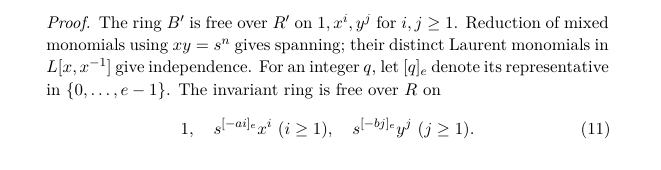
The ring \(B'\) is free over \(R'\) on
\(1,x^i,y^j\) for \(i,j\geq1\). Reduction of mixed monomials
using \(xy=s^n\) gives spanning; their distinct Laurent
monomials in \(L[x,x^{-1}]\) give independence.
For an integer \(q\), let \([q]_e\) denote its representative in
\(\{0,\ldots,e-1\}\). The invariant ring is free over \(R\) on
\[
 1,\quad s^{[-ai]_e}x^i\ (i\geq1),\quad
          s^{[-bj]_e}y^j\ (j\geq1).
 \tag{11}
\]
This follows by expanding each coefficient in the basis (5)
and imposing the character equation. The elements in (11) with
\(1\leq i,j\leq e\) generate the algebra, since multiplying by
the invariant \(x^e\) or \(y^e\) handles the remaining exponents.
Thus \(B\) is flat and of finite type, hence finitely presented,
over the Noetherian ring \(R\).

Set \(d=\gcd(e,a)\), \(h=e/d\). If \(h>1\), choose an integer
\(v\) with \((a/d)v\equiv1\pmod h\); if \(h=1\), take \(v=0\).
On the invariant open where \(x^e\) is invertible, put
\[
       z=s^d x^{-v},\qquad w=x^h.
\]
Both are invariant and \(w\) is a unit. We claim
\[
 B[1/x^e]\simeq
 R[z,w,w^{-1}]/(z^h w^v-\pi).
 \tag{12}
\]
Indeed \(B'[1/x^e]=R'[x,x^{-1}]\), and invariants commute with
localization at the invariant nonzerodivisor \(x^e\).
An invariant monomial \(s^r x^q\), \(0\leq r<e\), satisfies
\(r+aq\equiv0\pmod e\). Thus \(r=dj\) with \(0\leq j<h\)
and \(q=-vj+h\ell\) for an integer \(\ell\). It is \(z^jw^\ell\),
which proves surjectivity in (12). The monic relation in \(z\)
gives a spanning set \(z^jw^\ell\), \(0\leq j<h\).
Its images have distinct pairs of \(s\)-exponent modulo \(e\)
and \(x\)-exponent, so are \(R\)-linearly independent. This
proves (12).

Reducing (12) modulo \(\pi\) gives
\(k[z,w,w^{-1}]/(z^h)\). At its sole generic point the local
ring has length \(h\), proving the first multiplicity in (9).
Interchanging \(x,a\) with \(y,b\) proves the other.
These are the generic points of the two component images:
\(x^e\), respectively \(y^e\), is nonzero there and vanishes
on the other component. The two images are therefore distinct.
The finite invariant map introduces no ambiguity here:
\(B'\) is finite over \(B\), since \(s,x,y\) are integral
and generate it as a \(B\)-algebra.

On \(B'/sB'=k[x,y]/(xy)\), the action is the identity exactly
when \(a=b=0\). The preceding corollary proves the equivalence
of conditions 1 and 2. If either weight is nonzero, its
multiplicity in (9) exceeds one, so \(B/\pi B\) is not reduced
on the corresponding open and condition 3 fails. If both
weights vanish, the congruence in (8) gives \(e\mid n\);
(11) directly gives (10), which is flat with reduced nodal
geometric special fibre and smooth generic fibre.
\end{proof}
Typeset reader excerpt
Typed proof inputs
- NAG-002611 · selected whole (exact native dependency)
Proof map
Verified map inputs · NAG-002613
Registered proof input
- NAG-002611 · The affine special-fibre criterion over a DVR · accepted whole Exact source window 278–279
NAG-002613 · Branch characters and the quotient of a node · Chapter argument