NAG-002615 · Accepted whole
A tame valuation-ring extension that is not finite
Proper direct image on historical ordinary compact tests
Open in the English reader · PDF page 1906
Statement · exact TeX
\begin{proposition}[A tame valuation-ring extension that is not finite]
\label{cand:f5tame:nondiscretecoefficients}
Use the audited field
\[
 K=\widehat{\bigcup_{r\geq0}k((t^{1/3^r}))},\qquad
 \operatorname{char}(k)=0,\quad k\ \hbox{algebraically closed},
 \qquad v(t)=1,\quad \Gamma=\mathbb Z[1/3],
\]
and \(L=K(b)\), \(b^2=t\). For \(O=K^\circ\), \(O'=L^\circ\),
\[
 O'=O\oplus Mb,\qquad
 M=\{c\in K:v(c)>-1/2\}.
 \tag{13}
\]
The \(O\)-module \(M\), and therefore \(O'\), is not finitely
generated. In particular \(O[b]\ne O'\), although \(L/K\)
is tame quadratic with unchanged residue field.
\end{proposition}
Full selected proof · exact TeX
\begin{proof}
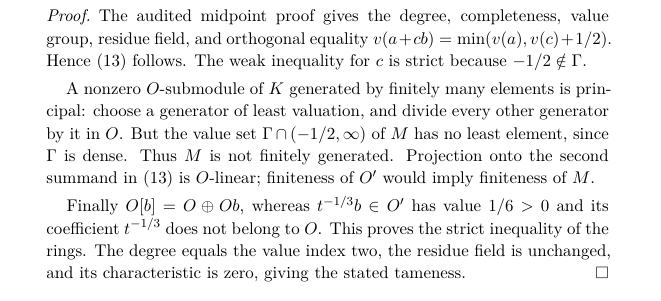
The audited midpoint proof gives the degree, completeness,
value group, residue field, and orthogonal equality
\(v(a+cb)=\min(v(a),v(c)+1/2)\). Hence (13) follows.
The weak inequality for \(c\) is strict because
\(-1/2\notin\Gamma\).

A nonzero \(O\)-submodule of \(K\) generated by finitely many
elements is principal: choose a generator of least valuation,
and divide every other generator by it in \(O\).
But the value set \(\Gamma\cap(-1/2,\infty)\) of \(M\) has no
least element, since \(\Gamma\) is dense. Thus \(M\) is not
finitely generated. Projection onto the second summand in
(13) is \(O\)-linear; finiteness of \(O'\) would imply
finiteness of \(M\).

Finally \(O[b]=O\oplus Ob\), whereas
\(t^{-1/3}b\in O'\) has value \(1/6>0\) and its coefficient
\(t^{-1/3}\) does not belong to \(O\). This proves the strict
inequality of the rings. The degree equals the value index
two, the residue field is unchanged, and its characteristic
is zero, giving the stated tameness.
\end{proof}
Typeset reader excerpt
Typed proof inputs
- NAG-002604 · selected whole (earlier unchanged whole in this batch)
Proof map
Verified map inputs · NAG-002615
Registered proof input
- NAG-002604 · An invariant midpoint over a dense value group · accepted whole Exact source window 779–784
- Use the exact field construction, unchanged residue field, value coset and completeness of the same quadratic extension. The coefficient cut is strict because −1/2 is not in the original value group.
NAG-002615 · A tame valuation-ring extension that is not finite · Chapter argument