NAG-002647 · Accepted whole
Finite type makes the additive descent defect finite
Proper direct image on historical ordinary compact tests
Open in the English reader · PDF page 1831
Statement · exact TeX
\begin{lemma}[Finite type makes the additive descent defect finite]
\label{cand:f5res:finitedefect}
Let \(A'\) be a commutative algebra, let a finite group \(G\) of
order \(e\) act on \(A'\), and let \(R'\subset A'\) be a subring.
Put \(B=(A')^G\) and let \(S=R'[B]\subset A'\) be the subalgebra
generated by \(R'\) and \(B\).
If \(A'=R'[z_1,\ldots,z_r]\), then \(A'\) is a finite \(S\)-module,
generated by the \(e^r\) monomials
\[
               z_1^{j_1}\cdots z_r^{j_r},
                    \qquad 0\leq j_\nu<e.
 \tag{2}
\]
Consequently the additive quotient \(A'/S\) is a finite \(S\)-module.
No Noetherian hypothesis and no assumption that \(G\) fixes
\(R'\) pointwise are required.
\end{lemma}
Full selected proof · exact TeX
\begin{proof}
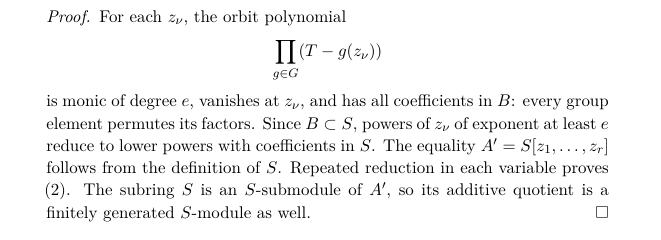
For each \(z_\nu\), the orbit polynomial
\[
                 \prod_{g\in G}(T-g(z_\nu))
\]
is monic of degree \(e\), vanishes at \(z_\nu\), and has all
coefficients in \(B\): every group element permutes its factors.
Since \(B\subset S\), powers of \(z_\nu\) of exponent at least
\(e\) reduce to lower powers with coefficients in \(S\).
The equality \(A'=S[z_1,\ldots,z_r]\) follows from the definition
of \(S\). Repeated reduction in each variable proves (2).
The subring \(S\) is an \(S\)-submodule of \(A'\), so its additive
quotient is a finitely generated \(S\)-module as well.
\end{proof}
Typeset reader excerpt
Typed proof inputs
- BASE-RINGS · standing context or base
- BASE-RINGS · standing context or base (requires)
Proof map
Verified map inputs · NAG-002647
No addressable selected proof input is recorded in this projection.
Unlinked source pointers
These pointers have no operative linked edge in this map.
BASE-RINGS
NAG-002647 · Finite type makes the additive descent defect finite · Chapter argument