NAG-002711 · Accepted whole
Interior Gauss recognition under a finite fan projection
I Descent of the polarized mixed tower
Open in the English reader · PDF page 2109
Statement · exact TeX
\begin{lemma}[Interior Gauss recognition under a finite fan projection]
\label{gci:gaussrank}
Let \(Z\) be a generalized affinoid, let
\(x\in\operatorname{Int}(Z/K)\), and let \(f\) be an actual
unit tuple with \(t_f(x)=w\).
Suppose that \(C_x\) is contained in the support of a finite
pure \(d\)-dimensional rational fan \(\Sigma\subset\mathbb R^n\),
where \(d\geq1\).
Let \(Q:\mathbb Z^n\to\mathbb Z^d\) be integral and injective
on the real span of every top cone of \(\Sigma\).
For the actual monomial tuple \(g=f^Q\),
\[
               g(x)=\eta_{Qw}
                  \quad\Longleftrightarrow\quad r_f(x)=d.
 \tag{7}\label{gci:gausscriterion}
\]
This is an equality criterion for analytic points of the
target torus. It does not identify the different projected
fibre algebras with one another.
\end{lemma}
Full selected proof · exact TeX
\begin{proof}
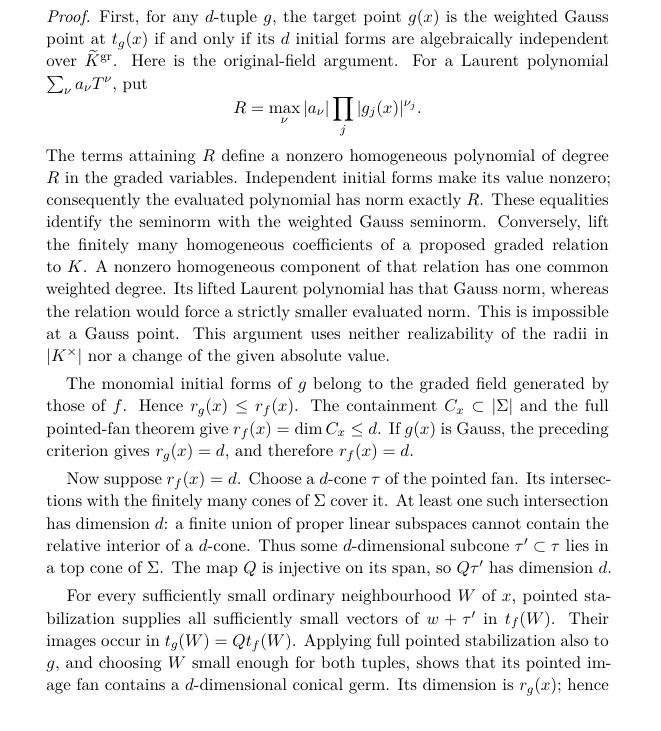
First, for any \(d\)-tuple \(g\), the target point \(g(x)\)
is the weighted Gauss point at \(t_g(x)\) if and only if its
\(d\) initial forms are algebraically independent over
\(\widetilde K^{\rm gr}\).
Here is the original-field argument.
For a Laurent polynomial \(\sum_\nu a_\nu T^\nu\), put
\[
 R=\max_\nu |a_\nu|\prod_j|g_j(x)|^{\nu_j}.
\]
The terms attaining \(R\) define a nonzero homogeneous
polynomial of degree \(R\) in the graded variables.
Independent initial forms make its value nonzero; consequently
the evaluated polynomial has norm exactly \(R\).
These equalities identify the seminorm with the weighted
Gauss seminorm. Conversely, lift the finitely many homogeneous
coefficients of a proposed graded relation to \(K\).
A nonzero homogeneous component of that relation has one
common weighted degree. Its lifted Laurent polynomial has
that Gauss norm, whereas the relation would force a strictly
smaller evaluated norm. This is impossible at a Gauss point.
This argument uses neither realizability of the radii in
\(|K^\times|\) nor a change of the given absolute value.

The monomial initial forms of \(g\) belong to the graded field
generated by those of \(f\). Hence \(r_g(x)\leq r_f(x)\).
The containment \(C_x\subset|\Sigma|\) and the full pointed-fan
theorem give \(r_f(x)=\dim C_x\leq d\).
If \(g(x)\) is Gauss, the preceding criterion gives
\(r_g(x)=d\), and therefore \(r_f(x)=d\).

Now suppose \(r_f(x)=d\).
Choose a \(d\)-cone \(\tau\) of the pointed fan.
Its intersections with the finitely many cones of \(\Sigma\)
cover it. At least one such intersection has dimension \(d\):
a finite union of proper linear subspaces cannot contain the
relative interior of a \(d\)-cone.
Thus some \(d\)-dimensional subcone \(\tau'\subset\tau\)
lies in a top cone of \(\Sigma\).
The map \(Q\) is injective on its span, so \(Q\tau'\) has
dimension \(d\).

For every sufficiently small ordinary neighbourhood \(W\)
of \(x\), pointed stabilization supplies all sufficiently
small vectors of \(w+\tau'\) in \(t_f(W)\).
Their images occur in \(t_g(W)=Qt_f(W)\).
Applying full pointed stabilization also to \(g\), and
choosing \(W\) small enough for both tuples, shows that its
pointed image fan contains a \(d\)-dimensional conical germ.
Its dimension is \(r_g(x)\); hence \(r_g(x)\geq d\).
There are only \(d\) generators, so \(r_g(x)=d\).
The Gauss criterion proved in the first paragraph completes
the proof. This uses a dimension lower bound from the
actual neighbourhood images, not a claim that arbitrary
projection commutes with an uncontrolled image germ.
\end{proof}
Typeset reader excerpt
Typed proof inputs
- NAG-000182 · selected whole (explicit current dependencies)
- NAG-002455 · selected whole (explicit current dependencies)
Proof map
Verified map inputs · NAG-002711
AND · joint registered proof inputs
- NAG-000182 · Multiplicativity of the weighted Gauss norm · accepted whole
- NAG-002455 · Stabilization and purity of pointed tropical germs · accepted whole
NAG-002711 · Interior Gauss recognition under a finite fan projection · Chapter argument