NAG-002732 · Accepted whole
Identity (M) on every continuous radial test
I Descent of the polarized mixed tower
Open in the English reader · PDF page 2127
Statement · exact TeX
\begin{theorem}[Identity (M) on every continuous radial test]
\label{f9tm:radialcomparison}
For the class in Section~\ref{ex68:radial:sec:class}, Identity $(M_{\rm tor})$ holds
for every $F\in\mathcal S$:
\begin{equation}\label{ex68:radial:eq:Mtor}
 I_K(u_F\theta)=J_{\rm GK}(u_F\theta)
       =\int_{X^\an}u_F\,d\mu_{\rm GK}
       =\int_{\mathbf R^d}F(t)W(t)\,dt.
\end{equation}
Both restricted functionals have a unique continuous extension from
$\mathcal S$ to all $F\in C(\overline{\mathbf R}^{,d})$ in the uniform
norm, and \eqref{ex68:radial:eq:Mtor} holds for every such $F$, with $I_K$ understood
as this extension. These tests belong to the uniform closure of the
ordinary smooth moment functions on $X^\an$. The common functional is
positive, vanishes if $F|_S=0$, and satisfies
\begin{equation}\label{ex68:radial:eq:bound}
 |I_K(u_F\theta)|\leq D\|F\|_\infty,\qquad I_K(\theta)=D.
\end{equation}
Here $D$ is the algebraic mixed degree of $L_1,\ldots,L_d$ on $X$,
including the local intersection lengths. If
$L=L_1\otimes\cdots\otimes L_d$ has the product metric, then
$c_1(L)^d=d!\theta$, so its mass and algebraic self-degree are $d!D$.
\end{theorem}
Full selected proof · exact TeX
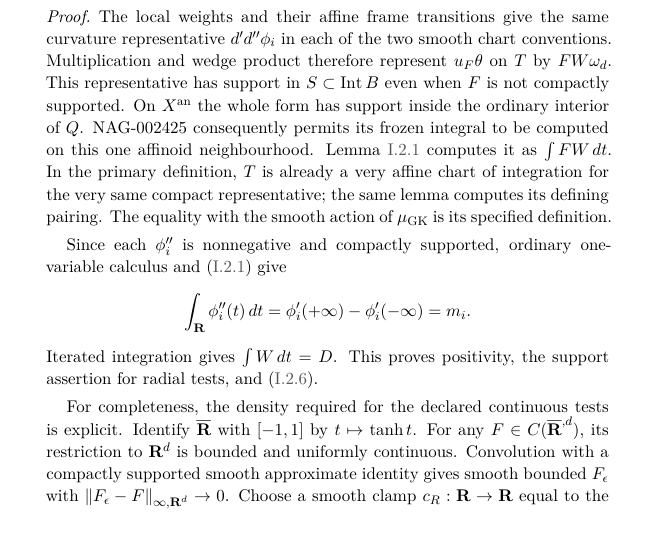
\begin{proof}
The local weights and their affine frame transitions give the same
curvature representative $\dd\phi_i$ in each of the two smooth chart
conventions. Multiplication and wedge product therefore represent
$u_F\theta$ on $T$ by $F W\omega_d$. This representative has support in
$S\subset\Int B$ even when $F$ is not compactly supported. On $X^\an$
the whole form has support inside the ordinary interior of $Q$.
NAG-002425 consequently permits its frozen integral to be computed on
this one affinoid neighbourhood. Lemma~\ref{f9tm:torusweight} computes
it as $\int F W\,dt$. In the primary definition, $T$ is already a very
affine chart of integration for the very same compact representative;
the same lemma computes its defining pairing. The equality with the
smooth action of $\mu_{\rm GK}$ is its specified definition.

Since each $\phi_i''$ is nonnegative and compactly supported,
ordinary one-variable calculus and \eqref{ex68:radial:eq:tails} give
\[
 \int_{\mathbf R}\phi_i''(t)\,dt
       =\phi_i'(+\infty)-\phi_i'(-\infty)=m_i.
\]
Iterated integration gives $\int W\,dt=D$. This proves positivity,
the support assertion for radial tests, and \eqref{ex68:radial:eq:bound}.

For completeness, the density required for the declared continuous
tests is explicit. Identify $\overline{\mathbf R}$ with $[-1,1]$
by $t\mapsto\tanh t$. For any $F\in C(\overline{\mathbf R}^{,d})$,
its restriction to $\mathbf R^d$ is bounded and uniformly continuous.
Convolution with a compactly supported smooth approximate identity
gives smooth bounded $F_\epsilon$ with
$\|F_\epsilon-F\|_{\infty,\mathbf R^d}\to0$. Choose a smooth clamp
$c_R:\mathbf R\to\mathbf R$ equal to the identity on $[-R,R]$ and
constant on both ends outside $[-R-1,R+1]$, with $c_R(t)\geq R$ for
$t\geq R$ and $c_R(t)\leq-R$ for $t\leq-R$. Such a clamp is obtained
by integrating a smooth cutoff of the derivative from one to zero
on each end. Let $C_R$ be its coordinatewise product. The function
$F_\epsilon\circ C_R$ belongs to $\mathcal S$. Moreover
\[
 \|F_\epsilon\circ C_R-F\|_\infty
 \leq\|F_\epsilon-F\|_\infty+\|F\circ C_R-F\|_\infty.
\]
The last term tends to zero as $R\to\infty$, because each of
$\tanh(c_R(t))$ and $\tanh t$ lies in the same end interval of length
$1-\tanh R$ whenever $|t|>R$. This estimate holds at the endpoints
as well. Uniform continuity on $[-1,1]^d$ proves the assertion.
Composing with $\bar t$ now gives uniform approximation on $X^\an$
by the specified globally smooth functions.

The bound \eqref{ex68:radial:eq:bound} gives unique extensions of the two restricted
functionals. The right real integral has the same bound, so their
extensions still equal it. The action of the given finite signed
primary measure is also continuous in the uniform norm, hence it has
the same values on these limits. If the previously reviewed bounded
extension is subsequently adopted, uniqueness identifies it with this
extension on $\mathcal C_{\rm rad}$; no further density theorem is
being assumed.

Finally choose $a_i\in K^\times$ and the effective divisor
$m_i\{T_i=a_i\}$ representing $L_i$. These divisors meet properly at
one point. Writing $z_i=T_i-a_i$, their local intersection quotient is
\[
 K[z_1,\ldots,z_d]_{(z_1,\ldots,z_d)}/(z_1^{m_1},\ldots,z_d^{m_d}).
\]
The equations are a regular sequence, since successively the next
variable is a polynomial variable over the previous quotient. The
residue monomials $z_1^{e_1}\cdots z_d^{e_d}$ with $0\leq e_i<m_i$
form a $K$-basis. The quotient has length $D$ and residue degree one;
this computes the mixed degree in this explicit complete intersection.
It retains all the nilpotent layers. Since $\theta_i\wedge\theta_i=0$
and $(1,1)$-forms commute with one another, expansion gives
$(\sum_i\theta_i)^d=d!\theta$. Independently, the Hilbert polynomial
of $L$ is $\prod_i(m_i k+1)$, whose leading coefficient is $D$;
the algebraic self-degree is $d!D$. This verifies both normalizations.
\end{proof}
Typeset reader excerpt
Typed proof inputs
- NAG-002425 · selected whole (explicit current dependencies)
- NAG-002731 · selected whole (explicit current dependencies)
Reader cross-references
Proof map
Verified map inputs · NAG-002732
AND · joint registered proof inputs
- NAG-002425 · Integration of compactly supported smooth moment forms · accepted whole
- NAG-002731 · The full torus chart has weight one · accepted whole
NAG-002732 · Identity (M) on every continuous radial test · Chapter argument