NAG-002769 · Accepted whole
Points computing full generic lengths; F8ST-G
F Descent of an algebraized polarized tower
Open in the English reader · PDF page 1996
Statement · exact TeX
\begin{proposition}[Points computing full generic lengths; F8ST-G]
\label{fnd:nag002769:generic-length}
Let \(Y=\cM(B)\) be nonempty and pure of analytic dimension \(d\),
\(\mathfrak p\in\Min B\), and \(M\) a finite \(B\)-module. There is
\(x\in\cM(B/\mathfrak p)\) with \(d_K(x)=d\). Every such point has
kernel \(\mathfrak p\) on \(B\), belongs to no other irreducible
component, and has the following property. For every affinoid domain
\(V\subset Y\) containing \(x\), the ordinary local ring
\(S_V=\cO_{V,x}\) is Artinian, and
\begin{equation}\label{fnd:nag002769:length-formula}
 \length_{S_V}(M\otimes_B S_V)=\length_{B_{\mathfrak p}}M_{\mathfrak p}.
\end{equation}
The same equality holds for the pointed analytic-domain colimit
\(\cO_{Y_G,x}\) and the coherent module colimit. These colimit modules
have finite length. Thus the analytic generic multiplicity can be
computed by the algebraic generic length, including nilpotents.
\end{proposition}
Full selected proof · exact TeX
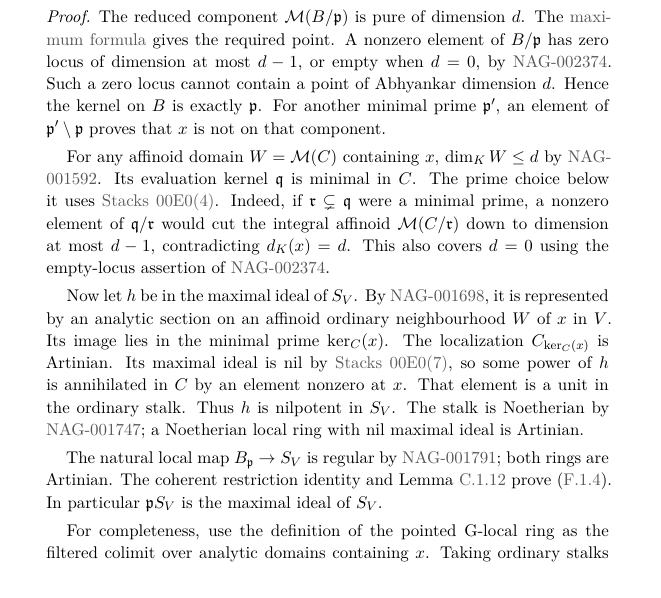
\begin{proof}
The reduced component \(\cM(B/\mathfrak p)\) is pure of dimension
\(d\). The \hyperref[fnd:affinoidabhyankarmaximum]{maximum formula} gives the required point. A nonzero
element of \(B/\mathfrak p\) has zero locus of dimension at most
\(d-1\), or empty when \(d=0\), by \tagg{NAG-002374}. Such a zero
locus cannot contain a point of Abhyankar dimension \(d\). Hence the
kernel on \(B\) is exactly \(\mathfrak p\). For another minimal
prime \(\mathfrak p'\), an element of
\(\mathfrak p'\setminus\mathfrak p\) proves that \(x\) is not on
that component.

For any affinoid domain \(W=\cM(C)\) containing \(x\),
\(\dim_K W\le d\) by \tagg{NAG-001592}. Its evaluation kernel
\(\mathfrak q\) is minimal in \(C\). The prime choice below it uses \href{https://stacks.math.columbia.edu/tag/00E0}{Stacks 00E0(4)}. Indeed, if
\(\mathfrak r\subsetneq\mathfrak q\) were a minimal prime, a
nonzero element of \(\mathfrak q/\mathfrak r\) would cut the
integral affinoid \(\cM(C/\mathfrak r)\) down to dimension at most
\(d-1\), contradicting \(d_K(x)=d\). This also covers \(d=0\)
using the empty-locus assertion of \tagg{NAG-002374}.

Now let \(h\) be in the maximal ideal of \(S_V\). By
\tagg{NAG-001698}, it is represented by an analytic section on an
affinoid ordinary neighbourhood \(W\) of \(x\) in \(V\).
Its image lies in the minimal prime \(\ker_C(x)\).
The localization \(C_{\ker_C(x)}\) is Artinian. Its maximal ideal is nil by \href{https://stacks.math.columbia.edu/tag/00E0}{Stacks 00E0(7)}, so some power of
\(h\) is annihilated in \(C\) by an element nonzero at \(x\).
That element is a unit in the ordinary stalk. Thus \(h\) is nilpotent
in \(S_V\). The stalk is Noetherian by \tagg{NAG-001747}; a
Noetherian local ring with nil maximal ideal is Artinian.

The natural local map \(B_{\mathfrak p}\to S_V\) is regular by
\tagg{NAG-001791}; both rings are Artinian. The coherent restriction
identity and Lemma~\ref{lem:length} prove \eqref{fnd:nag002769:length-formula}.
In particular \(\mathfrak pS_V\) is the maximal ideal of \(S_V\).

For completeness, use the definition of the pointed G-local ring as
the filtered colimit over analytic domains containing \(x\). Taking
ordinary stalks on those domains gives the same colimit: a representative
section restricts to an ordinary neighbourhood in its domain, and that
neighbourhood has an affinoid refinement containing \(x\).
Finite intersections admit such refinements (\tagg{NAG-002411}).
Tensor a composition series of \(M_{\mathfrak p}\) with every
\(S_V\), then pass to this filtered colimit. Each factor is the
filtered colimit of the fields \(S_V/\mathfrak pS_V\). The transition
maps of these fields are unital and injective, so this colimit is a
field. It is precisely the residue field of the colimit local ring,
because every stage has maximal ideal \(\mathfrak pS_V\).
The resulting series has exactly
\(\length_{B_{\mathfrak p}}M_{\mathfrak p}\) nonzero simple factors.
Taking \(M=B\) also shows directly that the colimit ring is Artinian.
No general Noetherianity theorem for G-local rings is needed here.
\end{proof}
Typeset reader excerpt
Typed proof inputs
No explicit typed target in the exported bindings.
Reader cross-references
Proof map
Verified map inputs · NAG-002769
No addressable selected proof input is recorded in this projection.
NAG-002769 · Points computing full generic lengths; F8ST-G · Chapter argument