NAG-002787 · Accepted whole
Minimal primes of a product; F8CA-M
Proper direct image on historical ordinary compact tests
Open in the English reader · PDF page 1828
Statement · exact TeX
\begin{lemma}[Minimal primes of a product; F8CA-M]
\label{lem:minimal}\label{f8ca:m}
For any \(a,b\in A\), \(\Min_A(ab)\) is exactly the set of
inclusion-minimal members of
\(\Min_A(a)\cup\Min_A(b)\). Consequently
\begin{equation}\label{eq:union}
 \Min_A(ab)=\Min_A(a)\cup\Min_A(b)
\end{equation}
holds if and only if that union is an antichain. This assertion is
in the one actual common ring \(A\); it is not an identification of
unrelated chart components.
\end{lemma}
Full selected proof · exact TeX
\begin{proof}
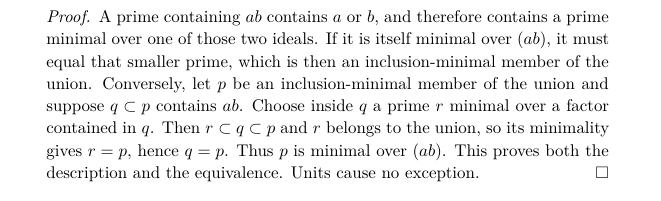
A prime containing \(ab\) contains \(a\) or \(b\), and therefore
contains a prime minimal over one of those two ideals. If it is itself
minimal over \((ab)\), it must equal that smaller prime, which is then
an inclusion-minimal member of the union. Conversely, let \(p\) be
an inclusion-minimal member of the union and suppose
\(q\subset p\) contains \(ab\). Choose inside \(q\) a prime \(r\)
minimal over a factor contained in \(q\). Then \(r\subset q\subset p\)
and \(r\) belongs to the union, so its minimality gives \(r=p\),
hence \(q=p\). Thus \(p\) is minimal over \((ab)\). This proves
both the description and the equivalence. Units cause no exception.
\end{proof}
Typeset reader excerpt
Typed proof inputs
- BASE-RINGS · standing context or base
- BASE-RINGS · standing context or base (requires)
- CLAUSE:NAG-002105:prime-filtration · typed target unresolved in this export
- CLAUSE:NAG-002105:prime-filtration · typed target unresolved in this export (requires)
Proof map
Verified map inputs · NAG-002787
No addressable selected proof input is recorded in this projection.
Standing context and base inputs
BASE-RINGS
Unlinked source pointers
These pointers have no operative linked edge in this map.
CLAUSE:NAG-002105:prime-filtration
NAG-002787 · Minimal primes of a product; F8CA-M · Chapter argument