NAG-002844 · Accepted whole
Uniform logarithmic tails suffice
G Stable inertia and original-field models
Open in the English reader · PDF page 2014
Statement and full selected proof · exact TeX
\begin{theorem}[Uniform logarithmic tails suffice]
\label{f9ml:uniformtails}
In the preceding setup write
\[
 T_j(R)=\int(g_j-R)_+\,d\mu_j
       =\sum_V a_{j,V}\bigl(g_j(\xi_{j,V})-R\bigr)_+,
 \qquad a_{j,V}=\mu_j(\{\xi_{j,V}\})\geq0.
\]
Suppose
\begin{equation}\label{eq:f9ml:tailcondition}
                      \lim_{R\to\infty}\sup_j T_j(R)=0.
\end{equation}
Then $\mu(D^\an)=0$, $g\in L^1(\mu)$ and
\begin{equation}\label{eq:f9ml:loglimit}
                        \int g\,d\mu
                         =\lim_{j\to\infty}\int g_j\,d\mu_j.
\end{equation}
If $h_j$ and the metrics defining $\mu_j$ have the common model data of
\hyperref[f9ml:finite-model-data]{the standing finite-model data}, the hypothesis is the explicit coefficient condition
\begin{equation}\label{eq:f9ml:computabletail}
 \lim_{R\to\infty}\sup_j
  \sum_V\frac{\delta_{j,V}}{e_{0,j}E_j}
       \bigl(\lambda c_{j,V}-e_{0,j}b_{j,V}R\bigr)_+=0.
\end{equation}
In particular a common upper bound on
$c_{j,V}/(e_{0,j}b_{j,V})$ suffices. More generally, if $g_j\geq C$
at all atoms and for some $\alpha>0$ and $A<\infty$ one has
\begin{equation}\label{eq:f9ml:momentbound}
                 \sup_j\sum_V a_{j,V}
                 (g_j(\xi_{j,V})-C)^{1+\alpha}\leq A,
\end{equation}
then $T_j(R)\leq A/(R-C)^\alpha$ for $R>C$, so the conclusion holds.
\end{theorem}
\par\smallskip\noindent{\small\textit{Direct inputs} Theorem~\ref{f9ml:atomiclog}, \hyperref[fnd:analytificationprojectivecompact]{\texttt{NAG-001714}}.}\par\smallskip
\begin{proof}
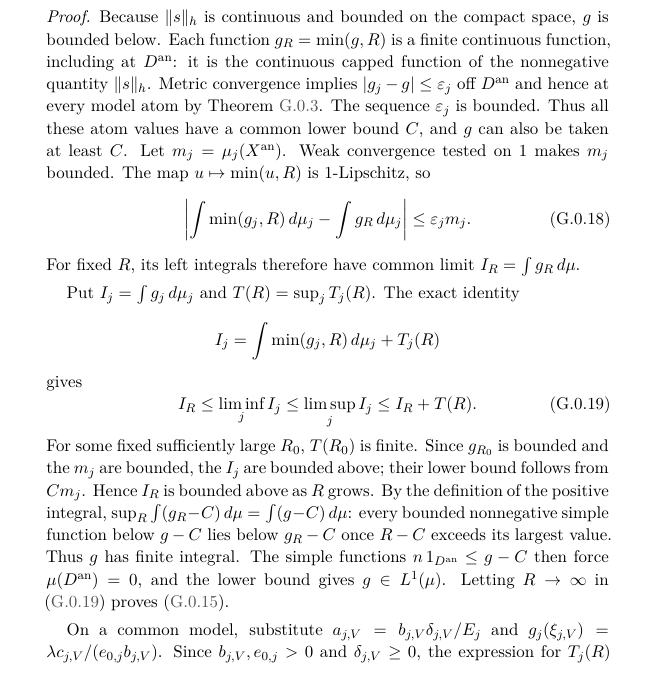
Because $\|s\|_h$ is continuous and bounded on the compact space,
$g$ is bounded below. Each function $g_R=\min(g,R)$ is a finite
continuous function, including at $D^\an$: it is the continuous capped
function of the nonnegative quantity $\|s\|_h$. Metric convergence
implies $|g_j-g|\leq\varepsilon_j$ off $D^\an$ and hence at every
model atom by Theorem~\ref{f9ml:atomiclog}. The sequence
$\varepsilon_j$ is bounded. Thus all these atom values have a common
lower bound $C$, and $g$ can also be taken at least $C$.
Let $m_j=\mu_j(X^\an)$. Weak convergence tested on $1$ makes $m_j$
bounded. The map $u\mapsto\min(u,R)$ is $1$-Lipschitz, so
\begin{equation}\label{eq:f9ml:truncbound}
 \left|\int\min(g_j,R)\,d\mu_j-\int g_R\,d\mu_j\right|
                         \leq\varepsilon_jm_j.
\end{equation}
For fixed $R$, its left integrals therefore have common limit
$I_R=\int g_R\,d\mu$.

Put $I_j=\int g_j\,d\mu_j$ and $T(R)=\sup_jT_j(R)$. The exact
identity
\[
               I_j=\int\min(g_j,R)\,d\mu_j+T_j(R)
\]
gives
\begin{equation}\label{eq:f9ml:sandwich}
 I_R\leq\liminf_j I_j\leq\limsup_j I_j\leq I_R+T(R).
\end{equation}
For some fixed sufficiently large $R_0$, $T(R_0)$ is finite. Since
$g_{R_0}$ is bounded and the $m_j$ are bounded, the $I_j$ are bounded
above; their lower bound follows from $C m_j$. Hence $I_R$ is bounded
above as $R$ grows. By the definition of the positive integral,
$\sup_R\int(g_R-C)\,d\mu=\int(g-C)\,d\mu$: every bounded
nonnegative simple function below $g-C$ lies below $g_R-C$ once
$R-C$ exceeds its largest value. Thus $g$ has finite integral.
The simple functions $n\,1_{D^\an}\leq g-C$ then force
$\mu(D^\an)=0$, and the lower bound gives $g\in L^1(\mu)$.
Letting $R\to\infty$ in
\eqref{eq:f9ml:sandwich} proves \eqref{eq:f9ml:loglimit}.

On a common model, substitute
$a_{j,V}=b_{j,V}\delta_{j,V}/E_j$ and
$g_j(\xi_{j,V})=\lambda c_{j,V}/(e_{0,j}b_{j,V})$.
Since $b_{j,V},e_{0,j}>0$ and $\delta_{j,V}\geq0$, the expression
for $T_j(R)$ becomes exactly the sum in \eqref{eq:f9ml:computabletail}.
A uniform upper bound on the indicated ratios makes it zero for large
$R$. Finally, for $x\geq C$ and $R>C$,
\[
                  (x-R)_+\leq\frac{(x-C)^{1+\alpha}}{(R-C)^\alpha}.
\]
Summing proves the final sufficient condition.
\end{proof}
Typeset reader excerpt
Typed proof inputs
- NAG-002844 · selected whole
Reader cross-references
Proof map
Verified map inputs · NAG-002844
No addressable selected proof input is recorded in this projection.
NAG-002844 · Uniform logarithmic tails suffice · Chapter argument