NAG-002864 · Accepted whole
A full-rank Gauss lift and a vertical projective fibre
I Descent of the polarized mixed tower
Open in the English reader · PDF page 2088
Statement · exact TeX
\begin{proposition}[A full-rank Gauss lift and a vertical projective fibre]
\label{wfi:verticalobstruction}
Over any complete field \(K\) as above, put
\(T_{\rm alg}=\operatorname{Spec}K[T_1^{\pm1},T_2^{\pm1}]\)
and define the closed projective incidence surface
\[
 Y=\{(T_1,T_2,[U:V])\in T_{\rm alg}\times\mathbf P^1_K:
                       (T_1-1)V=(T_2-1)U\}.
 \tag{5}\label{wfi:incidence}
\]
Let \(\Omega=Y^{\rm an}\), and let
\(\phi:\Omega\to(\mathbb G_m^2)^{\rm an}\) be the projection,
with moment tuple \(f=(T_1,T_2)\) and weight \(w=(0,0)\).
Then \(\Omega\) is good, Hausdorff and boundaryless, \(\phi\)
is proper, and every whole weight-box inverse image is compact.
The fibre over the torus Gauss point \(\eta_w\) consists of
one point \(x\), with unchanged completed residue field and
graded moment rank two. Nevertheless no affinoid domain in
\(\Omega\) contains the entire \(F_w^\Omega\).

Moreover, there is a pure two-dimensional affinoid domain
\(X\subset\Omega\) containing \(x\) in its absolute interior
for which
\[
                F_w^X\not\subset\operatorname{Int}(X/K).
 \tag{6}\label{wfi:cutfailure}
\]
It has the actual presentation, on the chart \(U\ne0\) with
\(z=V/U\),
\[
 X=\left\{
 \tfrac12\le |T_1|,|T_2|\le2,\quad |z|\le2,\quad
                  T_2=1+(T_1-1)z
              \right\}.
 \tag{7}\label{wfi:cutdomain}
\]
Thus even a good moment chart about an interior full-rank Gauss
lift in a proper boundaryless ambient source need not have an
interior whole moment fibre. The restriction of the proper
ambient map to this cut is compact but has relative boundary
at weight \(w\); it is not analytically proper.
\end{proposition}
Full selected proof · exact TeX
\begin{proof}
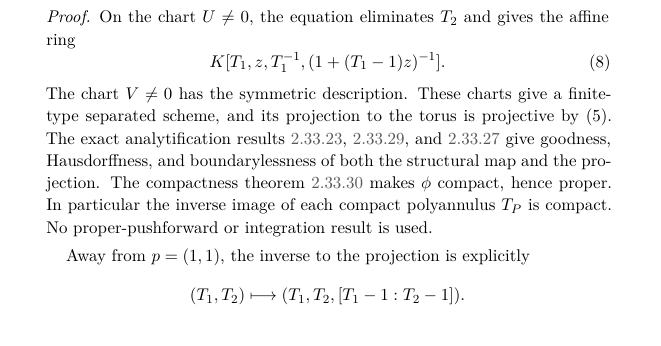
On the chart \(U\ne0\), the equation eliminates \(T_2\) and
gives the affine ring
\[
 K[T_1,z,T_1^{-1},(1+(T_1-1)z)^{-1}].
 \tag{8}\label{wfi:chart}
\]
The chart \(V\ne0\) has the symmetric description. These
charts give a finite-type separated scheme, and its projection
to the torus is projective by (5).
The exact analytification results
\Dep{fnd:affineanalytificationconstruction},
\Dep{fnd:analytificationseparatedtopology}, and
\Dep{fnd:algebraicmorphismboundaryless} give goodness,
Hausdorffness, and boundarylessness of both the structural
map and the projection. The compactness theorem
\Dep{fnd:analytificationprojectivecompact} makes \(\phi\)
compact, hence proper. In particular the inverse image of
each compact polyannulus \(T_P\) is compact.
No proper-pushforward or integration result is used.

Away from \(p=(1,1)\), the inverse to the projection is
explicitly
\[
             (T_1,T_2)\longmapsto
                (T_1,T_2,[T_1-1:T_2-1]).
\]
At \(\eta_w\), both \(|T_j-1|\) are one, so this point is
outside \(p\), and \(\phi\) is an analytic isomorphism on
an ordinary neighbourhood of it. It follows that its entire
Gauss fibre is \(\{x\}\) and
\(\mathcal H(x)=\mathcal H(\eta_w)\).
The initial forms of \(T_1,T_2\) at the weighted Gauss point
are algebraically independent over \(\widetilde K^{\rm gr}\):
a nonzero homogeneous Laurent polynomial has the prescribed
Gauss norm and cannot vanish in the graded field.
Thus the graded moment rank is two. In chart (8),
\(|z(x)|=|T_2-1|/|T_1-1|=1\).

The fibre over \(p\), by contrast, is the whole
\(E=(\mathbf P^1_K)^{\rm an}\), with its actual analytic
structure: the incidence equation becomes zero.
It is a closed analytic subspace of \(\Omega\) and is contained
in \(F_w^\Omega\).
If an affinoid domain \(A\subset\Omega\) contained all of
\(F_w^\Omega\), the pullback of the closed immersion
\(E\hookrightarrow\Omega\) to \(A\) would identify \(E\)
with a closed analytic subspace of an affinoid. Hence \(E\)
would itself be affinoid. It is boundaryless over \(K\), so
\Dep{fnd:affinoidboundarylessfinite} would make it finite over
\(K\). Its spectrum would then be a finite set.
This is impossible: the weighted Gauss points in its affine
line chart, indexed by all radii \(\rho>0\), are distinct
because the value of the affine coordinate is \(\rho\).
This proves the failure of any affinoid container for the
whole original moment fibre.

We now verify the cut, rather than presuming its boundary
behaviour. The domain (7) has affinoid algebra
\[
 D=K\{2^{-1}T_1,2^{-1}S_1,2^{-1}T_2,2^{-1}S_2,2^{-1}z\}
       /(T_1S_1-1,T_2S_2-1,T_2-1-(T_1-1)z).
 \tag{9}\label{wfi:cutalgebra}
\]
The domain universal property, applied in chart (8), identifies
this with the actual indicated analytic domain, including its
Banach structure. Equivalently, it is the generalized rational
domain of the bidisc \(|T_1|,|z|\le2\) cut out by the lower
bound on \(T_1\) and the two bounds on \(1+(T_1-1)z\).
The Gauss norm makes the bidisc integral. Its completed
residue fields are completions of fields generated by at most
two coordinate classes, so \Dep{fnd:valuedfieldabhyankar}
bounds their residual dimensions by two. The weighted Gauss
field attains two by \Dep{fnd:gaussvaluedfielddimension};
\Dep{fnd:affinoidabhyankarmaximum} therefore gives analytic
dimension two. The frozen domain-purity theorem \Dep{v036:analytic:domainpurity} therefore
makes the nonempty \(X\) pure of dimension two.

All inequalities in (7) are strict at \(x\). The chart is
ordinary open in \(\Omega\), so \(X\) contains an ordinary
neighbourhood of \(x\). Since \(\Omega\) is boundaryless,
(1) gives \(x\in\operatorname{Int}(X/K)\).
For \(\rho>0\), let \(y_\rho\) be the Gauss point of radius
\(\rho\) on the exceptional affine chart
\(T_1=T_2=1\), with coordinate \(z\).
Then \(y_2\in X\), whereas \(y_\rho\notin X\) for \(\rho>2\).
As \(\rho\downarrow2\), these points converge to \(y_2\).
Indeed polynomial evaluations are the continuous functions
\(\max_j|a_j|\rho^j\); on any fixed larger closed disc,
uniform polynomial approximation gives the same continuity
for all analytic functions, which determine the spectrum
topology. These are actual points over the original field,
also when its absolute value is trivial.

Thus \(y_2\notin\operatorname{Int}_{\rm top}(X,\Omega)\).
Equation (1) gives \(y_2\notin\operatorname{Int}(X/K)\),
but \(t(y_2)=(0,0)\). This proves (6).
The map from \(X\) to the target polyannulus of (7) is compact.
At \(y_2\) the target bounds are strict, so the affinoid
composition formula identifies relative interiority there
with absolute interiority in \(X\). Consequently that map
has relative boundary and is not proper.
Likewise no full collar \((t|_X)^{-1}(P)\to T_P\), with \(w\)
strictly inside \(P\), can be finite: finite-map innerness
and target innerness would make \(y_2\) absolutely interior
in that domain and, by composition, in \(X\), a contradiction.
\end{proof}
Typeset reader excerpt
Typed proof inputs
- CLAUSE:NAG-001626:source_factor_interior_for_actual_affinoid_maps · selected scope (explicit current dependencies)
- NAG-001496 · selected whole (explicit current dependencies)
- NAG-001554 · selected whole (explicit current dependencies)
- NAG-001576 · selected whole (explicit current dependencies)
- NAG-001587 · selected whole, export unavailable (explicit current dependencies)
- NAG-001588 · selected whole (explicit current dependencies)
- NAG-001591 · selected whole (explicit current dependencies)
- NAG-001615 · selected whole (explicit current dependencies)
- NAG-001628 · selected whole (explicit current dependencies)
- NAG-001631 · selected whole (explicit current dependencies)
- NAG-001701 · selected whole (explicit current dependencies)
- NAG-001704 · selected whole (explicit current dependencies)
- NAG-001707 · selected whole (explicit current dependencies)
- NAG-001708 · selected whole (explicit current dependencies)
- NAG-001709 · selected whole (explicit current dependencies)
- NAG-001710 · selected whole (explicit current dependencies)
- NAG-001711 · selected whole (explicit current dependencies)
- NAG-001713 · selected whole (explicit current dependencies)
- NAG-001714 · selected whole (explicit current dependencies)
- NAG-001997 · selected whole (explicit current dependencies)
- NAG-002293 · selected whole (explicit current dependencies)
Proof map
Verified map inputs · NAG-002864
AND · joint registered proof inputs
- CLAUSE:NAG-001626:source_factor_interior_for_actual_affinoid_maps · source factor interior for actual affinoid maps · selected scope
- NAG-001496 · Compactness of the bounded spectrum · accepted whole
- NAG-001554 · Closed presentations after adjoining coefficients · accepted whole
- NAG-001576 · Points of an arbitrary-radius rational presentation · accepted whole
- NAG-001587 · Result 3.22.3 · accepted whole; PDF destination
- NAG-001588 · Residual dimension of a Gauss field · accepted whole
- NAG-001591 · Dimension as a maximum over analytic points · accepted whole
- NAG-001615 · Fibre products of analytic spaces · accepted whole
- NAG-001628 · Interior of an affinoid domain · accepted whole
- NAG-001631 · Ordinary local testing for good spaces · accepted whole
- NAG-001701 · Finite algebras with their canonical norm · accepted whole
- NAG-001704 · Presentation calculus for relative interior · accepted whole
- NAG-001707 · Affine analytification and its mapping property · accepted whole
- NAG-001708 · Principal opens and global analytification · accepted whole
- NAG-001709 · Products and extension of the ground field · accepted whole
- NAG-001710 · Finite maps and closed immersions under analytification · accepted whole
- NAG-001711 · Relative neighbourhoods for algebraic morphisms · accepted whole
- NAG-001713 · Separated algebraic maps and the underlying topology · accepted whole
- NAG-001714 · Compactness of analytified projective maps · accepted whole
- NAG-001997 · Boundaryless affinoid morphisms are finite · accepted whole
- NAG-002293 · Purity of affinoid domains · accepted whole
NAG-002864 · A full-rank Gauss lift and a vertical projective fibre · Chapter argument