NAG-002907 · Accepted whole
Orbit tensor and its canonical linearization
D Polarized towers with compatible cyclic actions
Open in the English reader · PDF page 1975
Statement · exact TeX
\begin{proposition}[Orbit tensor and its canonical linearization]
\label{cand:f5proj:orbittensor}
Let a cyclic group \(G=\langle\tau\rangle\) of order \(e\)
act on a scheme \(X\), and let \(\mathcal A\) be an invertible
sheaf on \(X\), with no chosen linearization. The orbit tensor
\[
                \mathcal N=\bigotimes_{j=0}^{e-1}(\tau^j)^*\mathcal A
 \tag{6}
\]
has a canonical \(G\)-linearization. If \(i:Z\hookrightarrow X\)
is an invariant closed subscheme and \(G\) acts identically on
\(Z\) as a scheme, then this linearization acts identically on
\(i^*\mathcal N\).
If \(X\) is separated over an affine scheme \(S\) and
\(\mathcal A\) is relatively ample over \(S\), then so is
\(\mathcal N\); the group action need not be \(S\)-linear.
\end{proposition}
Full selected proof · exact TeX
\begin{proof}
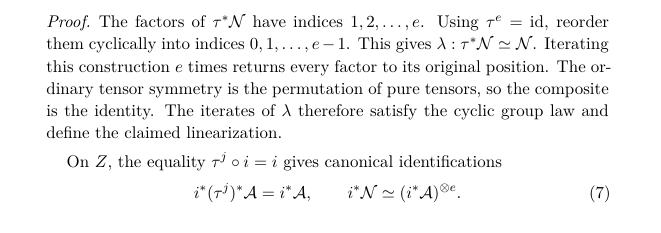
The factors of \(\tau^*\mathcal N\) have indices
\(1,2,\ldots,e\). Using \(\tau^e=\operatorname{id}\), reorder
them cyclically into indices \(0,1,\ldots,e-1\). This gives
\(\lambda:\tau^*\mathcal N\simeq\mathcal N\).
Iterating this construction \(e\) times returns every factor
to its original position. The ordinary tensor symmetry is the
permutation of pure tensors, so the composite is the identity.
The iterates of \(\lambda\) therefore satisfy the cyclic group
law and define the claimed linearization.

On \(Z\), the equality \(\tau^j\circ i=i\) gives canonical
identifications
\[
 i^*(\tau^j)^*\mathcal A=i^*\mathcal A,
       \qquad i^*\mathcal N\simeq(i^*\mathcal A)^{\otimes e}.
 \tag{7}
\]
The restricted \(\lambda\) is the cyclic permutation of these
identical line-bundle factors. On an open of \(Z\) where
\(i^*\mathcal A\) has a generator \(a\), it fixes
\(a^{\otimes e}\). It fixes every coefficient as well, because
\(\tau|_Z\) is the identity morphism. Hence it fixes every local
section. This proves identity of the full module, including
its behaviour over any nilpotent functions on \(Z\). It also
proves identity on the associated total line-bundle scheme.

For ampleness, \stacks{01VK} turns relative ampleness over the
affine \(S\) into ampleness on \(X\). Each automorphism
\(\tau^j\) preserves ampleness, by \stacks{0B3E}.
For two ample invertible sheaves \(\mathcal H_1,\mathcal H_2\)
on \(X\), \stacks{0DNK} makes
\(\operatorname{pr}_1^*\mathcal H_1\otimes
\operatorname{pr}_2^*\mathcal H_2\) ample on \(X\times_S X\).
Here \(S\) is quasi-separated because it is affine.
Pulling back along the closed diagonal by \stacks{0B3E} shows
that \(\mathcal H_1\otimes\mathcal H_2\) is ample on \(X\).
Induction gives ampleness of (6), and \stacks{01VK} converts
it back to relative ampleness over \(S\).
\end{proof}
Typeset reader excerpt
Typed proof inputs
No explicit typed target in the exported bindings.
Proof map
Verified map inputs · NAG-002907
No addressable selected proof input is recorded in this projection.
NAG-002907 · Orbit tensor and its canonical linearization · Chapter argument