NAG-002910 · Accepted whole
Polarization of a supplied curve tower
B Recovered native algebraization source
Open in the English reader · PDF page 1753
Statement · exact TeX
\begin{proposition}[Polarization of a supplied curve tower]
\label{cand:f5alg:towerpolarization}
For $n\geq1$, put $R_n=O/\pi^n O$ and $S_n=\operatorname{Spec}R_n$.
Suppose given schemes $X_n\to S_n$, proper, flat, and of finite
presentation, together with transition morphisms
$i_n:X_n\hookrightarrow X_{n+1}$ for which the squares over
$S_n\hookrightarrow S_{n+1}$ are cartesian. Suppose that
\[
                        C=X_1\times_{R_1}k
\]
has dimension at most one. Then $C$ has an ample invertible sheaf.
For any prescribed ample invertible sheaf $\mathcal L_C$ on $C$,
there exist ample invertible sheaves $\mathcal L_n$ on $X_n$,
an isomorphism $\mathcal L_1|_C\simeq\mathcal L_C$, and isomorphisms
\[
              \varphi_n:i_n^*\mathcal L_{n+1}
                                  \xrightarrow{\ \sim\ }\mathcal L_n
              \qquad(n\geq1).
\]
\end{proposition}
Full selected proof · exact TeX
\begin{proof}
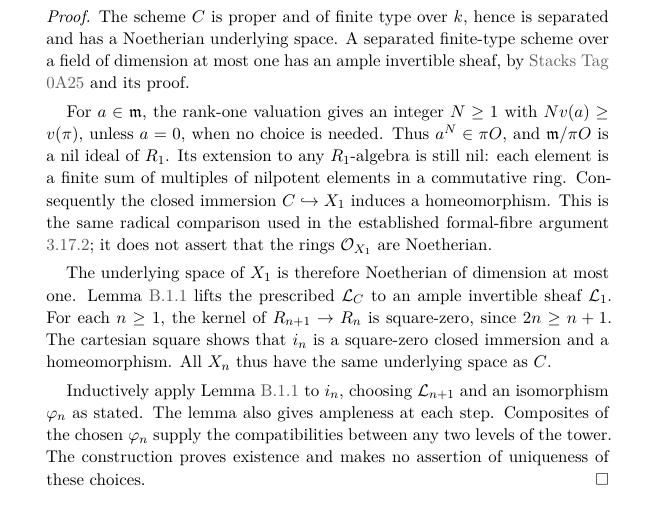
The scheme $C$ is proper and of finite type over $k$, hence is
separated and has a Noetherian underlying space. A separated
finite-type scheme over a field of dimension at most one has an
ample invertible sheaf, by \stacks{0A25} and its proof.

For $a\in\mathfrak m$, the rank-one valuation gives an integer
$N\geq1$ with $Nv(a)\geq v(\pi)$, unless $a=0$, when no choice is
needed. Thus $a^N\in\pi O$, and $\mathfrak m/\pi O$ is a nil ideal
of $R_1$. Its extension to any $R_1$-algebra is still nil: each
element is a finite sum of multiples of nilpotent elements in a
commutative ring. Consequently the closed immersion
$C\hookrightarrow X_1$ induces a homeomorphism. This is the same
radical comparison used in the established formal-fibre argument
\dep{fnd:formalglobalgenericfaithful}; it does not assert that the
rings $\mathcal O_{X_1}$ are Noetherian.

The underlying space of $X_1$ is therefore Noetherian of dimension
at most one. Lemma~\ref{cand:f5alg:nilpicard} lifts the prescribed
$\mathcal L_C$ to an ample invertible sheaf $\mathcal L_1$.
For each $n\geq1$, the kernel of $R_{n+1}\to R_n$ is square-zero,
since $2n\geq n+1$. The cartesian square shows that $i_n$ is a
square-zero closed immersion and a homeomorphism. All $X_n$ thus
have the same underlying space as $C$.

Inductively apply Lemma~\ref{cand:f5alg:nilpicard} to $i_n$, choosing
$\mathcal L_{n+1}$ and an isomorphism $\varphi_n$ as stated.
The lemma also gives ampleness at each step. Composites of the
chosen $\varphi_n$ supply the compatibilities between any two
levels of the tower. The construction proves existence and makes
no assertion of uniqueness of these choices.
\end{proof}
Standing context 1 · exact TeX
Let $K$ be a complete nontrivially valued field with a real-valued
rank-one valuation $v$. Put $O=K^\circ$, $\mathfrak m=K^{\circ\circ}$,
and $k=O/\mathfrak m$, and fix $0\ne\pi\in\mathfrak m$.
The value group need not be discrete. All schemes and invertible
sheaves below are ordinary algebraic schemes and sheaves until a
formal completion is explicitly taken.
Typeset reader excerpt
Typed proof inputs
- NAG-002909 · selected whole
- NAG-002909 · selected whole (requires)
Reader cross-references
Proof map
Verified map inputs · NAG-002910
Registered proof input
- NAG-002909 · Picard lifting in topological dimension at most one · accepted whole
Exact named external applications
- APP:STACKS-0A25@NAG-002910:residue_curve_ample
- The proof of Lemma 33.43.3 supplies an ample invertible sheaf on the actual separated finite-type residue curve C of dimension at most one
NAG-002910 · Polarization of a supplied curve tower · Chapter argument