NAG-002937 · Accepted whole
Generic avoidance does not make model cuts proper
I Descent of the polarized mixed tower
Open in the English reader · PDF page 2066
Statement · exact TeX
\begin{proposition}[Generic avoidance does not make model cuts proper]
\label{f9mi:avoidanceobstruction}
Fix $d\geq2$ and $n\geq1$ on $\mathbf P_R^d$, with unshifted standard
metrics and $m_i=1$. Take
\begin{equation}\label{eq:ex68:f9mi-projective:obstruction-rows}
                \ell_0=z_0,\qquad \ell_i=z_0+\pi^n z_i
                                      \quad(1\leq i\leq d).
\end{equation}
Every model section avoids the generic point of the special component.
Every generic-fibre subfamily meets properly, and the full generic
intersection is empty. Nevertheless the simultaneous model zero scheme
has special-fibre support $\{z_0=0\}\simeq\mathbf P_k^{d-1}$, so
it is not a finite vertical intersection to which a final quotient-length
formula could be applied. The symmetric model recursion is finite and
has value $dn\lambda$.

After the first horizontal cut $z_0=0$, each remaining section has
vertical order $n$. Its restriction to that vertical component is the
zero section. Thus using the remaining restricted sections themselves
to cut that vertical component fails; its contribution must use the
mixed line-bundle degree, with the correct multiplicities.
\end{proposition}
Full selected proof · exact TeX
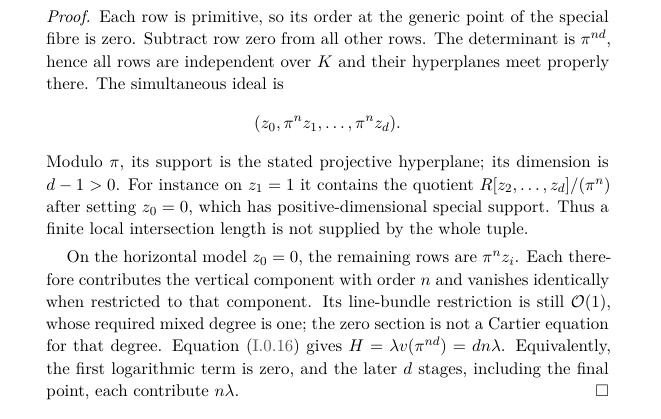
\begin{proof}
Each row is primitive, so its order at the generic point of the special
fibre is zero. Subtract row zero from all other rows. The determinant
is $\pi^{nd}$, hence all rows are independent over $K$ and their
hyperplanes meet properly there. The simultaneous ideal is
\[
                         (z_0,\pi^n z_1,\ldots,\pi^n z_d).
\]
Modulo $\pi$, its support is the stated projective hyperplane; its
dimension is $d-1>0$. For instance on $z_1=1$ it contains the quotient
$R[z_2,\ldots,z_d]/(\pi^n)$ after setting $z_0=0$, which has
positive-dimensional special support. Thus a finite local intersection
length is not supplied by the whole tuple.

On the horizontal model $z_0=0$, the remaining rows are $\pi^n z_i$.
Each therefore contributes the vertical component with order $n$ and
vanishes identically when restricted to that component. Its line-bundle
restriction is still $\cO(1)$, whose required mixed degree is one;
the zero section is not a Cartier equation for that degree.
Equation~\eqref{eq:ex68:f9mi-projective:height-formula} gives $H=\lambda v(\pi^{nd})=dn\lambda$.
Equivalently, the first logarithmic term is zero, and the later $d$
stages, including the final point, each contribute $n\lambda$.
\end{proof}
Typeset reader excerpt
Typed proof inputs
- NAG-002935 · selected whole (explicit current dependencies)
Proof map
Verified map inputs · NAG-002937
Registered proof input
- NAG-002935 · Symmetric projective model induction · accepted whole
NAG-002937 · Generic avoidance does not make model cuts proper · Chapter argument