NAG-002964 · Accepted whole
Full lengths at a regular principal prime; F8CR-L
Proper direct image on historical ordinary compact tests
Open in the English reader · PDF page 1805
Statement and full selected proof · exact TeX
\begin{proposition}[Full lengths at a regular principal prime; F8CR-L]
\label{prop:length}
Let \(A\) be Noetherian, let \(f\in A\) be a non-zero-divisor, and let
\(\mathfrak p\) be minimal over \((f)\). Then
\(R=A_{\mathfrak p}\) has Krull dimension one, \(f\) is a regular
nonunit in \(R\), and \(R/fR\) is Artinian. For
\(\mathfrak q_i\in\Min A\) contained in \(\mathfrak p\), put
\(m_i=\length_{A_{\mathfrak q_i}}A_{\mathfrak q_i}\). Then
\begin{equation}\label{eq:local-length}
 \length_{A_{\mathfrak p}}(A_{\mathfrak p}/fA_{\mathfrak p})
 =\sum_{\mathfrak q_i\subset\mathfrak p}m_i\,
 \length_{(A/\mathfrak q_i)_{\mathfrak p/\mathfrak q_i}}
 \left((A/\mathfrak q_i)_{\mathfrak p/\mathfrak q_i}/f_i\right).
\end{equation}
No \(S_1\) hypothesis on \(A\) is made. The proof uses Stacks
\href{https://stacks.math.columbia.edu/tag/00E0}{00E0(7)} with the
zero ideal for the nilradical steps in the local rings and quotients,
\href{https://stacks.math.columbia.edu/tag/00KV}{00KV(1)} for the height
bound, and \href{https://stacks.math.columbia.edu/tag/02QG}{02QG},
second clause with \(I=0\), for the length formula.
\end{proposition}
% CLAIM F8CR-L PROOF
\begin{proof}
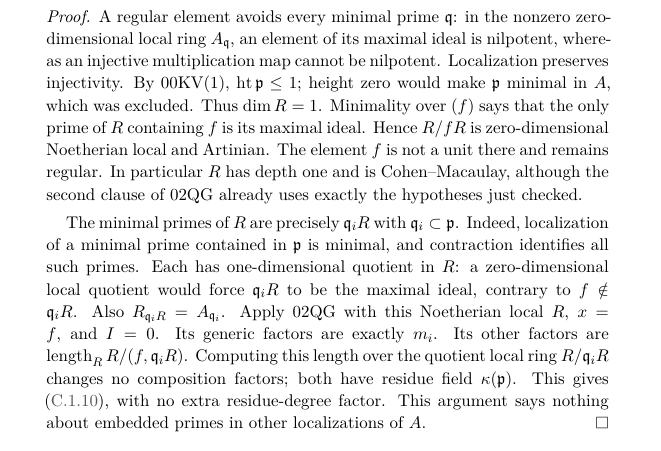
A regular element avoids every minimal prime \(\mathfrak q\): in the
nonzero zero-dimensional local ring \(A_{\mathfrak q}\), an element of
its maximal ideal is nilpotent, whereas an injective multiplication map
cannot be nilpotent. Localization preserves injectivity. By 00KV(1),
\(\operatorname{ht}\mathfrak p\leq1\); height zero would make
\(\mathfrak p\) minimal in \(A\), which was excluded. Thus
\(\dim R=1\). Minimality over \((f)\) says that the only prime of
\(R\) containing \(f\) is its maximal ideal. Hence \(R/fR\) is
zero-dimensional Noetherian local and Artinian. The element \(f\) is
not a unit there and remains regular. In particular \(R\) has depth
one and is Cohen--Macaulay, although the second clause of 02QG already
uses exactly the hypotheses just checked.

The minimal primes of \(R\) are precisely
\(\mathfrak q_iR\) with \(\mathfrak q_i\subset\mathfrak p\).
Indeed, localization of a minimal prime contained in \(\mathfrak p\)
is minimal, and contraction identifies all such primes. Each has
one-dimensional quotient in \(R\): a zero-dimensional local quotient
would force \(\mathfrak q_iR\) to be the maximal ideal, contrary to
\(f\notin\mathfrak q_iR\). Also
\(R_{\mathfrak q_iR}=A_{\mathfrak q_i}\).
Apply 02QG with this Noetherian local \(R\), \(x=f\), and \(I=0\).
Its generic factors are exactly \(m_i\). Its other factors are
\(\length_R R/(f,\mathfrak q_iR)\). Computing this length over the
quotient local ring \(R/\mathfrak q_iR\) changes no composition
factors; both have residue field \(\kappa(\mathfrak p)\). This gives
\eqref{eq:local-length}, with no extra residue-degree factor. This
argument says nothing about embedded primes in other localizations
of \(A\).
\end{proof}
Typeset reader excerpt
Typed proof inputs
- BASE-RINGS · standing context or base
- BASE-RINGS · standing context or base (requires)
Proof map
Verified map inputs · NAG-002964
No addressable selected proof input is recorded in this projection.
Standing context and base inputs
BASE-RINGS
NAG-002964 · Full lengths at a regular principal prime; F8CR-L · Chapter argument