NAG-003007 · Accepted whole
A finite-group orbit tensor with trivial inertia
G Stable inertia and original-field models
Open in the English reader · PDF page 2016
Statement · exact TeX
\begin{lemma}[A finite-group orbit tensor with trivial inertia]
\label{cand:f5mix:orbitkernel}
Let $S$ be affine, let $X/S$ be separated, and let a finite group
$G$ act on $X$ by automorphisms covering automorphisms of $S$.
Let $I\triangleleft G$, and let $C\hookrightarrow X$ be a
$G$-stable closed subscheme on which every element of $I$ acts
identically. If $\mathcal A$ is relatively ample on $X/S$, then
\[
              \mathcal N=\bigotimes_{g\in G}\rho_g^*\mathcal A
 \tag{11}
\]
is relatively ample and has its canonical permutation
$G$-linearization. Its restricted $I$-action on $\mathcal N|_C$
is the identity. If $H=G/I$, and $\bar\rho_h$ denotes its induced
action on $C$, the underlying restricted invertible sheaf is
\[
 \mathcal N|_C\simeq
   \bigotimes_{h\in H}(\bar\rho_h^*(\mathcal A|_C))^{\otimes |I|}.
 \tag{12}
\]
The construction commutes with equivariant pullbacks and specified
transition isomorphisms of the input sheaves. It therefore applies
to compatible towers. No group order is inverted.
\end{lemma}
Full selected proof · exact TeX
\begin{proof}
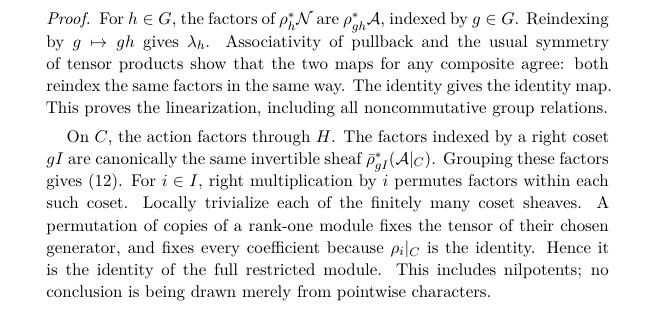
For $h\in G$, the factors of $\rho_h^*\mathcal N$ are
$\rho_{gh}^*\mathcal A$, indexed by $g\in G$. Reindexing by
$g\mapsto gh$ gives $\lambda_h$. Associativity of pullback and
the usual symmetry of tensor products show that the two maps
for any composite agree: both reindex the same factors in the
same way. The identity gives the identity map. This proves the
linearization, including all noncommutative group relations.

On $C$, the action factors through $H$. The factors indexed by
a right coset $gI$ are canonically the same invertible sheaf
$\bar\rho_{gI}^*(\mathcal A|_C)$. Grouping these factors gives
(12). For $i\in I$, right multiplication by $i$ permutes factors
within each such coset. Locally trivialize each of the finitely
many coset sheaves. A permutation of copies of a rank-one module
fixes the tensor of their chosen generator, and fixes every
coefficient because $\rho_i|_C$ is the identity. Hence it is the
identity of the full restricted module. This includes nilpotents;
no conclusion is being drawn merely from pointwise characters.

Ampleness is unchanged by an isomorphism of schemes. Over the
affine base, relative and absolute ampleness agree by
\hypertarget{foundations.nag003007.stacks.01VK.affine-relative-and-absolute}{}\stacks{01VK}. Finite tensor products of these ample sheaves are
ample: use the external-product assertion \hypertarget{foundations.nag003007.stacks.0DNK.exterior-product}{}\stacks{0DNK} over the
affine, hence quasi-separated, base, and pull back by the closed
diagonal using \hypertarget{foundations.nag003007.stacks.0B3E.separated-diagonal-restriction}{}\stacks{0B3E}; then induct on the number of factors.
In the section argument for the external-product assertion,
sections of powers $n$ and $m$ are first raised to powers $m$
and $n$, so their product is a section of the common power $nm$.
This is the same ampleness argument used in the audited cyclic
orbit construction, with a finite group as index set.

Finally, an equivariant pullback identifies each indexed factor
with the corresponding pulled-back factor. Tensoring the given
maps on these factors commutes with every permutation above.
This proves the asserted transition compatibility and the tower
statement.
\end{proof}
Typeset reader excerpt
Typed proof inputs
- NAG-003007 · selected whole
- STACKS-01VK · named external application
- STACKS-0B3E · named external application
- STACKS-0DNK · named external application
Proof map
Verified map inputs · NAG-003007
No addressable selected proof input is recorded in this projection.
Unlinked source pointers
These pointers have no operative linked edge in this map.
STACKS-01VKSTACKS-0B3ESTACKS-0DNK
NAG-003007 · A finite-group orbit tensor with trivial inertia · Chapter argument