NAG-003020 · Accepted whole
Two different saturation questions
Proper direct image on historical ordinary compact tests
Open in the English reader · PDF page 1826
Statement · exact TeX
\begin{proposition}[Two different saturation questions]\label{prop:coordinates}\label{f7unit:t2}
For chosen units $u_1,\ldots,u_r\in A^\times$, the relation kernel
\[
 R_u=\{a\in\Z^r: \textstyle\prod_i u_i^{a_i}\in K^\times\}
\]
is saturated in $\Z^r$. Thus $\Z^r/R_u$ is the actual subgroup $H_u\subset M_A$ generated by these units. The inclusion $H_u\subset M_A$ need not be saturated, even when $A$ is normal and the chosen units and their inverses generate $A$.
\end{proposition}
Full selected proof · exact TeX
\begin{proof}
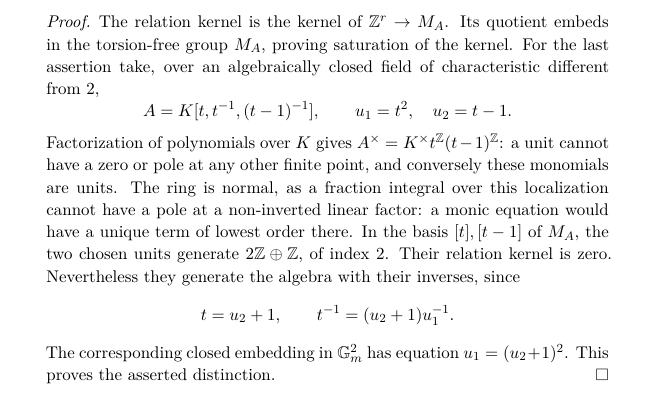
The relation kernel is the kernel of $\Z^r\to M_A$. Its quotient embeds in the torsion-free group $M_A$, proving saturation of the kernel. For the last assertion take, over an algebraically closed field of characteristic different from $2$,
\[
 A=K[t,t^{-1},(t-1)^{-1}],\qquad u_1=t^2,\quad u_2=t-1.
\]
Factorization of polynomials over $K$ gives
$A^\times=K^\times t^\Z(t-1)^\Z$: a unit cannot have a zero or pole at any other finite point, and conversely these monomials are units. The ring is normal, as a fraction integral over this localization cannot have a pole at a non-inverted linear factor: a monic equation would have a unique term of lowest order there. In the basis $[t],[t-1]$ of $M_A$, the two chosen units generate $2\Z\oplus\Z$, of index $2$. Their relation kernel is zero. Nevertheless they generate the algebra with their inverses, since
\[
         t=u_2+1,\qquad t^{-1}=(u_2+1)u_1^{-1}.
\]
The corresponding closed embedding in $\Gm^2$ has equation $u_1=(u_2+1)^2$. This proves the asserted distinction.
\end{proof}
Typeset reader excerpt
Typed proof inputs
- BASE-RINGS · standing context or base
- BASE-RINGS · standing context or base (requires)
Proof map
Verified map inputs · NAG-003020
No addressable selected proof input is recorded in this projection.
Standing context and base inputs
BASE-RINGS
NAG-003020 · Two different saturation questions · Chapter argument