NAG-003030 · Accepted whole
The full analytic unit group is not a finite lattice
Proper direct image on historical ordinary compact tests
Open in the English reader · PDF page 1827
Statement · exact TeX
\begin{proposition}[The full analytic unit group is not a finite lattice]\label{prop:analytic}\label{f7unit:e2}
The group $\mathcal B^\times/K^\times$ is not finitely generated. In fact, for any prime $\ell$ with $|\ell|=1$, it contains a subgroup isomorphic to $\Z[1/\ell]$, represented by units whose absolute value is identically $1$ on $\mathcal M(\mathcal B)$.
\end{proposition}
Full selected proof · exact TeX
\begin{proof}
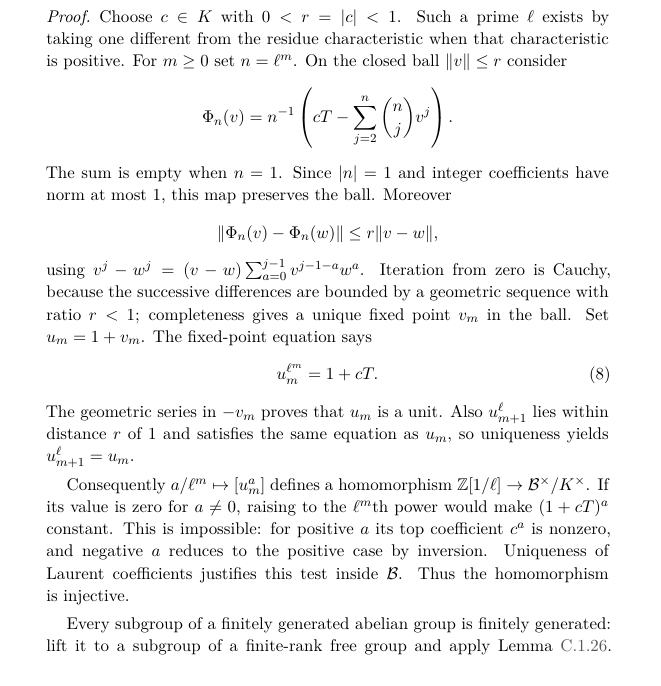
Choose $c\in K$ with $0<r=|c|<1$. Such a prime $\ell$ exists by taking one different from the residue characteristic when that characteristic is positive. For $m\geq0$ set $n=\ell^m$. On the closed ball $\|v\|\leq r$ consider
\[
 \Phi_n(v)=n^{-1}\left(cT-\sum_{j=2}^n\binom nj v^j\right).
\]
The sum is empty when $n=1$. Since $|n|=1$ and integer coefficients have norm at most $1$, this map preserves the ball. Moreover
\[
 \|\Phi_n(v)-\Phi_n(w)\|\leq r\|v-w\|,
\]
using $v^j-w^j=(v-w)\sum_{a=0}^{j-1}v^{j-1-a}w^a$. Iteration from zero is Cauchy, because the successive differences are bounded by a geometric sequence with ratio $r<1$; completeness gives a unique fixed point $v_m$ in the ball. Set $u_m=1+v_m$. The fixed-point equation says
\[
               u_m^{\ell^m}=1+cT.
\tag{8}\label{eq:root}
\]
The geometric series in $-v_m$ proves that $u_m$ is a unit. Also $u_{m+1}^{\ell}$ lies within distance $r$ of $1$ and satisfies the same equation as $u_m$, so uniqueness yields $u_{m+1}^{\ell}=u_m$.

Consequently $a/\ell^m\mapsto[u_m^a]$ defines a homomorphism $\Z[1/\ell]\to\mathcal B^\times/K^\times$. If its value is zero for $a\ne0$, raising to the $\ell^m$th power would make $(1+cT)^a$ constant. This is impossible: for positive $a$ its top coefficient $c^a$ is nonzero, and negative $a$ reduces to the positive case by inversion. Uniqueness of Laurent coefficients justifies this test inside $\mathcal B$. Thus the homomorphism is injective.

Every subgroup of a finitely generated abelian group is finitely generated: lift it to a subgroup of a finite-rank free group and apply Lemma~\ref{lem:subgroup}. But a finite collection of elements of $\Z[1/\ell]$ has bounded denominator and cannot generate this group. This proves non-finite-generation. Finally frozen \texttt{NAG-000655} gives $|v_m(x)|\leq\|v_m\|<1$ at every analytic point $x$, so $|u_m(x)|=1$. All represented tropical logarithms therefore vanish.
\end{proof}
Typeset reader excerpt
Typed proof inputs
- BASE-RINGS · standing context or base
- BASE-RINGS · standing context or base (requires)
- BASE-TOPOLOGY · standing context or base
- BASE-TOPOLOGY · standing context or base (requires)
- NAG-000655 · selected whole
- NAG-000655 · selected whole (requires)
- NAG-001553 · selected whole
- NAG-001553 · selected whole (requires)
- NAG-003012 · selected whole
- NAG-003012 · selected whole (requires)
Reader cross-references
Proof map
Verified map inputs · NAG-003030
AND · joint registered proof inputs
- NAG-000655 · Result 1.6.1 · accepted whole
- NAG-001553 · The actual multi-Laurent relation quotient · accepted whole
- NAG-003012 · Subgroups of an integer lattice · accepted whole
Standing context and base inputs
BASE-RINGSBASE-TOPOLOGY
NAG-003030 · The full analytic unit group is not a finite lattice · Chapter argument