NAG-003036 · Accepted whole
The normalized diagonal gives a common model
Proper direct image on historical ordinary compact tests
Open in the English reader · PDF page 1916
Statement · exact TeX
\begin{theorem}[The normalized diagonal gives a common model]
\label{f9cn:common}
Let $\cX_1,\ldots,\cX_m$ be a finite nonempty family of models of
$X$. Each $\cX_i$ is integral. In
$P=\prod_{i=1}^m\cX_i$ over $R$, let $C$ be the scheme-theoretic
closure of the generic diagonal $X\hookrightarrow P_K$. Then $C$ is
integral and proper flat of finite type over $R$, with $C_K=X$.
Its normalization $\nu:\cM\to C$ is finite, and $\cM$ is a normal
integral proper flat finite-type model of $X$. The maps
\[
                p_i:\cM\longrightarrow\cX_i
\]
are proper birational maps inducing the identity on $X$.
The normalization map is finite; the maps $p_i$ need not be finite.

The same construction provides a common normal refinement of any
finite collection of normal models already mapping to a fixed model;
the new maps commute with those maps to the fixed model.
\end{theorem}
Full selected proof · exact TeX
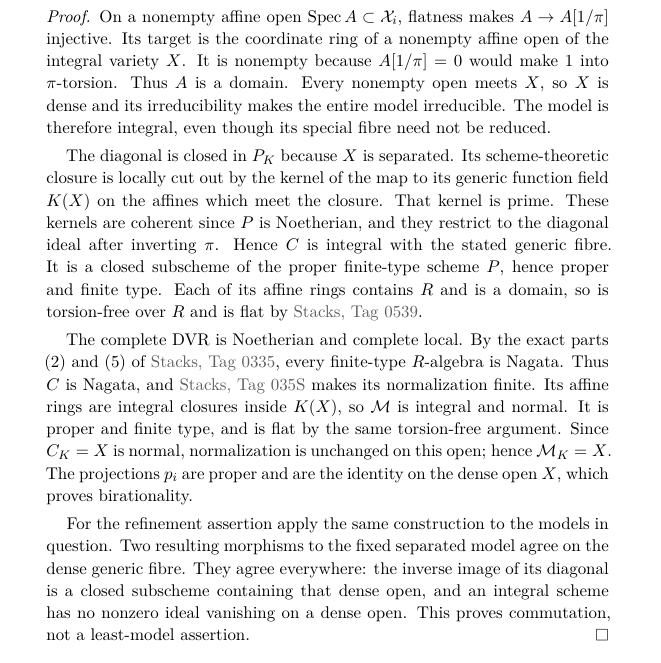
\begin{proof}
On a nonempty affine open $\Spec A\subset\cX_i$, flatness makes
$A\to A[1/\pi]$ injective. Its target is the coordinate ring of a
nonempty affine open of the integral variety $X$. It is nonempty
because $A[1/\pi]=0$ would make $1$ into $\pi$-torsion. Thus $A$
is a domain. Every nonempty open meets $X$, so $X$ is dense and its
irreducibility makes the entire model irreducible. The model is
therefore integral, even though its special fibre need not be reduced.

The diagonal is closed in $P_K$ because $X$ is separated. Its
scheme-theoretic closure is locally cut out by the kernel of the map
to its generic function field $K(X)$ on the affines which meet the
closure. That kernel is prime. These kernels are coherent since $P$
is Noetherian, and they restrict to the diagonal ideal after inverting
$\pi$. Hence $C$ is integral with the stated generic fibre. It is a
closed subscheme of the proper finite-type scheme $P$, hence proper
and finite type. Each of its affine rings contains $R$ and is a domain,
so is torsion-free over $R$ and is flat by \st{0539}.

The complete DVR is Noetherian and complete local. By the exact
parts (2) and (5) of \st{0335}, every finite-type $R$-algebra is
Nagata. Thus $C$ is Nagata, and \st{035S} makes its normalization
finite. Its affine rings are integral closures inside $K(X)$, so
$\cM$ is integral and normal. It is proper and finite type, and is
flat by the same torsion-free argument. Since $C_K=X$ is normal,
normalization is unchanged on this open; hence $\cM_K=X$.
The projections $p_i$ are proper and are the identity on the dense
open $X$, which proves birationality.

For the refinement assertion apply the same construction to the
models in question. Two resulting morphisms to the fixed separated
model agree on the dense generic fibre. They agree everywhere: the
inverse image of its diagonal is a closed subscheme containing that
dense open, and an integral scheme has no nonzero ideal vanishing on
a dense open. This proves commutation, not a least-model assertion.
\end{proof}
Standing context 1 · exact TeX
Let $R$ be a complete DVR with uniformizer $\pi$, fraction field $K$,
and residue field $k$. A model of a fixed normal integral proper
$K$-variety $X$ is a proper flat finite-type $R$-scheme $\cX$ with a
specified isomorphism $\cX_K\simeq X$. Write $d=\dim X$; the
applications of interest have $d\geq2$. Maps of models must respect
these actual identifications. The special fibre may be nonreduced.
We impose no projectivity or normality on the initial models.
Standing context 2 · exact TeX
We use the affine construction of normalization: for an integral scheme
with function field $F$, normalize $\Spec A$ by the integral closure
$\overline A\subset F$ and glue. Integral closure commutes with
localization. Indeed, if $z$ is integral over $A[1/t]$, multiplying $z$
by a sufficiently high power of $t$ clears all coefficients of its monic
equation and makes that multiple integral over $A$. The same argument
works for an arbitrary multiplicative set. Consequently normalization
is an isomorphism on any normal open. A normal integral scheme mapping
birationally to an integral scheme factors uniquely through its
normalization: each integral element in the common function field is
regular in every normal local ring upstairs, and these sections glue.

Properness is preserved by composition, base change and closed
immersion, by \st{01W3}, \st{01W4} and \st{01W5}.
A morphism from a proper $S$-scheme to a separated $S$-scheme is proper
by \st{01W6}. Finite morphisms are proper: they are affine, separated
and of finite type, and are universally closed by \st{01WM}.
These facts concern schemes and do not invoke formal-model domination.
Typeset reader excerpt
Typed proof inputs
No explicit typed target in the exported bindings.
Proof map
Verified map inputs · NAG-003036
No addressable selected proof input is recorded in this projection.
NAG-003036 · The normalized diagonal gives a common model · Chapter argument