NAG-003044 · Accepted whole
A principal divisor with no presentation on its support
Proper direct image on historical ordinary compact tests
Open in the English reader · PDF page 1921
Statement · exact TeX
\begin{proposition}[A principal divisor with no presentation on its support]
\label{f9cn:obstruction}
Over any field $K$, let
\[
 X=\{ad-bc=0\}\subset\mathbf P^4_K,
 \qquad [a:b:c:d:t],\qquad o=[0:0:0:0:1].
\]
This is a normal integral proper threefold. Put
\[
 P_0=\{a=b=0\},\qquad P_1=\{c=d=0\},\qquad Z=P_0\cup P_1.
\]
The rational section $f=a/c$ of $\cO_X$ has Cartier divisor with
Weil cycle $P_0-P_1$ and is a regular unit off $Z$.
It has no signed presentation on $Z$, even in a neighbourhood of $o$.
Hence no proper generic-identity modification of any normal DVR model
carrying this datum can acquire such a presentation on the inverse
image of the prescribed support. In particular this obstruction applies
to the constant equation $ad-bc=0$ over a complete DVR.
\end{proposition}
Full selected proof · exact TeX
\begin{proof}
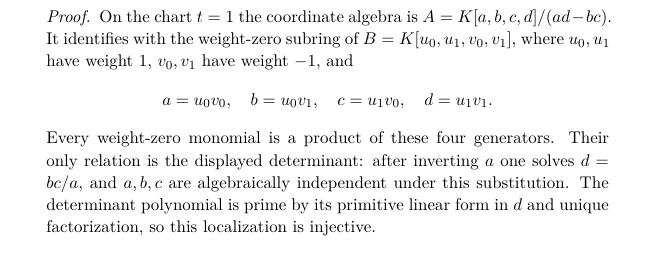
On the chart $t=1$ the coordinate algebra is
$A=K[a,b,c,d]/(ad-bc)$. It identifies with the weight-zero subring
of $B=K[u_0,u_1,v_0,v_1]$, where $u_0,u_1$ have weight $1$,
$v_0,v_1$ have weight $-1$, and
\[
 a=u_0v_0,\quad b=u_0v_1,\quad c=u_1v_0,\quad d=u_1v_1.
\]
Every weight-zero monomial is a product of these four generators.
Their only relation is the displayed determinant: after inverting $a$
one solves $d=bc/a$, and $a,b,c$ are algebraically independent under
this substitution. The determinant polynomial is prime by its
primitive linear form in $d$ and unique factorization, so this
localization is injective.

The polynomial ring $B$ is normal by \st{0BC1} and \st{0AFV}.
If $z\in\Frac(A)$ is integral over $A$, it is integral over $B$,
so belongs to $B$. Under the weight substitution with an independent
Laurent variable, $z$ is fixed because it is a fraction of weight-zero
elements. Comparing Laurent powers shows that its polynomial expression
has weight zero, hence lies in $A$. Thus $A$ is normal. Its
localizations are normal by \st{00GY}. The remaining projective
charts, where one of $a,b,c,d$ is nonzero, solve for a variable and
are polynomial three-dimensional charts. This proves normality and
integrality of $X$; projectivity gives properness.

The hyperplane sections satisfy
$\divi(a)=P_0+Q$ and $\divi(c)=P_1+Q$, where $Q=\{a=c=0\}$.
Each coefficient is one, as is seen by solving the determinant equation
at the corresponding generic point. Their difference is $P_0-P_1$.
Off $Z$, the two rows are nonzero; where $a/c$ is not directly a unit,
it equals $b/d$, which is a unit there. Thus the support is exactly
as claimed. The presentation using the two hyperplane sections adds
$Q$, which is not contained in $Z$, and is not an allowed presentation.

We prove the obstruction without a class-group computation. Over the
affine chart $t=1$, consider the incidence variety
\[
 Y=\{((a,b,c,d),[u_0:u_1]):
                   au_1=cu_0,\ bu_1=du_0\}
                 \longrightarrow\Spec A.
\]
It is closed in $\Spec A\times\mathbf P^1$ and hence proper over
$\Spec A$. Its two charts are
\[
 (a,b,z),\quad c=za,\ d=zb;
 \qquad (c,d,w),\quad a=wc,\ b=wd.
\]
They are affine three-spaces. The map is an isomorphism off the
origin, since a nonzero rank-one matrix determines its column line.
Its exceptional fibre is the zero section $C\simeq\mathbf P^1$,
which has codimension two. In particular there is no exceptional
prime divisor. The strict transforms $F_0,F_1$ of $P_0,P_1$ are
fibres of $Y\to\mathbf P^1$, over $[0:1]$ and $[1:0]$.

Suppose an effective Cartier divisor $H$ near $o$ is supported in
$P_0\cup P_1$, with multiplicities $m,n\geq0$. Shrink to an affine
neighbourhood of $o$ on which $H$ is principal. Its pullback to $Y$
over that neighbourhood has divisor $mF_0+nF_1$: off $C$ this
follows from the isomorphism, and no prime divisor is contained in
$C$. Equality of these Cartier divisors follows on the local UFD
charts. The associated line bundle restricts to the trivial line on
$C$, because it was pulled back from a principal divisor. But the
restriction of $\cO_Y(mF_0+nF_1)$ is
$\cO_{\mathbf P^1}(m+n)$. In the standard two affine
trivializations its transition function is $z^{m+n}$. A trivialization
of the line on each affine chart can change this only by invertible
polynomials, which are constants. Thus triviality forces $m+n=0$,
and hence $m=n=0$.
Both effective factors of a hypothetical signed presentation would
therefore have zero coefficients at $P_0,P_1$ near $o$, contradicting
the coefficients $1,-1$ of $\divi(f)$.

The same weight-zero argument over the UFD $R$ shows that the
constant affine cone is normal over $R$; the other charts are
polynomial rings over $R$. This gives a normal proper model, flat
by torsion-freeness. The ratio $a/c$ is a unit outside the two
corresponding closed row planes, so defines the prescribed model datum.
Any proposed generic-identity presentation would restrict to the
impossible presentation on $X$, by
Theorem~\ref{f9cn:presentation}.
\end{proof}
Typeset reader excerpt
Typed proof inputs
- NAG-003043 · selected whole (exact native application)
Reader cross-references
Proof map
Verified map inputs · NAG-003044
Registered proof input
- NAG-003043 · Exact generic criterion for acquiring presentations · accepted whole Exact source window 387
- Apply the checked necessary generic support condition to this actual obstruction.
NAG-003044 · A principal divisor with no presentation on its support · Chapter argument