\begin{theorem}[Exact component-degree criterion for model measures]
\label{f9md:degreecriterion}
Use $p:\cY\to\cX$ as above and the pulled-back model lines
$p^*\cL_i$ with the same root exponents. Then the following are equivalent:
\begin{enumerate}
\item The two finite measures on the common $X^\an$ are equal.
\item Their component degrees satisfy
\begin{equation}\label{ex68:model:eq:degreecriterion}
 \delta_{\widetilde V}=\delta_V\quad\hbox{for every }V,
       \qquad \delta_W=0\quad\hbox{for every exceptional }W.
\end{equation}
\end{enumerate}
Under this criterion all continuous tests, and all Borel tests finite on the
common finite support, have equal integrals. In particular, if $M$ has
a model $\cM$ extending $M^{\otimes e_0}$, the pullback model metric
is the same metric on $M$. Every nonzero rational section $s$ satisfies
\begin{equation}\label{ex68:model:eq:logpreserved}
        \int-\log\|s\|\,d\mu_{\cY}
                     =\int-\log\|s\|\,d\mu_{\cX}.
\end{equation}
The logarithm is used off its zero/pole support and may be extended
arbitrarily across that null set for these atomic measures. Both are
finite total-variation integrals. If
$a_V=\ord_V(s^{\otimes e_0})$ in a model frame, the common downstairs
expression is
\begin{equation}\label{ex68:model:eq:unreduced}
   \frac{\lambda}{e_0E}\sum_Va_V\delta_V,
   \qquad -\log\|s(\xi_V)\|=\frac{\lambda a_V}{e_0b_V}.
\end{equation}
Replacing $s$ by $\pi s$ changes it by
$+\lambda\mu_{\cX}(X^\an)$.
\end{theorem}
Full selected proof · exact TeX
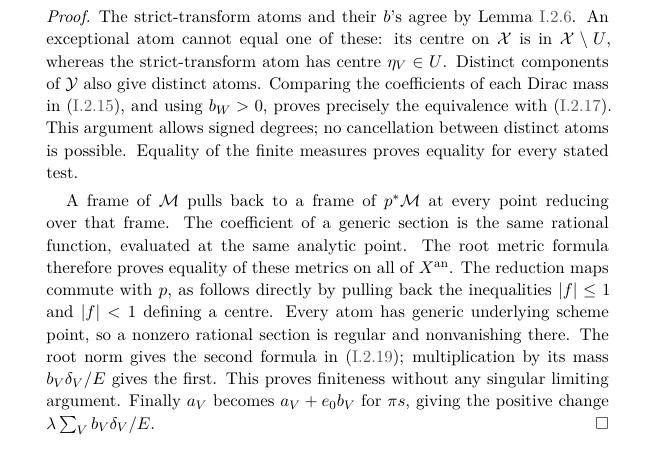
\begin{proof}
The strict-transform atoms and their $b$'s agree by
Lemma~\ref{f9md:codimone}. An exceptional atom cannot equal one of
these: its centre on $\cX$ is in $\cX\setminus U$, whereas the
strict-transform atom has centre $\eta_V\in U$. Distinct components
of $\cY$ also give distinct atoms. Comparing the coefficients of each
Dirac mass in \eqref{ex68:model:eq:measure}, and using $b_W>0$, proves precisely
the equivalence with \eqref{ex68:model:eq:degreecriterion}. This argument allows
signed degrees; no cancellation between distinct atoms is possible.
Equality of the finite measures proves equality for every stated test.

A frame of $\cM$ pulls back to a frame of $p^*\cM$ at every point
reducing over that frame. The coefficient of a generic section is the
same rational function, evaluated at the same analytic point. The root
metric formula therefore proves equality of these metrics on all of
$X^\an$. The reduction maps commute with $p$, as follows directly by
pulling back the inequalities $|f|\leq1$ and $|f|<1$ defining a centre.
Every atom has generic underlying scheme point, so a nonzero rational
section is regular and nonvanishing there. The root norm gives the
second formula in \eqref{ex68:model:eq:unreduced}; multiplication by its mass
$b_V\delta_V/E$ gives the first. This proves finiteness without any
singular limiting argument. Finally $a_V$ becomes $a_V+e_0b_V$ for
$\pi s$, giving the positive change $\lambda\sum_Vb_V\delta_V/E$.
\end{proof}
\begin{theorem}[Component-degree criterion with supplied model atoms]
\label{f9md:degreecriterion-conditional-atoms}
Under the point, centre and frame hypotheses above, use $p:\cY\to\cX$ and the pulled-back model lines
$p^*\cL_i$ with the same root exponents. Then the following are equivalent:
\begin{enumerate}
\item The two finite measures on the common $X^\an$ are equal.
\item Their component degrees satisfy
\begin{equation}\label{eq:f9md:conditional-degree-criterion}
 \delta_{\widetilde V}=\delta_V\quad\hbox{for every }V,
       \qquad \delta_W=0\quad\hbox{for every exceptional }W.
\end{equation}
\end{enumerate}
Under this criterion all continuous tests, and all Borel tests finite on the
common finite support, have equal integrals. In particular, if $M$ has
a model $\cM$ extending $M^{\otimes e_0}$, the pullback model metric
is the same metric on $M$. Every nonzero rational section $s$ satisfies
\begin{equation}\label{eq:f9md:conditional-log-preserved}
        \int-\log\|s\|\,d\mu_{\cY}
                     =\int-\log\|s\|\,d\mu_{\cX}.
\end{equation}
The logarithm is used off its zero/pole support and may be extended
arbitrarily across that null set for these atomic measures. Both are
finite total-variation integrals. If
$a_V=\ord_V(s^{\otimes e_0})$ in a model frame, the common downstairs
expression is
\begin{equation}\label{eq:f9md:conditional-finite-log}
   \frac{\lambda}{e_0E}\sum_Va_V\delta_V,
   \qquad -\log\|s(\xi_V)\|=\frac{\lambda a_V}{e_0b_V}.
\end{equation}
Replacing $s$ by $\pi s$ changes it by
$+\lambda\mu_{\cX}(X^\an)$.
\end{theorem}
Selected scope proof · exact TeX
\begin{proof}
The strict-transform atoms agree by hypothesis, and their $b$'s agree by Lemma~\ref{f9md:codimone-algebraic}. An exceptional atom cannot equal one of
these: its centre on $\cX$ is in $\cX\setminus U$, whereas the
strict-transform atom has centre $\eta_V\in U$. Distinct components
of $\cY$ also give distinct atoms. Comparing the coefficients of each
Dirac mass in \eqref{eq:f9md:conditional-model-measure}, and using $b_W>0$, proves precisely
the equivalence with \eqref{eq:f9md:conditional-degree-criterion}. This argument allows
signed degrees; no cancellation between distinct atoms is possible.
Equality of the finite measures proves equality for every stated test.

A frame of $\cM$ pulls back to a frame of $p^*\cM$ at every point
reducing over that frame. The coefficient of a generic section is the
same rational function, evaluated at the same analytic point. The root
metric formula therefore proves equality of these metrics on all of
$X^\an$. The prescribed centres are compatible under $p$, so the comparison uses the same reducing domains.
Every atom has generic underlying scheme point, so a nonzero rational
section is regular and nonvanishing there. The root norm gives the
second formula in \eqref{eq:f9md:conditional-finite-log}; multiplication by its mass
$b_V\delta_V/E$ gives the first. This proves finiteness without any
singular limiting argument. Finally $a_V$ becomes $a_V+e_0b_V$ for
$\pi s$, giving the positive change $\lambda\sum_Vb_V\delta_V/E$.
\end{proof}