NAG-003054 · Accepted whole
Common domination and the uniformizer test
Proper direct image on historical ordinary compact tests
Open in the English reader · PDF page 1924
Statement · exact TeX
\begin{proposition}[Common domination and the uniformizer test]
\label{f9md:supportedprojection}
Assume the four interface properties for all cycles and operations below.
Let $p:\cY\to\cX$ be a proper common-generic-fibre domination with
$p_*[\cY]=[\cX]$. Let $D_i$ be model pseudo-divisors with lines
extending $L_i^{\otimes e_i}$ and specified sections $s_i^{\otimes e_i}$,
$0\leq i\leq d$. Suppose only that
\begin{equation}\label{eq:f9md:genericsupport}
                    \bigcap_{i=0}^d |D_i|\cap X=\varnothing.
\end{equation}
No pairwise or intermediate proper intersection is required. With
$E_0=\prod_{i=0}^d e_i$, define the supported model value by
\[
 J_{\cX}(D_0,\ldots,D_d)
     =\frac{\lambda}{E_0}\deg_k(D_0\cdots D_d\cdot[\cX]).
\]
Then it is symmetric and
\begin{equation}\label{eq:f9md:supportedpush}
                  J_{\cY}(p^*D_0,\ldots,p^*D_d)
                            =J_{\cX}(D_0,\ldots,D_d).
\end{equation}
Hence two model presentations have equal values if their divisor data
pull back compatibly to a common domination satisfying the same
properties. This requires the actual pulled-back lines, sections and
supports, not just their generic line-bundle classes.

Replacing $s_i$ by $\pi s_i$ at a fixed metric gives
\begin{equation}\label{eq:f9md:piregression}
 \Delta J=+\frac{\lambda}{\prod_{j\ne i}e_j}
              \sum_V b_V\deg_{(\cL_j|_V)_{j\ne i},k}(V).
\end{equation}
This equals $+\lambda$ times the corresponding model-measure mass.
It is $+\lambda$ times the generic degree only when the relevant
specialization-of-degree identity has also been established.
\end{proposition}
Full selected proof · exact TeX
\begin{proof}
The support after all $d+1$ operations lies in $\bigcap_i|D_i|$.
By \eqref{eq:f9md:genericsupport} this is vertical, so the degree in the
definition is available, even when the total support has positive
dimension. The operations produce a zero-dimensional class there.
Their commutativity proves symmetry.
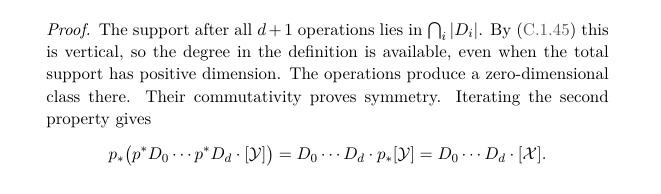
Iterating the second property gives
\[
 p_*\bigl(p^*D_0\cdots p^*D_d\cdot[\cY]\bigr)
            =D_0\cdots D_d\cdot p_*[\cY]
            =D_0\cdots D_d\cdot[\cX].
\]
The retained vertical degree and identical root exponents prove
\eqref{eq:f9md:supportedpush}. Applying this equality to each side of a
common domination proves the next assertion. This proof does not
manufacture the supported operators or their projection formula.

The model divisor changes by $e_i\divi(\pi)$ when $s_i$ is
multiplied by $\pi$. Additivity, commutativity and the third property
turn the change in the final class into
\[
 e_i\sum_V b_V\left(\prod_{j\ne i}c_1(\cL_j|_V)\right)[V].
\]
Taking its degree and dividing by $E_0/\lambda$ proves
\eqref{eq:f9md:piregression}. The generic support condition is unchanged;
the model support is enlarged by the special fibre when needed.
On a model with only the standard projective component and degrees
$m_j$, this gives $+\lambda\prod_{j\ne i}m_j$, as required by the
point normalization. The blowup computation gives the same mass for
pulled-back data, so it is also a common-model regression test.
\end{proof}
Standing context 1 · exact TeX
Let $K$ be complete and nontrivially discretely valued, with valuation
ring $R$, residue field $k$, uniformizer $\pi$, and the fixed number
$\lambda=-\log|\pi|>0$. Let $X$ be an integral proper $K$-variety of
dimension $d\geq2$. A model in this note is proper, flat, integral and
normal over $R$, of finite type, with generic fibre identified with $X$.
Retain explicitly the ordinary DVR local rings at all height-one points
used below. Its special components have dimension $d$.
Standing context 2 · exact TeX
For a proper model $\cT$ and closed support $S$, suppose there are
groups $C_r(\cT;S)$ of $r$-dimensional cycles modulo equivalences
\emph{retaining that support}. Suppose model pseudo-divisors $D$ act by
operators $D\cdot:C_r(\cT;S)\to C_{r-1}(\cT;S\cap|D|)$.
For the objects used, require the following four properties:
\begin{enumerate}
\item The operators are additive and commute; the first operation on an
integral model is its Cartier divisor cycle when that is defined.
\item Proper pushforward retains the prescribed supports and satisfies
$p_*(p^*D\cdot\alpha)=D\cdot p_*\alpha$.
\item On vertical cycles, $D$ acts by the ordinary first Chern operation
of its model line, even if its chosen section restricts identically to
zero. Moreover $\divi(\pi)\cdot[\cT]=\sum_Vb_V[V]$.
\item Vertical zero-cycles have degree over $k$, with actual local
lengths and full residue-field degrees, and this degree is preserved by
proper pushforward.
\end{enumerate}
These are interface hypotheses. In particular, the second property is
the supported algebraic projection formula, not F6's analytic theorem.
Typeset reader excerpt
Typed proof inputs
No explicit typed target in the exported bindings.
Proof map
Verified map inputs · NAG-003054
No addressable selected proof input is recorded in this projection.
NAG-003054 · Common domination and the uniformizer test · Chapter argument