NAG-003062 · Accepted whole
Simultaneous algebraic replacement
Proper direct image on historical ordinary compact tests
Open in the English reader · PDF page 1851
Statement · exact TeX
\begin{proposition}[Simultaneous algebraic replacement]\label{prop:approx}
Let $x\in W$ and let $f_1,\ldots,f_m\in\cO(W)^\times$. There exist a compact affinoid domain $C\subset W$, an ordinary open neighborhood $V$ of $x$ in $C$, a very affine Zariski open $U\subset X$ with $C\subset U^\an$, and $g_i\in\cO(U)^\times$ such that
\[
                    |f_i(z)|=|g_i(z)|\quad(z\in C,\ 1\leq i\leq m).
\]
Moreover, $V$ is the inverse image of an open real set under an explicit algebraic closed embedding of $U$ into a torus. All analytic coordinates and all finite germ relations specified in advance may use this same $C$.
\end{proposition}
Full selected proof · exact TeX
\begin{proof}
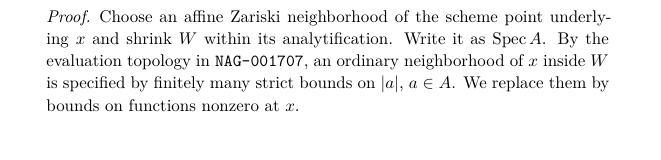
Choose an affine Zariski neighborhood of the scheme point underlying $x$ and shrink $W$ within its analytification. Write it as $\Spec A$. By the evaluation topology in \tagid{001707}, an ordinary neighborhood of $x$ inside $W$ is specified by finitely many strict bounds on $|a|$, $a\in A$. We replace them by bounds on functions nonzero at $x$.

If $|a(x)|>0$, choose a smaller positive lower and upper bound around this value. If $a(x)=0$, the only relevant constraint is an upper bound $|a|<b$. Choose $c\in K^\times$ with $|c|<b$ and numbers $0<s<|c|<r<b$. Then
\[
        s<|a-c|<r \quad\Longrightarrow\quad |a|<b,
\]
and the new inequalities hold at $x$. Also choose algebra generators for $A$, translating any generator vanishing at $x$ by a nonzero scalar. Translated generators still generate $A$.

Combining these finite lists gives $y_1,\ldots,y_N\in A$ which generate $A$ and satisfy $|y_j(x)|>0$. We can choose
\[
 0<s_j<|y_j(x)|<r_j,\qquad
 C=\{z\in(\Spec A)^\an:s_j\leq|y_j(z)|\leq r_j\ \forall j\}
 \subset W.
\]
Choose all bounds strictly inside the earlier bounds. Since $K$ is algebraically closed and nontrivially valued, $|K^\times|$ is dense in $\mathbb R_{>0}$: the rational powers of any element of absolute value different from one already have this property. Hence the $s_j,r_j$ may belong to $|K^\times|$.

If $A=K[T_1,\ldots,T_N]/I$, with $T_j\mapsto y_j$, the domain has the actual affinoid presentation
\begin{equation}\label{eq:B}
 B=K\{r^{-1}T,sS\}/(I(T),T_jS_j-1)_j.
\end{equation}
Here the bound on $S_j$ is $s_j^{-1}$. The affine analytification and rational-domain results \tagid{001707}, \tagid{001576} and \tagid{001577} identify its spectrum with $C$. Actual ideals are closed by \tagid{001562}; compactness is \tagid{001496}. Set
\[
                    V=\{z:s_j<|y_j(z)|<r_j\ \forall j\}.
\]
This is ordinary open, contains $x$ and lies in $C$. The displayed strict inequalities on both sets of generators also put $V$ in the analytic interior of this presentation of $C$ over $K$.

The image of $A[(y_1\cdots y_N)^{-1}]$ is dense in $B$: truncate a lift in the weighted Tate algebra in \eqref{eq:B}; the resulting polynomial in $T,S$ is such a Laurent polynomial. This uses the actual quotient norm and does not require a Runge theorem. By \tagid{001610}, restriction of the analytic units and their inverses gives units of $B$. Apply Lemma~\ref{lem:uniform}, writing each approximant as
\[
                     g_i=p_i/(y_1\cdots y_N)^{a_i},\qquad p_i\in A.
\]
The equality of absolute values holds on all of $C$, so every $p_i$ is nonzero at every point of $C$. Define
\[
 U=\Spec A[(y_1\cdots y_Np_1\cdots p_m)^{-1}].
\]
By \tagid{001708}, its analytification contains $C$. Its coordinate algebra is generated by the units $y_j,p_i$ and their inverses, so these coordinates give an explicit closed embedding $\psi:U\hookrightarrow\mathbb G_m^{N+m}$. The open set $V$ is exactly $\psi_{\rm trop}^{-1}(\Omega)$, where $\Omega$ imposes the strict bounds on the first $N$ coordinates. Its remaining coordinates are unrestricted.

For a finite list of germ relations, first intersect their ordinary witness neighborhoods with $W$ and include all analytic units occurring in them in one tuple. The preceding construction then applies once. This proves the last assertion without a compatibility choice between separate approximations.
\end{proof}
Typeset reader excerpt
Typed proof inputs
- NAG-001496 · selected whole (sealed whole native proof)
- NAG-001562 · selected whole (sealed whole native proof)
- NAG-001576 · selected whole (sealed whole native proof)
- NAG-001577 · selected whole (sealed whole native proof)
- NAG-001610 · selected whole (sealed whole native proof)
- NAG-001707 · selected whole (sealed whole native proof)
- NAG-001708 · selected whole (sealed whole native proof)
- NAG-003061 · selected whole (sealed whole native proof)
- NAG-001496 · selected whole
- NAG-001496 · selected whole (requires)
- NAG-001562 · selected whole
- NAG-001562 · selected whole (requires)
- NAG-001576 · selected whole
- NAG-001576 · selected whole (requires)
- NAG-001577 · selected whole
- NAG-001577 · selected whole (requires)
- NAG-001610 · selected whole
- NAG-001610 · selected whole (requires)
- NAG-001707 · selected whole
- NAG-001707 · selected whole (requires)
- NAG-001708 · selected whole
- NAG-001708 · selected whole (requires)
- NAG-003061 · selected whole
- NAG-003061 · selected whole (requires)
Reader cross-references
Proof map
Verified map inputs · NAG-003062
AND · joint registered proof inputs
- NAG-001496 · Compactness of the bounded spectrum · accepted whole
- NAG-001562 · Actual quotients by arbitrary ideals · accepted whole
- NAG-001576 · Points of an arbitrary-radius rational presentation · accepted whole
- NAG-001577 · Bounded and geometric rational factorization · accepted whole
- NAG-001610 · The structure sheaf of an atlas · accepted whole
- NAG-001707 · Affine analytification and its mapping property · accepted whole
- NAG-001708 · Principal opens and global analytification · accepted whole
- NAG-003061 · Uniform norm preservation · accepted whole
NAG-003062 · Simultaneous algebraic replacement · Chapter argument