NAG-003073 · Accepted whole
Detection through an affine image
Proper direct image on historical ordinary compact tests
Open in the English reader · PDF page 1832
Statement · exact TeX
\begin{lemma}[Detection through an affine image]\label{lem:poly}
Let $Q$ be a finite union of compact convex polytopes in a real affine space, let $\pi$ be an affine map, and put $P=\pi(Q)$. If $\alpha$ is a smooth ambient superform near $P$, then
\[
       \pi^*\alpha|_Q=0\quad\Longleftrightarrow\quad\alpha|_P=0.
\]
Moreover, if $P=\bigcup_{i=1}^r P_i$ is a finite union of compact polyhedral subsets and $\alpha|_{P_i}=0$ for every $i$, then $\alpha|_P=0$.
\end{lemma}
Full selected proof · exact TeX
\begin{proof}
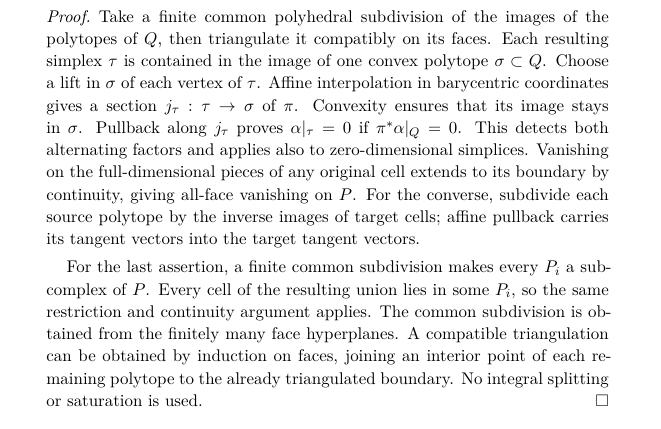
Take a finite common polyhedral subdivision of the images of the polytopes of $Q$, then triangulate it compatibly on its faces. Each resulting simplex $\tau$ is contained in the image of one convex polytope $\sigma\subset Q$. Choose a lift in $\sigma$ of each vertex of $\tau$. Affine interpolation in barycentric coordinates gives a section $j_\tau:\tau\to\sigma$ of $\pi$. Convexity ensures that its image stays in $\sigma$. Pullback along $j_\tau$ proves $\alpha|_\tau=0$ if $\pi^*\alpha|_Q=0$. This detects both alternating factors and applies also to zero-dimensional simplices. Vanishing on the full-dimensional pieces of any original cell extends to its boundary by continuity, giving all-face vanishing on $P$. For the converse, subdivide each source polytope by the inverse images of target cells; affine pullback carries its tangent vectors into the target tangent vectors.

For the last assertion, a finite common subdivision makes every $P_i$ a subcomplex of $P$. Every cell of the resulting union lies in some $P_i$, so the same restriction and continuity argument applies. The common subdivision is obtained from the finitely many face hyperplanes. A compatible triangulation can be obtained by induction on faces, joining an interior point of each remaining polytope to the already triangulated boundary. No integral splitting or saturation is used.
\end{proof}
Typeset reader excerpt
Typed proof inputs
- BASE-LINEAR · standing context or base
- BASE-LINEAR · standing context or base (requires)
- BASE-TOPOLOGY · standing context or base
- BASE-TOPOLOGY · standing context or base (requires)
Proof map
Verified map inputs · NAG-003073
No addressable selected proof input is recorded in this projection.
Unlinked source pointers
These pointers have no operative linked edge in this map.
BASE-LINEARBASE-TOPOLOGY
NAG-003073 · Detection through an affine image · Chapter argument