NAG-003081 · Accepted whole
The exact local-to-final comparison
Proper direct image on historical ordinary compact tests
Open in the English reader · PDF page 1911
Statement · exact TeX
\begin{proposition}[The exact local-to-final comparison]\label{prop:finalcompare}
For the matched stages above, $\tau_t\subseteq\tau_a$.
Choose an increasing cofinal sequence of ambient seminorms $p_m$ and put
\[
 q_m([\eta])=\inf_{\nu\in N_P}p_m(\eta+\nu).
\]
If, on every coefficient space used in a generating family, for each $m$
there are finitely many intrinsic seminorms $r_l$ and a constant $C_m$
with
\begin{equation}\label{eq:reverse}
 q_m(a)\leq C_m\max_{l\leq s_m}r_l(a),
\end{equation}
then $\tau_t=\tau_a$ for that generating family. Constants and derivative
orders may depend on the presentation. No uniform estimate over all
presentations is needed for this equality of final topologies.
\end{proposition}
Full selected proof · exact TeX
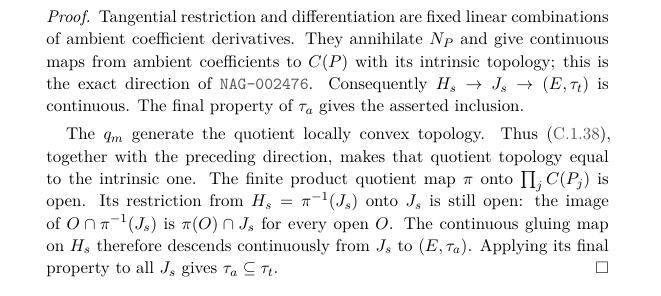
\begin{proof}
Tangential restriction and differentiation are fixed linear combinations
of ambient coefficient derivatives. They annihilate $N_P$ and give
continuous maps from ambient coefficients to $C(P)$ with its intrinsic
topology; this is the exact direction of \tagref{NAG-002476}.
Consequently $H_s\to J_s\to(E,\tau_t)$ is continuous. The final property
of $\tau_a$ gives the asserted inclusion.

The $q_m$ generate the quotient locally convex topology. Thus
\eqref{eq:reverse}, together with the preceding direction, makes that
quotient topology equal to the intrinsic one. The finite product
quotient map $\pi$ onto $\prod_j C(P_j)$ is open. Its restriction from
$H_s=\pi^{-1}(J_s)$ onto $J_s$ is still open: the image of
$O\cap\pi^{-1}(J_s)$ is $\pi(O)\cap J_s$ for every open $O$.
The continuous gluing map on $H_s$ therefore descends continuously from
$J_s$ to $(E,\tau_a)$. Applying its final property to all $J_s$ gives
$\tau_a\subseteq\tau_t$.
\end{proof}
Standing context 1 · exact TeX
Write $U$ for a good Hausdorff analytic space over a complete
non-Archimedean field, with arbitrary valuation. For an application with
interior tests, take $U$ to be an ordinary open subset of the true analytic
interior of the ambient space. Put $E=\A_c^{p,q}(U)$, with the frozen
ordinary moment sheaf and actual ordinary compact supports.
The two final topologies of \tagref{NAG-002472} are equal by
\tagref{NAG-002473}; denote their common value by $\tau_a$.
A cutoff generator has the form
\[
 Q_i:E^{p,q}(\Omega_i)\longrightarrow E,\qquad
 Q_i\eta=\operatorname{ext}_0(\chi_i t_{f_i}^*\eta),
 \qquad t_{f_i}=-\log|f_i|.
\]
Here $V_i$ is affinoid, $f_i$ is a unit tuple, $\Omega_i$ contains
$t_{f_i}(V_i)$, and $\supp\chi_i$ is compact in
$\Int_{\rm top}(V_i,U)$. The coefficient space has all compact $C^\infty$
seminorms. A seminorm on $E$ is $\tau_a$-continuous exactly when all its
composites with $Q_i$ are continuous. The images of the $Q_i$ span $E$.
Standing context 2 · exact TeX
We now define a matched intrinsic model, so that no external sheaf
identification is hidden. For a finite compact polyhedral set
$P\subset\Omega\subset\R^N$, let
\[
 C(P)=E^{p,q}(\Omega)/N_P,
\]
where $N_P$ consists of forms whose tangential restrictions to all faces
vanish. The underlying vector space consists of ambiently smooth
restrictions. Its \emph{intrinsic} topology is generated by the suprema
$r_{\sigma,m}$ of tangential coefficient derivatives through order $m$
on the compact faces $\sigma$, in fixed affine tangent bases.
Using all compact subfaces gives the same model after the corresponding
restrictions. This definition does not add arbitrary piecewise smooth
forms that lack an ambient representative.

For a finite ordinary presentation $s$, set $P_j=t_{f_j}(V_j)$ and
use these $C(P_j)$. We require the usual native nullity implication:
zero tangential restriction on $P_j$ pulls back to the zero ordinary
section. Let $J_s\subset\prod_j C(P_j)$ consist of the tuples whose
pullbacks agree on ordinary open overlaps and vanish off the fixed
compact support $K_s\subset\bigcup_j\Int_{\rm top}(V_j,U)$.
Give $J_s$ the intrinsic subspace topology. Its gluing map is $G_s$.
Let $\tau_t$ be the final locally convex topology for these $G_s$.
The ambient preimage of $J_s$ is exactly the frozen space $H_s$.
Thus both topologies in this comparison are on the same native test
space, with the same compact supports and overlap relations.
Typeset reader excerpt
Typed proof inputs
- NAG-002473 · selected whole
- NAG-002476 · selected whole
Proof map
Verified map inputs · NAG-003081
AND · joint registered proof inputs
- NAG-002473 · Comparison of the two final topologies · accepted whole Exact source window 135–140
- ambient tangential restriction is continuous on actual matched stages; compose with the intrinsic stage maps
- NAG-002476 · The available direction of the tangential comparison · accepted whole Exact source window 135–140
- ambient tangential restriction is continuous on actual matched stages; compose with the intrinsic stage maps
NAG-003081 · The exact local-to-final comparison · Chapter argument