NAG-003085 · Accepted whole
No presentation-independent extension constant
Proper direct image on historical ordinary compact tests
Open in the English reader · PDF page 1804
Statement and full selected proof · exact TeX
\begin{example}[No presentation-independent extension constant]\label{ex:angle}
Even integral finite polyhedral complexes with weight one can require
unbounded constants in estimates of an ambient quotient seminorm by finitely many intrinsic seminorms. For $k\geq1$, put
\[
 v_k=(k,1),\quad w_k=(k+1,1),\qquad
 P_k=\{tv_k:|t|\leq(k+1)^{-1}\}
       \cup\{tw_k:|t|\leq(k+1)^{-1}\}.
\]
Subdivide at the origin and use the primitive integral tangent vectors
on the segments. In scalar degree, let $a_k$ be the restriction of
$x-ky$. Every intrinsic derivative seminorm of order at least one is at
most one, but every ambient representative has coefficient $C^1$
seminorm at least $k$ on any compact neighbourhood of the origin.
\end{example}
% CLAIM F8IT-U PROOF
\begin{proof}
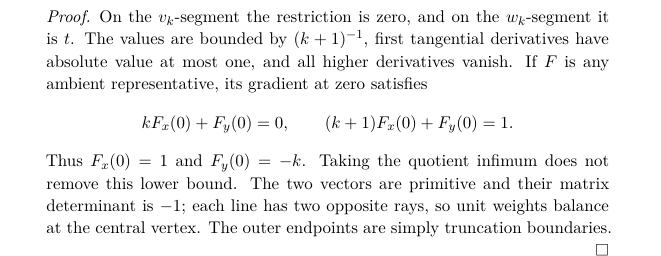
On the $v_k$-segment the restriction is zero, and on the $w_k$-segment
it is $t$. The values are bounded by $(k+1)^{-1}$, first tangential
derivatives have absolute value at most one, and all higher derivatives
vanish. If $F$ is any ambient representative, its gradient at zero
satisfies
\[
 k F_x(0)+F_y(0)=0,\qquad (k+1)F_x(0)+F_y(0)=1.
\]
Thus $F_x(0)=1$ and $F_y(0)=-k$. Taking the quotient infimum does not
remove this lower bound. The two vectors are primitive and their
matrix determinant is $-1$; each line has two opposite rays, so unit
weights balance at the central vertex. The outer endpoints are simply
truncation boundaries.
\end{proof}
Typeset reader excerpt
Typed proof inputs
- BASE-LINEAR · standing context or base
- BASE-LINEAR · standing context or base (requires)
- BASE-REAL · standing context or base
- BASE-REAL · standing context or base (requires)
- BASE-TOPOLOGY · standing context or base
- BASE-TOPOLOGY · standing context or base (requires)
Proof map
Verified map inputs · NAG-003085
No addressable selected proof input is recorded in this projection.
Standing context and base inputs
BASE-LINEARBASE-REALBASE-TOPOLOGY
NAG-003085 · No presentation-independent extension constant · Chapter argument