NAG-003116 · Accepted whole
Independence with no extra support
Proper direct image on historical ordinary compact tests
Open in the English reader · PDF page 1928
Statement · exact TeX
\begin{proposition}[Independence with no extra support]
\label{f9sc:signed}
The operation \eqref{eq:f9sc:signed} is independent of the signed presentation
on the \emph{same prescribed $Z$}. It is additive under tensor product
with union of supports, commutes with other such operations on their
intersection of supports, and satisfies \eqref{eq:f9sc:projection} for
pulled-back presentations. These assertions remain meaningful when a
pulled-back factor section vanishes identically. Its image in $C_{r-1}(\cX;T)$
is the first Chern operation of $\cL|_T$.

Every rational Cartier section on a locally factorial integral
Noetherian $\cX$ has a signed presentation on exactly the support of
its divisor. Thus the result applies, in particular, to arbitrary
rational Cartier sections on locally factorial proper DVR models.
On other integral models the existence of the stated presentation
is a hypothesis, not a conclusion obtained by enlarging $Z$.
\end{proposition}
Full selected proof · exact TeX
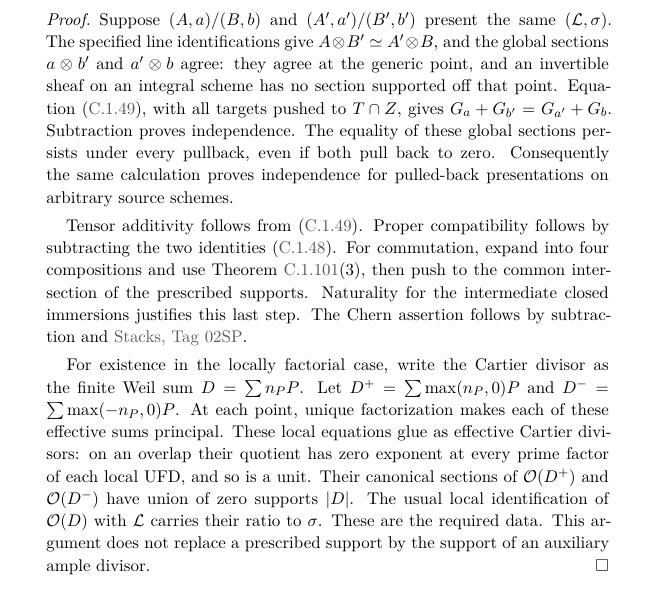
\begin{proof}
Suppose $(A,a)/(B,b)$ and $(A',a')/(B',b')$ present the same
$(\cL,\sigma)$. The specified line identifications give
$A\otimes B'\simeq A'\otimes B$, and the global sections
$a\otimes b'$ and $a'\otimes b$ agree: they agree at the generic
point, and an invertible sheaf on an integral scheme has no section
supported off that point. Equation~\eqref{eq:f9sc:tensor}, with all targets
pushed to $T\cap Z$, gives
$G_a+G_{b'}=G_{a'}+G_b$. Subtraction proves independence.
The equality of these global sections persists under every pullback,
even if both pull back to zero. Consequently the same calculation proves
independence for pulled-back presentations on arbitrary source schemes.

Tensor additivity follows from \eqref{eq:f9sc:tensor}. Proper compatibility
follows by subtracting the two identities \eqref{eq:f9sc:projection}.
For commutation, expand into four compositions and use
Theorem~\ref{f9sc:refined-supported}(3), then push to the common intersection
of the prescribed supports. Naturality for the intermediate closed
immersions justifies this last step. The Chern assertion follows by
subtraction and \st{02SP}.

For existence in the locally factorial case, write the Cartier divisor
as the finite Weil sum $D=\sum n_P P$. Let
$D^+=\sum\max(n_P,0)P$ and $D^-=\sum\max(-n_P,0)P$.
At each point, unique factorization makes each of these effective sums
principal. These local equations glue as effective Cartier divisors:
on an overlap their quotient has zero exponent at every prime factor
of each local UFD, and so is a unit. Their canonical sections of
$\cO(D^+)$ and $\cO(D^-)$ have union of zero supports $|D|$.
The usual local identification of $\cO(D)$ with $\cL$ carries their
ratio to $\sigma$. These are the required data. This argument does not
replace a prescribed support by the support of an auxiliary ample divisor.
\end{proof}
Standing context 1 · exact TeX
A \emph{signed presentation on $Z$} of an invertible sheaf $\cL$
with a nonzero rational section $\sigma$ on an integral $\cX$ consists
of two pairs $(\cL^+,s^+)$, $(\cL^-,s^-)$ with nonzero global
sections, an isomorphism
$\cL\simeq\cL^+\otimes(\cL^-)^{-1}$ taking
$\sigma$ to $s^+/s^-$, and
$|Z(s^+)|\cup|Z(s^-)|\subset Z$.
For every $T$, define
\begin{equation}\label{eq:f9sc:signed}
 I_{(\cL,\sigma;Z),T}=G_{(\cL^+,s^+),T}-G_{(\cL^-,s^-),T}
       :C_r(\cX;T)\longrightarrow C_{r-1}(\cX;T\cap Z),
\end{equation}
using the closed-immersion pushforwards to this common target.
Typeset reader excerpt
Typed proof inputs
- CLAUSE:NAG-003112:supported_gysin_1_4 · selected scope (exact native application)
Reader cross-references
Proof map
Verified map inputs · NAG-003116
Registered proof input
- CLAUSE:NAG-003112:supported_gysin_1_4 · supported gysin 1 4 · selected scope Exact source window 187
- Supported proper, tensor and local comparison within the exact (1)–(4) scope.
NAG-003116 · Independence with no extra support · Chapter argument