NAG-003143 · Accepted whole
Corrected radicals and a value basis
G Stable inertia and original-field models
Open in the English reader · PDF page 2033
Source provenance: transcription from the printed reader.
Statement and full selected proof · exact TeX
\NextLinkTarget{foundations.nag003143.pdf-derived}
\begin{lemma}[Corrected radicals and a value basis]
\label{f5gt:pdf-derived:radicalsteps}
Let \(E/F\) be finite with equal residue fields and
\([E:F]=[\Gamma_E:\Gamma_F]=e\), where \(e\in(F^\circ)^\times\).
There is a tower
% @formula 17 227
\begin{equation}\label{eq:f5gt:pdf-derived:radical-tower}
 F=F_0\subset F_1\subset\cdots\subset F_r=E,\qquad
 F_i=F_{i-1}(s_i),\qquad s_i^{n_i}\in F_{i-1}^{\times},
\end{equation}
with \(n_i\ge2\), \(v(s_i)>0\), and
\([F_i:F_{i-1}]=[\Gamma_{F_i}:\Gamma_{F_{i-1}}]=n_i\).
The residue fields are unchanged, \(\prod_i n_i=e\), and the monomials
\(\prod_i s_i^{a_i}\), \(0\le a_i<n_i\), have distinct value classes
modulo \(\Gamma_F\) and form an \(F\)-basis of \(E\).
The empty tower is allowed when \(e=1\).

Every step is exact Kummer if either \(E/F\) is Galois or \(F\) contains all
\(e\)-th roots of unity. Moreover, if \(N/F\) is finite with \(\Gamma_N=\Gamma_F\)
in a common valued overfield, then \(E\otimes_F N\) is the field \(EN\),
of degree and value index \(e\) over \(N\) and with residue field
\(\widetilde N\). If \(N\) contains all \(e\)-th roots of unity,
the base-changed tower \eqref{eq:f5gt:pdf-derived:radical-tower} consists of exact Kummer steps of the same degrees.
\end{lemma}
\par\smallskip\noindent{\small\textit{Direct inputs} \hyperref[fnd:finiteextensionnorms]{\texttt{NAG-001450}}, \hyperref[cand:completevaluationhenselian]{\texttt{NAG-002049}}, \hyperref[cand:f5tame:charactercriterion]{\texttt{NAG-002610}}.}\par\smallskip
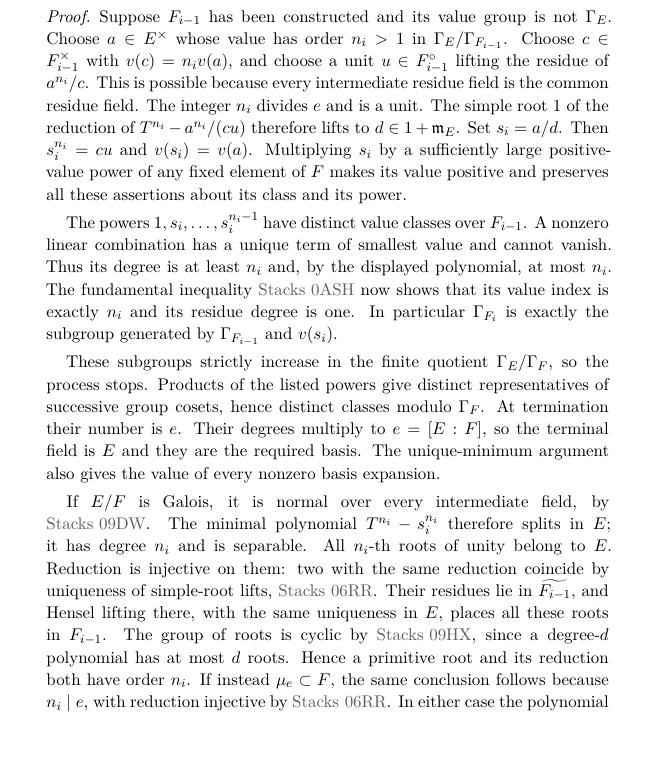
\begin{proof}
Suppose \(F_{i-1}\) has been constructed and its value group is not
\(\Gamma_E\). Choose \(a\in E^\times\) whose value has order \(n_i>1\) in
\(\Gamma_E/\Gamma_{F_{i-1}}\). Choose \(c\in F_{i-1}^\times\) with
\(v(c)=n_iv(a)\), and choose a unit \(u\in F_{i-1}^\circ\) lifting the
residue of \(a^{n_i}/c\). This is possible because every intermediate residue
field is the common residue field. The integer \(n_i\) divides \(e\) and is
a unit. The simple root \(1\) of the reduction of
\(T^{n_i}-a^{n_i}/(cu)\) therefore lifts to \(d\in1+\mathfrak m_E\).
Set \(s_i=a/d\). Then \(s_i^{n_i}=cu\) and \(v(s_i)=v(a)\).
Multiplying \(s_i\) by a sufficiently large positive-value power of any fixed
element of \(F\) makes its value positive and preserves all these assertions
about its class and its power.

The powers \(1,s_i,\ldots,s_i^{n_i-1}\) have distinct value classes over
\(F_{i-1}\). A nonzero linear combination has a unique term of smallest
value and cannot vanish. Thus its degree is at least \(n_i\) and, by the
displayed polynomial, at most \(n_i\). The fundamental inequality
\stacks{0ASH} now shows that its value index is exactly \(n_i\) and its
residue degree is one. In particular \(\Gamma_{F_i}\) is exactly the subgroup
generated by \(\Gamma_{F_{i-1}}\) and \(v(s_i)\).

% @witness proof_continued 228:4-24
These subgroups strictly increase in the finite quotient \(\Gamma_E/\Gamma_F\),
so the process stops. Products of the listed powers give distinct representatives
of successive group cosets, hence distinct classes modulo \(\Gamma_F\).
At termination their number is \(e\). Their degrees multiply to \(e=[E:F]\),
so the terminal field is \(E\) and they are the required basis.
The unique-minimum argument also gives the value of every nonzero basis expansion.

If \(E/F\) is Galois, it is normal over every intermediate field, by
\stacks{09DW}. The minimal polynomial \(T^{n_i}-s_i^{n_i}\) therefore splits
in \(E\); it has degree \(n_i\) and is separable. All \(n_i\)-th roots of
unity belong to \(E\). Reduction is injective on them: two with the same
reduction coincide by uniqueness of simple-root lifts, \stacks{06RR}.
Their residues lie in \(\widetilde{F_{i-1}}\), and Hensel lifting there,
with the same uniqueness in \(E\), places all these roots in \(F_{i-1}\).
The group of roots is cyclic by \stacks{09HX}, since a degree-\(d\)
polynomial has at most \(d\) roots. Hence a primitive root and its
reduction both have order \(n_i\). If instead \(\mu_e\subset F\), the same
conclusion follows because \(n_i\mid e\), with reduction injective by
\stacks{06RR}. In either case the polynomial splits in \(F_i\), and its root
multiplications give the cyclic Galois group. This proves \eqref{eq:f5gt:pdf-derived:exact-kummer}.

Finally the same \(e\) monomials remain linearly independent over \(N\),
since \(\Gamma_N=\Gamma_F\). The multiplication map \(E\otimes_F N\to EN\)
is therefore injective and has image of \(N\)-dimension \(e\); its image
is a finite-dimensional domain, hence a field and thus all of \(EN\).
Its value group contains \(\Gamma_E\), of index \(e\) over \(\Gamma_N\).
Another application of \stacks{0ASH} forces equality of the value index
with \(e\) and equality of residue fields with \(\widetilde N\).
Applying the same basis argument to each initial segment of \eqref{eq:f5gt:pdf-derived:radical-tower}
preserves its degree and value index. If \(\mu_e\subset N\), each segment
has the required roots of unity with unchanged residue order, so is exact Kummer.
\end{proof}
Typeset reader excerpt
Typed proof inputs
- NAG-001450 · selected whole (prerequisites)
- NAG-002049 · selected whole (prerequisites)
- NAG-002610 · selected whole (prerequisites)
- STACKS-06RR · named external application
- STACKS-09DW · named external application
- STACKS-09DW-GALOIS-CORRESPONDENCE-SCOPE · named external application
- STACKS-09HX · named external application
- STACKS-0ASH · named external application
- NAG-001450 · selected whole (explicit current dependencies)
- NAG-002049 · selected whole (explicit current dependencies)
- NAG-002610 · selected whole (explicit current dependencies)
Proof map
Verified map inputs · NAG-003143
AND · joint registered proof inputs
- NAG-001450 · Finite-dimensional norms and finite field extensions · accepted whole
- NAG-002049 · Simple roots over a complete valued field · accepted whole
- NAG-002610 · Character modules give an exact integral test · accepted whole
NAG-003143 · Corrected radicals and a value basis · Chapter argument