NAG-003200 · Accepted whole
Result C.1.16
Proper direct image on historical ordinary compact tests
Open in the English reader · PDF page 1808
Statement and full selected proof · exact TeX
Let $K$ be complete for a specified nontrivial discretely valued
non-Archimedean absolute value. Put
\[
 R=K^\circ,\qquad k=R/\mathfrak m_R,\qquad
 \lambda_K=-\log|\pi|>0
\]
for a uniformizer $\pi$ of $R$.

\begin{lemma}[The valuation-ring factors]\label{f9be:dvr}
Let $L/K$ be a finite field extension of degree $n$, with the unique
extension of the given absolute value, and put $R'=L^\circ$ and
$k'=R'/\mathfrak m_{R'}$. Then $R'$ is a complete DVR, finite free of
rank $n$ over $R$. If $\varpi$ is its uniformizer,
\[
 \pi=u\varpi^e,\quad u\in(R')^\times,\qquad
 f=[k':k],\qquad n=ef,\qquad
 \lambda_L=-\log|\varpi|=\lambda_K/e.
\]
No separability assumption is required.
\end{lemma}
\begin{proof}
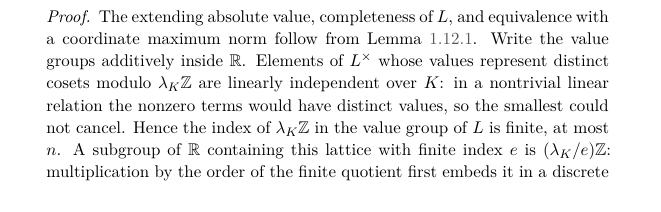
The extending absolute value, completeness of $L$, and equivalence
with a coordinate maximum norm follow from
Lemma~\ref{fnd:finiteextensionnorms}.
Write the value groups additively inside $\mathbb R$.
Elements of $L^\times$ whose values represent distinct cosets modulo
$\lambda_K\mathbb Z$ are linearly independent over $K$: in a nontrivial
linear relation the nonzero terms would have distinct values, so the
smallest could not cancel. Hence the index of
$\lambda_K\mathbb Z$ in the value group of $L$ is finite, at most $n$.
A subgroup of $\mathbb R$ containing this lattice with finite index
$e$ is $(\lambda_K/e)\mathbb Z$: multiplication by the order of the
finite quotient first embeds it in a discrete cyclic group.
Choose $\varpi$ with its least positive value. Every nonzero ideal
of $R'$ is generated by an element of least value, so $R'$ is a DVR,
and $\pi=u\varpi^e$.

Fix a $K$-basis of $L$. The coordinate norm bound puts the unit ball
$R'$ inside $\pi^{-N}R^n$ for some integer $N$.
It is an $R$-submodule and is finite free: for a submodule of $R^n$,
project to one coordinate, whose image is a principal ideal, lift
a generator, and apply induction to the kernel in $R^{n-1}$.
This also proves finite generation, without assuming it beforehand.
Scaling the chosen basis by powers of $\pi$ puts it inside $R'$,
so the rank is $n$. The $\varpi$-adic topology is the induced
valuation topology; the closed unit ball is complete.

Consequently $\dim_k R'/\pi R'=n$. Its filtration by
$\varpi^jR'/\varpi^eR'$ has $e$ quotients isomorphic to $k'$.
The residue extension is finite (it is a quotient of this finite
$k$-space), and comparison of dimensions proves $n=ef$.
The absolute-value formula follows from the displayed equation for
$\pi$, since a unit of $R'$ has absolute value one.
\end{proof}
Typeset reader excerpt
Typed proof inputs
- BASE-LINEAR · standing context or base
- BASE-LINEAR · standing context or base (requires)
- BASE-REAL · standing context or base
- BASE-REAL · standing context or base (requires)
- BASE-RINGS · standing context or base
- BASE-RINGS · standing context or base (requires)
- BASE-TOPOLOGY · standing context or base
- BASE-TOPOLOGY · standing context or base (requires)
- NAG-001450 · selected whole
- NAG-001450 · selected whole (requires)
Reader cross-references
Proof map
Verified map inputs · NAG-003200
Registered proof input
- NAG-001450 · Finite-dimensional norms and finite field extensions · accepted whole
Standing context and base inputs
BASE-LINEARBASE-REALBASE-RINGSBASE-TOPOLOGY