NAG-001373 · Accepted whole
Quantitative Laurent criterion
2 Analytic spaces, morphisms and fibres
Open in the English reader · PDF page 143
Statement · exact TeX
\begin{theorem}[\bi{Quantitative Laurent criterion}{Quantitative Laurent criterion}]\label{fnd:banachlaurentcriterion}
\bi{Suppose that there is a real number $c>0$ such that}
{假设存在实数 $c>0$,使}
\[
 \|Lw\|\geq c\|w\|\qquad(w\in E).
\]
\bi{Endow $P_+=E_+/Q_+E_+$, $P_-=E_-/Q_-E_-$ and $P_0=E/LE$ with their quotient norms. They are Banach $A$-modules, and the sequence}
{给 $P_+=E_+/Q_+E_+$、$P_-=E_-/Q_-E_-$ 和 $P_0=E/LE$ 配备 quotient norms。它们为 Banach $A$-modules,且 sequence}
\[
 \begin{gathered}
 0\longrightarrow M\xrightarrow{\ \iota\ }P_+\oplus P_-
 \xrightarrow{\ \delta\ }P_0\longrightarrow0,\\
 \iota(m)=([m],[m]),\quad
 \delta([u],[v])=[u-v].
 \end{gathered}
\]
\bi{is strict exact. The direct sum has its maximum norm. More precisely, with}
{为 strict exact,其中 direct sum 使用 maximum norm。更精确地,令}
\[
 C=\max\left(1,\frac{\max(r,\|f\|)}{cr}\right),
\]
\bi{one has $C^{-1}\|m\|\leq\|\iota(m)\|\leq\|m\|$. The induced map $(P_+\oplus P_-)/\iota(M)\to P_0$ is isometric for the quotient norms.}
{则有 $C^{-1}\|m\|\leq\|\iota(m)\|\leq\|m\|$。Induced map $(P_+\oplus P_-)/\iota(M)\to P_0$ 对 quotient norms 为 isometric。}
\end{theorem}
Full selected proof · exact TeX
\begin{proof}
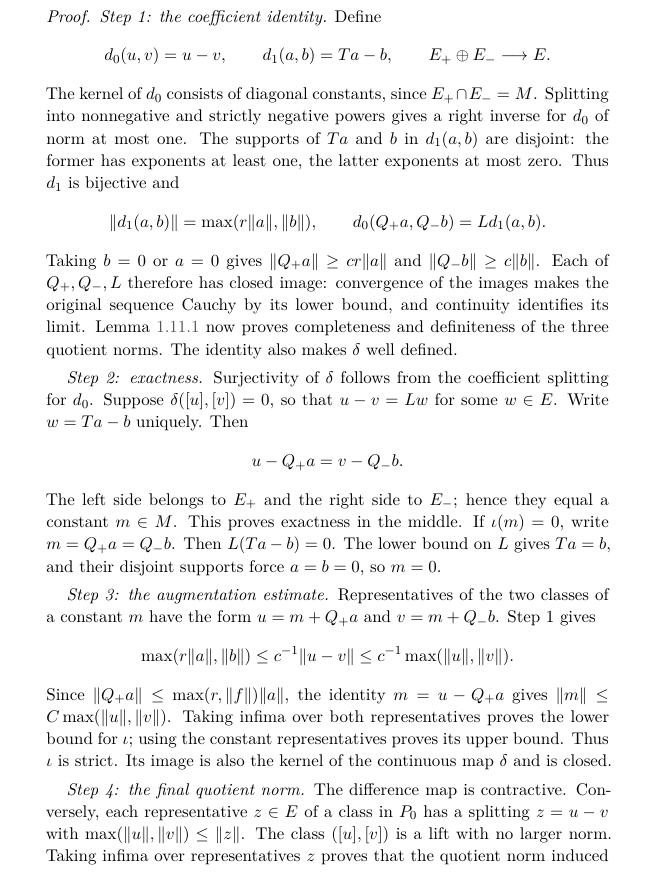
\bi{\emph{Step 1: the coefficient identity.} Define}
{\emph{Step 1:coefficient identity。} 定义}
\[
 d_0(u,v)=u-v,\qquad d_1(a,b)=Ta-b,
 \qquad E_+\oplus E_-\longrightarrow E.
\]
\bi{The kernel of $d_0$ consists of diagonal constants, since $E_+\cap E_-=M$. Splitting into nonnegative and strictly negative powers gives a right inverse for $d_0$ of norm at most one. The supports of $Ta$ and $b$ in $d_1(a,b)$ are disjoint: the former has exponents at least one, the latter exponents at most zero. Thus $d_1$ is bijective and}
{$d_0$ 的 kernel 由 diagonal constants 组成,因为 $E_+\cap E_-=M$。分成 nonnegative powers 和 strictly negative powers,得到 $d_0$ 的一个 norm 不超过一的 right inverse。$d_1(a,b)$ 中 $Ta$ 与 $b$ 的 supports 不相交:前者的 exponents 至少为一,后者至多为零。因此 $d_1$ 为 bijective,且}
\[
 \|d_1(a,b)\|=\max(r\|a\|,\|b\|),
 \qquad d_0(Q_+a,Q_-b)=Ld_1(a,b).
\]
\bi{Taking $b=0$ or $a=0$ gives $\|Q_+a\|\geq cr\|a\|$ and $\|Q_-b\|\geq c\|b\|$. Each of $Q_+,Q_-,L$ therefore has closed image: convergence of the images makes the original sequence Cauchy by its lower bound, and continuity identifies its limit. Lemma~\ref{fnd:completequotient} now proves completeness and definiteness of the three quotient norms. The identity also makes $\delta$ well defined.}
{分别取 $b=0$ 和 $a=0$,得到 $\|Q_+a\|\geq cr\|a\|$ 和 $\|Q_-b\|\geq c\|b\|$。因此 $Q_+,Q_-,L$ 都具有 closed image:image sequence 收敛时,相应 lower bound 使原 sequence 为 Cauchy,再由 continuity 识别其 limit。由 Lemma~\ref{fnd:completequotient},三个 quotient norms 均 definite 且 complete。上述 identity 也保证 $\delta$ well defined。}

\bi{\emph{Step 2: exactness.} Surjectivity of $\delta$ follows from the coefficient splitting for $d_0$. Suppose $\delta([u],[v])=0$, so that $u-v=Lw$ for some $w\in E$. Write $w=Ta-b$ uniquely. Then}
{\emph{Step 2:exactness。} $d_0$ 的 coefficient splitting 给出 $\delta$ 的 surjectivity。若 $\delta([u],[v])=0$,则存在 $w\in E$ 使 $u-v=Lw$。将 $w$ 唯一写成 $Ta-b$,得到}
\[
 u-Q_+a=v-Q_-b.
\]
\bi{The left side belongs to $E_+$ and the right side to $E_-$; hence they equal a constant $m\in M$. This proves exactness in the middle. If $\iota(m)=0$, write $m=Q_+a=Q_-b$. Then $L(Ta-b)=0$. The lower bound on $L$ gives $Ta=b$, and their disjoint supports force $a=b=0$, so $m=0$.}
{左边属于 $E_+$,右边属于 $E_-$,故两边等于同一个 constant $m\in M$,从而证明中间的 exactness。若 $\iota(m)=0$,可写 $m=Q_+a=Q_-b$。于是 $L(Ta-b)=0$;由 $L$ 的 lower bound 得 $Ta=b$。两者 supports 不相交,故 $a=b=0$,从而 $m=0$。}

\bi{\emph{Step 3: the augmentation estimate.} Representatives of the two classes of a constant $m$ have the form $u=m+Q_+a$ and $v=m+Q_-b$. Step~1 gives}
{\emph{Step 3:augmentation estimate。} Constant $m$ 的两个 classes 的 representatives 可写成 $u=m+Q_+a$ 和 $v=m+Q_-b$。由 Step~1,}
\[
 \max(r\|a\|,\|b\|)
 \leq c^{-1}\|u-v\|
 \leq c^{-1}\max(\|u\|,\|v\|).
\]
\bi{Since $\|Q_+a\|\leq\max(r,\|f\|)\|a\|$, the identity $m=u-Q_+a$ gives $\|m\|\leq C\max(\|u\|,\|v\|)$. Taking infima over both representatives proves the lower bound for $\iota$; using the constant representatives proves its upper bound. Thus $\iota$ is strict. Its image is also the kernel of the continuous map $\delta$ and is closed.}
{又有 $\|Q_+a\|\leq\max(r,\|f\|)\|a\|$,所以恒等式 $m=u-Q_+a$ 给出 $\|m\|\leq C\max(\|u\|,\|v\|)$。对两边的 representatives 分别取 infima,即得 $\iota$ 的 lower bound;取 constant representatives 得到 upper bound。因此 $\iota$ 为 strict。它的 image 同时是 continuous map $\delta$ 的 kernel,因而 closed。}

\bi{\emph{Step 4: the final quotient norm.} The difference map is contractive. Conversely, each representative $z\in E$ of a class in $P_0$ has a splitting $z=u-v$ with $\max(\|u\|,\|v\|)\leq\|z\|$. The class $([u],[v])$ is a lift with no larger norm. Taking infima over representatives $z$ proves that the quotient norm induced from $P_+\oplus P_-$ is at most the norm of the given class in $P_0$. Contractivity gives the reverse inequality. The induced map is therefore isometric, which proves strictness of $\delta$.}
{\emph{Step 4:最后的 quotient norm。} Difference map 为 contractive。反之,$P_0$ 中一个 class 的每个 representative $z\in E$ 都可分解为 $z=u-v$,且 $\max(\|u\|,\|v\|)\leq\|z\|$。Class $([u],[v])$ 是一个 norm 不增大的 lift。对 representatives $z$ 取 infimum,得到由 $P_+\oplus P_-$ 诱导的 quotient norm 不超过该 class 在 $P_0$ 中的 norm。反向 inequality 来自 contractivity。因此 induced map 为 isometric,证明了 $\delta$ 的 strictness。}
\end{proof}
Standing context 1 · exact TeX
\bi{Let $A$ be a Banach $K$-algebra and let $M$ be a Banach $A$-module with $\|am\|\leq\|a\|\|m\|$, as in Section~\ref{fnd:wp02division}. Fix $f\in A$ and $r>0$. Define}
{设 $A$ 为 Banach $K$-algebra,$M$ 为满足 $\|am\|\leq\|a\|\|m\|$ 的 Banach $A$-module,如 Section~\ref{fnd:wp02division}。固定 $f\in A$ 和 $r>0$。定义}
\[
\begin{split}
 E_+&=\left\{\sum_{n\geq0}m_nT^n:\|m_n\|r^n\longrightarrow0\right\},\\
 E_-&=\left\{\sum_{n\leq0}m_nT^n:\|m_n\|r^n\longrightarrow0\text{ as }n\to-\infty\right\},\\
 E&=\left\{\sum_{n\in\mathbb Z}m_nT^n:\|m_n\|r^n\longrightarrow0\text{ as }|n|\to\infty\right\}.
\end{split}
\]
\bi{Each has norm $\max_n\|m_n\|r^n$. The coefficientwise argument of Lemma~\ref{fnd:banachseriesmodule}, with the indicated index sets, proves their completeness. We regard $E_+,E_-$ as closed submodules of $E$. Multiplication by $T$ is the shift of coefficients and rescales the norm by $r$. The following operators preserve their indicated modules:}
{每个 module 都使用 norm $\max_n\|m_n\|r^n$。在相应 index sets 上应用 Lemma~\ref{fnd:banachseriesmodule} 的逐 coefficient 论证,即得 completeness。将 $E_+,E_-$ 视为 $E$ 的 closed submodules。乘以 $T$ 是 coefficient shift,恰好将 norm 乘以 $r$。以下 operators 保持各自指定的 modules:}
\[
 \begin{gathered}
 Q_+=T-f:E_+\longrightarrow E_+,\qquad Q_-=1-fT^{-1}:E_-\longrightarrow E_-,
 \\
 L=1-fT^{-1}:E\longrightarrow E.
 \end{gathered}
\]
Typeset reader excerpt
Typed proof inputs
- NAG-001376 · selected whole
- NAG-001376 · selected whole (required native context)
- NAG-001380 · selected whole
- NAG-001380 · selected whole (applied native theorem)
- BASE-LINEAR · standing context or base (selected rule)
- BASE-REAL · standing context or base (selected rule)
- BASE-RINGS · standing context or base (selected rule)
- BASE-SETS · standing context or base (selected rule)
- BASE-TOPOLOGY · standing context or base (selected rule)
- NAG-001376 · selected whole (selected rule)
- NAG-001380 · selected whole (selected rule)
- BASE-LINEAR · standing context or base
- BASE-LINEAR · standing context or base (requires)
- BASE-REAL · standing context or base
- BASE-REAL · standing context or base (requires)
- BASE-RINGS · standing context or base
- BASE-RINGS · standing context or base (requires)
- BASE-SETS · standing context or base
- BASE-SETS · standing context or base (requires)
- BASE-TOPOLOGY · standing context or base
- BASE-TOPOLOGY · standing context or base (requires)
- NAG-001376 · selected whole (requires)
- NAG-001380 · selected whole (requires)
Reader cross-references
Proof map
Verified map inputs · NAG-001373
AND · joint registered proof inputs
- NAG-001376 · Complete coefficient modules · accepted whole
- NAG-001380 · Complete quotients · accepted whole
NAG-001373 · Quantitative Laurent criterion · Chapter argument