NAG-001415 · Accepted whole
The Laurent coefficient normal form
2 Analytic spaces, morphisms and fibres
Open in the English reader · PDF page 147
Statement · exact TeX
\begin{theorem}[\bi{The Laurent coefficient normal form}{Laurent 系数正规形}]\label{fnd:laurentcoefficientnormalform}
\bi{For the data just specified, there are $A$-linear maps}
{对上述数据,存在 $A$-线性映射}
\[
 \begin{aligned}
 \mathcal N&:D_{a,b}(M)\longrightarrow L_{a,b}(M),\\
 \mathcal S&:L_{a,b}(M)\longrightarrow D_{a,b}(M),\\
 \mathcal H&:D_{a,b}(M)\longrightarrow D_{a,b}(M).
 \end{aligned}
\]
\bi{given by the convergent coefficient formulas}
{由以下收敛的系数公式给出:}
\[
 \begin{split}
 (\mathcal Ng)_n
   &=\sum_{k\geq0}m_{n_++k,n_-+k},
       \qquad n_+=\max(n,0),\quad n_-=\max(-n,0),\\
 \mathcal Sc
   &=\sum_{n\geq0}c_nT^n+\sum_{n<0}c_nU^{-n},\\
 (\mathcal Hg)_{ij}
   &=\sum_{k\geq1}m_{i+k,j+k}.
 \end{split}
\]
\bi{They satisfy}
{它们满足}
\[
 \begin{gathered}
 \|\mathcal Ng\|_L\leq\|g\|_D,\qquad
 \|\mathcal Sc\|_D=\|c\|_L,\qquad
 \|\mathcal Hg\|_D\leq\lambda^{-1}\|g\|_D,\\
 P\mathcal H=1-\mathcal S\mathcal N,\qquad
 \mathcal HP=1,\qquad
 \mathcal NP=0,\qquad
 \mathcal N\mathcal S=1,\qquad
 \mathcal H\mathcal S=0 .
 \end{gathered}
\]
\bi{In particular, every $g$ has a unique decomposition}
{特别地,每个 $g$ 都有唯一分解}
\[
 \begin{gathered}
 g=Pq+\mathcal Sc,\qquad q=\mathcal Hg,\quad c=\mathcal Ng,\\
 \|g\|_D=\max\{\lambda\|q\|_D,\|c\|_L\}.
 \end{gathered}
\]
\bi{The relation map satisfies $\|Pq\|_D=\lambda\|q\|_D$ and has closed image. Its image is the actual kernel of $\mathcal N$, so}
{关系映射满足 $\|Pq\|_D=\lambda\|q\|_D$,且具有闭像。其像恰为 $\mathcal N$ 的核,因此}
\[
 \begin{gathered}
 \ker\mathcal N=(TU-1)D_{a,b}(M),\\
 D_{a,b}(M)/(TU-1)D_{a,b}(M)
       \xrightarrow{\ \overline{\mathcal N}\ }L_{a,b}(M)
 \end{gathered}
\]
\bi{is an isometric isomorphism of Banach $A$-modules. The quotient norm of $[g]$ is $\|\mathcal Ng\|_L$, attained at its unique representative supported on the two coordinate axes, with the origin counted once. The associated short exact sequence is split as a sequence of Banach $A$-modules.}
{是 Banach $A$-模的等距同构。$[g]$ 的商范数为 $\|\mathcal Ng\|_L$,并在其唯一的两坐标轴支撑代表元处达到,其中原点只计一次。相应的短正合列作为 Banach $A$-模序列分裂。}
\end{theorem}
Full selected proof · exact TeX
\begin{proof}
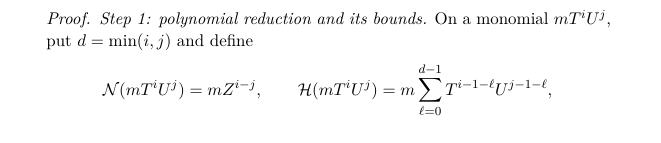
\bi{\emph{Step 1: polynomial reduction and its bounds.} On a monomial $mT^iU^j$, put $d=\min(i,j)$ and define}
{\emph{第一步:多项式约化及其估计。} 对单项式 $mT^iU^j$,记 $d=\min(i,j)$,定义}
\[
 \mathcal N(mT^iU^j)=mZ^{i-j},\qquad
 \mathcal H(mT^iU^j)
       =m\sum_{\ell=0}^{d-1}T^{i-1-\ell}U^{j-1-\ell},
\]
\bi{where the sum is zero if $d=0$. Extend these formulas $A$-linearly to polynomials, and define $\mathcal S$ by the displayed axis formula. The weights satisfy}
{当 $d=0$ 时,右侧和为零。将这些公式 $A$-线性延拓到多项式,并按所列坐标轴公式定义 $\mathcal S$。权重满足}
\[
 b^ia^{-j}=\lambda^d w_{i-j}.
\]
\bi{Thus $\mathcal N$ does not increase the norm of a monomial. Every monomial in its $\mathcal H$-image has weight at most $\lambda^{-1}b^ia^{-j}$, because its weight relative to the original one is $\lambda^{-1-\ell}$. Applying the ultrametric inequality to finite sums proves}
{所以 $\mathcal N$ 不增加单项式的范数。其 $\mathcal H$-像中每个单项式的权重与原权重之比为 $\lambda^{-1-\ell}$,故至多为 $\lambda^{-1}b^ia^{-j}$。对有限和应用超度量不等式,得到}
\[
 \|\mathcal Ng\|_L\leq\|g\|_D,\qquad
 \|\mathcal Hg\|_D\leq\lambda^{-1}\|g\|_D
 \qquad(g\in M[T,U]).
\]
\bi{The axis formula preserves each nonzero coefficient and its weight, so $\mathcal S$ is isometric, on Laurent polynomials and on the full coefficient space.}
{坐标轴公式保留每个非零系数及其权重,因此 $\mathcal S$ 在 Laurent 多项式以及整个系数空间上都等距。}

\bi{\emph{Step 2: completion and the explicit sums.} Choose finite polynomial truncations $g_\nu$ converging to $g$. The preceding bounds make $\mathcal Ng_\nu$ and $\mathcal Hg_\nu$ Cauchy in their respective complete coefficient spaces. Their limits define $\mathcal Ng$ and $\mathcal Hg$. Applying the same bounds to differences of two approximations proves independence of the truncations, linearity and the asserted bounds. This constructs the extensions directly.}
{\emph{第二步:完备化与显式求和。} 选取收敛到 $g$ 的有限多项式截断 $g_\nu$。前述估计使 $\mathcal Ng_\nu$、$\mathcal Hg_\nu$ 在各自完备的系数空间中成为 Cauchy 序列。以其极限定义 $\mathcal Ng$、$\mathcal Hg$。对两组逼近之差使用同样估计,即得定义与截断无关、线性以及所述范数界。这直接构造了所需延拓。}

\bi{For a fixed $n$, the terms in the claimed formula for $(\mathcal Ng)_n$ satisfy}
{固定 $n$,$(\mathcal Ng)_n$ 的所列公式中的各项满足}
\[
 \|m_{n_++k,n_-+k}\|w_n
   =\lambda^{-k}
     \|m_{n_++k,n_-+k}\|b^{n_++k}a^{-(n_-+k)}
   \longrightarrow0 .
\]
\bi{For fixed $i,j$, the terms in the formula for $(\mathcal Hg)_{ij}$ satisfy}
{固定 $i,j$,$(\mathcal Hg)_{ij}$ 的公式中的各项满足}
\[
 \|m_{i+k,j+k}\|b^ia^{-j}
   =\lambda^{-k}\|m_{i+k,j+k}\|b^{i+k}a^{-(j+k)}
   \longrightarrow0 .
\]
\bi{Both series therefore converge in $M$ by Lemma~\ref{fnd:seriescriterion}. The bounded coordinate maps of Lemma~\ref{fnd:weightedcoefficientcompleteness} identify their sums with the limits constructed from polynomial truncations. In particular, the formulas define families with the required uniform finite-tail condition; this also follows by approximating their images by the corresponding finite polynomial images.}
{由 Lemma~\ref{fnd:seriescriterion},这两个级数都在 $M$ 中收敛。Lemma~\ref{fnd:weightedcoefficientcompleteness} 中有界的坐标映射将其和识别为多项式截断所构造的极限。特别地,这些公式给出的系数族满足所需的统一有限尾条件;也可由相应的有限多项式像逼近它们直接看出。}

\bi{\emph{Step 3: the identities.} For a polynomial monomial, telescoping gives}
{\emph{第三步:算子恒等式。} 对多项式单项式,逐项相消给出}
\[
 \begin{split}
 (TU-1)m\sum_{\ell=0}^{d-1}T^{i-1-\ell}U^{j-1-\ell}
     &=mT^iU^j-mT^{i-d}U^{j-d},\\
 \mathcal H(mT^{i+1}U^{j+1})-\mathcal H(mT^iU^j)
     &=mT^iU^j .
 \end{split}
\]
\bi{Summing over monomials proves $P\mathcal H=1-\mathcal S\mathcal N$ and $\mathcal HP=1$ on polynomials. Substitution of $Z,Z^{-1}$ gives $\mathcal NP=0$. The axis formula gives $\mathcal N\mathcal S=1$ and $\mathcal H\mathcal S=0$. Every map in these identities is bounded. Taking limits of polynomial truncations proves all five identities on the complete spaces.}
{对单项式求和,便在多项式上得到 $P\mathcal H=1-\mathcal S\mathcal N$ 和 $\mathcal HP=1$。代入 $Z,Z^{-1}$ 得到 $\mathcal NP=0$。坐标轴公式给出 $\mathcal N\mathcal S=1$ 和 $\mathcal H\mathcal S=0$。这些恒等式中的每个映射都有界,因此对多项式截断取极限,五个恒等式都在完备空间上成立。}

\bi{\emph{Step 4: the relation image and the quotient norm.} The identities give the displayed decomposition. Applying $\mathcal H$ and $\mathcal N$ to any such decomposition proves uniqueness. Their bounds, together with the bound for $P$, imply}
{\emph{第四步:关系映射的像与商范数。} 上述恒等式给出所列分解。对任意这样的分解应用 $\mathcal H$ 和 $\mathcal N$,即得唯一性。结合它们的界与 $P$ 的界,得到}
\[
 \begin{split}
 \|Pq+\mathcal Sc\|_D
   &\leq\max\{\lambda\|q\|_D,\|c\|_L\},\\
 \lambda\|q\|_D
   &=\lambda\|\mathcal H(Pq+\mathcal Sc)\|_D
     \leq\|Pq+\mathcal Sc\|_D,\\
 \|c\|_L
   &=\|\mathcal N(Pq+\mathcal Sc)\|_L
     \leq\|Pq+\mathcal Sc\|_D.
 \end{split}
\]
\bi{These are the asserted norm equality. Taking $c=0$ gives $\|Pq\|_D=\lambda\|q\|_D$, and hence injectivity of $P$. If $Pq_\nu$ converges, this equality makes $q_\nu$ Cauchy. Completeness gives a limit $q$, and boundedness of $P$ identifies the original limit as $Pq$. Thus $PD_{a,b}(M)$ is closed.}
{这便证明所述范数等式。取 $c=0$ 得到 $\|Pq\|_D=\lambda\|q\|_D$,从而 $P$ 单射。若 $Pq_\nu$ 收敛,该等式使 $q_\nu$ 为 Cauchy 序列。由完备性得到极限 $q$,再由 $P$ 的有界性可知原极限为 $Pq$。因此 $PD_{a,b}(M)$ 闭。}

\bi{We have $\mathcal NP=0$, while $\mathcal Ng=0$ implies $g=P\mathcal Hg$. This proves the kernel equality with the algebraic image, without first taking its closure. For every $h\in D_{a,b}(M)$,}
{已有 $\mathcal NP=0$;反之,$\mathcal Ng=0$ 蕴含 $g=P\mathcal Hg$。这证明核等于代数意义下的像,不需要预先取闭包。对每个 $h\in D_{a,b}(M)$,}
\[
 \|\mathcal Ng\|_L=\|\mathcal N(g+Ph)\|_L\leq\|g+Ph\|_D.
\]
\bi{The choice $h=-\mathcal Hg$ gives $g+Ph=\mathcal S\mathcal Ng$ and attains equality. Hence the quotient norm is exactly $\|\mathcal Ng\|_L$. The target is complete, so the quotient is a Banach module. The right inverse $\mathcal S$, the left inverse $\mathcal H$ and the decomposition prove the splitting and norm-strictness. A representative supported on the two axes equals $\mathcal Sc$ for a unique $c$; applying $\mathcal N$ identifies $c$ with the class, proving the final uniqueness assertion.}
{取 $h=-\mathcal Hg$,则 $g+Ph=\mathcal S\mathcal Ng$,并达到等号。因此商范数恰为 $\|\mathcal Ng\|_L$。目标空间完备,所以商也是 Banach 模。右逆 $\mathcal S$、左逆 $\mathcal H$ 以及所列分解证明分裂性与范数严格性。支撑在两坐标轴上的代表元唯一写成 $\mathcal Sc$;应用 $\mathcal N$ 即将 $c$ 与商类相识别,从而得到最后的唯一性。}
\end{proof}
Standing context 1 · exact TeX
\section{\bi{Laurent coefficient normal forms}{Laurent 系数的正规形}}\label{fnd:t01normalforms}

\bi{The Laurent coefficient module in Theorem~\ref{fnd:banachlaurentcriterion} was defined directly. We now identify it with a quotient of a two-variable coefficient module, including the quotient norm and the actual image of the relation map. The same construction treats two boundary radii $0<a\leq b$; setting $a=b=r$ gives the equal-radius module used in that theorem.}
{Theorem~\ref{fnd:banachlaurentcriterion} 直接定义了 Laurent 系数模。下面将它与一个双变量系数模的商相识别,同时确定商范数以及关系映射的实际像。同一个构造适用于两个边界半径 $0<a\leq b$;取 $a=b=r$,即得到该定理使用的等半径系数模。}
Standing context 2 · exact TeX
{在某个有限集合之外,有 $\|m_i^{(j)}\|w_i<\varepsilon/2$,因而 $\|m_i\|w_i\leq\varepsilon/2$。所以 $x=(m_i)$ 属于上述空间,同一个估计证明原序列收敛到 $x$。最后,保留所有加权范数至少为 $\varepsilon/2$ 的坐标,便得到误差不超过 $\varepsilon/2$ 的有限截断。这证明稠密性和完备性。坐标映射的界直接来自上确界范数的定义。}
\end{proof}

\bi{Fix $0<a\leq b$ and write $\lambda=b/a$. We use $T,U$ for two independent variables, and $Z$ for the Laurent variable. Define}
{固定 $0<a\leq b$,记 $\lambda=b/a$。以 $T,U$ 表示两个独立变量,以 $Z$ 表示 Laurent 变量。定义}
\[
 \begin{split}
 D_{a,b}(M)
   &=M\{b^{-1}T,aU\}\\
   &=\left\{\sum_{i,j\geq0}m_{ij}T^iU^j:
       \|m_{ij}\|b^ia^{-j}\longrightarrow0\right\},\\
 \|g\|_D&=\sup_{i,j\geq0}\|m_{ij}\|b^ia^{-j},\\
 w_n&=\begin{cases}b^n&n\geq0,\\a^n&n<0,\end{cases}\\
 L_{a,b}(M)
   &=\left\{\sum_{n\in\mathbb Z}c_nZ^n:
       \|c_n\|w_n\longrightarrow0\text{ as }|n|\to\infty\right\},\\
 \|c\|_L&=\sup_{n\in\mathbb Z}\|c_n\|w_n .
 \end{split}
\]
\bi{In the definition of $D_{a,b}(M)$, convergence to zero means convergence outside finite subsets of $\mathbb N^2$. This is a definition by coefficients, not a tensor-product assertion. The preceding lemma proves completeness and polynomial density for both spaces. Multiplication by $TU$ shifts both indices up by one and multiplies the norm by $\lambda$. Consequently}
{在 $D_{a,b}(M)$ 的定义中,趋于零指在 $\mathbb N^2$ 的有限子集之外趋于零。该记号按系数定义,不包含任何张量积断言。前一引理证明两个空间的完备性与多项式稠密性。乘以 $TU$ 将两个指标同时增加一,并将范数恰好乘以 $\lambda$。因此}
\[
 P=TU-1:D_{a,b}(M)\longrightarrow D_{a,b}(M),
 \qquad \|Pg\|_D\leq\lambda\|g\|_D
\]
\bi{is a bounded $A$-linear operator.}
{是有界的 $A$-线性算子。}
Typeset reader excerpt
Typed proof inputs
- NAG-000221 · selected whole
- NAG-000221 · selected whole (direct native theorem)
- NAG-001414 · selected whole
- NAG-001414 · selected whole (direct native theorem)
- BASE-LINEAR · standing context or base (selected rule)
- BASE-REAL · standing context or base (selected rule)
- BASE-RINGS · standing context or base (selected rule)
- BASE-SETS · standing context or base (selected rule)
- BASE-TOPOLOGY · standing context or base (selected rule)
- NAG-000221 · selected whole (selected rule)
- NAG-001414 · selected whole (selected rule)
- BASE-LINEAR · standing context or base
- BASE-LINEAR · standing context or base (requires)
- BASE-REAL · standing context or base
- BASE-REAL · standing context or base (requires)
- BASE-RINGS · standing context or base
- BASE-RINGS · standing context or base (requires)
- BASE-SETS · standing context or base
- BASE-SETS · standing context or base (requires)
- BASE-TOPOLOGY · standing context or base
- BASE-TOPOLOGY · standing context or base (requires)
- NAG-000221 · selected whole (requires)
- NAG-001414 · selected whole (requires)
Reader cross-references
Proof map
Verified map inputs · NAG-001415
AND · joint registered proof inputs
- NAG-000221 · Result 1.1.2 · accepted whole
- NAG-001414 · Weighted coefficient completeness · accepted whole
NAG-001415 · The Laurent coefficient normal form · Chapter argument