NAG-001440 · Accepted whole
Finite diagrams of elementary constraints
2 Analytic spaces, morphisms and fibres
Open in the English reader · PDF page 175
Statement · exact TeX
\begin{proposition}[\bi{Finite diagrams of elementary constraints}{有限组 elementary 约束的图表}]\label{fnd:elementaryintersectiondiagram}
\bi{Fix a finite labelled list of data $(f_i,r_i,\epsilon_i)$, where $f_i\in A$, $r_i\in|K^\times|$ and $\epsilon_i\in\{+,-\}$. For each sublist $S$, give $X_i$ radius $R_i=r_i$ if $\epsilon_i=+$ and radius $R_i=r_i^{-1}$ if $\epsilon_i=-$, and put}
{固定带标签的有限列数据 $(f_i,r_i,\epsilon_i)$,其中 $f_i\in A$,$r_i\in|K^\times|$,$\epsilon_i\in\{+,-\}$。对每个子列 $S$,当 $\epsilon_i=+$ 时给 $X_i$ 配备半径 $R_i=r_i$,当 $\epsilon_i=-$ 时配备半径 $R_i=r_i^{-1}$,并记}
\[
 \begin{gathered}
 h_i=\begin{cases}X_i-f_i&\epsilon_i=+,\\1-f_iX_i&\epsilon_i=-,\end{cases}
 \qquad
 A(S)=A\{(R_i^{-1}X_i)_{i\in S}\}/(h_i:i\in S),\\
 A(\varnothing)=A,\qquad M(S)=A(S)\otimes_A M,
 \end{gathered}
\]
\bi{where $M$ and all finite-module norms are chosen as in the preceding theorem. These presentations have the following properties. For $S\subseteq T$, the variable inclusions give contractive maps $A(S)\to A(T)$ and $M(S)\to M(T)$, compatible with composition and with the augmentation from $A,M$. Successive imposition of the listed constraints gives the same quotient algebra and the same quotient norm as simultaneous imposition. For any $S,T$,}
{其中 $M$ 及各有限模的范数如前一定理所选。这些表示具有如下性质。对 $S\subseteq T$,变量包含给出 contractive 映射 $A(S)\to A(T)$ 与 $M(S)\to M(T)$,并与复合以及从 $A,M$ 出发的增广映射相容。依次施加所列约束与同时施加约束得到相同的商代数及商范数。对任意 $S,T$,}
\[
 A(S)\widehat\otimes_A A(T)\ \simeq\ A(S\cup T)
\]
\bi{is isometric, with the evident maps, where a constraint appearing in both lists is imposed only once on the right. Permuting constraints or repeating an identical constraint gives canonical isometric identifications. All these maps commute. For $S\subseteq T$, the corresponding finite-module identification is}
{为等距同构,并与自然映射相容;其中同时出现在两列中的约束在右端只施加一次。重排约束或重复同一约束均给出典范等距识别,所有这些映射相互交换。对 $S\subseteq T$,相应的有限模识别为}
\[
 A(T)\otimes_{A(S)}M(S)
 \ \simeq\ A(T)\widehat\otimes_{A(S)}M(S)
 \ \simeq\ M(T),
\]
\bi{isometrically. The assertions remain valid when one of the quotient algebras is zero. The algebra $A(S\cup T)$ is a simultaneous constraint algebra here; no assertion that it represents an analytic-domain intersection is included.}
{并且为等距同构。当某个商代数为零时,上述断言仍成立。此处 $A(S\cup T)$ 是同时施加约束所得的代数,结论尚未断言它表示解析域的交。}
\end{proposition}
Full selected proof · exact TeX
\begin{proof}
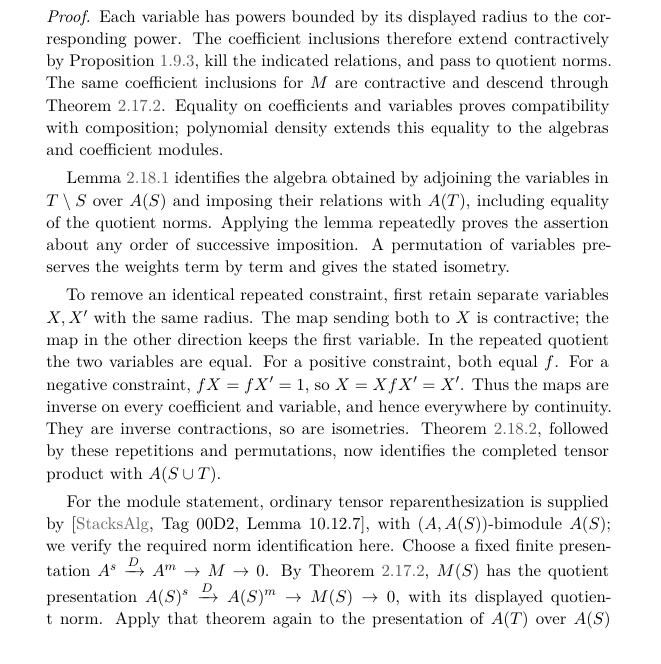
\bi{Each variable has powers bounded by its displayed radius to the corresponding power. The coefficient inclusions therefore extend contractively by Proposition~\ref{fnd:powerboundedsubstitution}, kill the indicated relations, and pass to quotient norms. The same coefficient inclusions for $M$ are contractive and descend through Theorem~\ref{fnd:strictquotientmodule}. Equality on coefficients and variables proves compatibility with composition; polynomial density extends this equality to the algebras and coefficient modules.}
{每个变量的幂的范数都不超过相应半径的该次幂。因此由 Proposition~\ref{fnd:powerboundedsubstitution},系数包含可 contractively 延伸,并零化指定的关系,随后传到商范数。对 $M$ 的相应系数包含也为 contractive,并通过 Theorem~\ref{fnd:strictquotientmodule} 下降。在系数和变量上验证相等即得到复合相容性,再由多项式稠密性将相等推广到代数及系数模。}

\bi{Lemma~\ref{fnd:iteratedstrictquotients} identifies the algebra obtained by adjoining the variables in $T\setminus S$ over $A(S)$ and imposing their relations with $A(T)$, including equality of the quotient norms. Applying the lemma repeatedly proves the assertion about any order of successive imposition. A permutation of variables preserves the weights term by term and gives the stated isometry.}
{Lemma~\ref{fnd:iteratedstrictquotients} 将在 $A(S)$ 上添入 $T\setminus S$ 中的变量并施加其关系所得的代数与 $A(T)$ 相识别,并保证商范数相等。反复应用该引理,即得到任意顺序下依次施加约束的结论。变量置换逐项保持权重,因而给出所述等距同构。}

\bi{To remove an identical repeated constraint, first retain separate variables $X,X'$ with the same radius. The map sending both to $X$ is contractive; the map in the other direction keeps the first variable. In the repeated quotient the two variables are equal. For a positive constraint, both equal $f$. For a negative constraint, $fX=fX'=1$, so $X=XfX'=X'$. Thus the maps are inverse on every coefficient and variable, and hence everywhere by continuity. They are inverse contractions, so are isometries. Theorem~\ref{fnd:strictpresentationpushout}, followed by these repetitions and permutations, now identifies the completed tensor product with $A(S\cup T)$.}
{为消去完全相同的重复约束,先保留具有同一半径的两个变量 $X,X'$。将它们都送到 $X$ 的映射为 contractive;反方向的映射则保留第一个变量。在重复约束的商中,这两个变量相等:对正约束,二者均等于 $f$;对负约束,有 $fX=fX'=1$,故 $X=XfX'=X'$。因此两个映射在每个系数和变量上互逆,再由连续性知其处处互逆。它们为互逆的 contractions,因而等距。现在应用 Theorem~\ref{fnd:strictpresentationpushout},再结合上述重复约束与置换识别,即将完备张量积识别为 $A(S\cup T)$。}

\bi{For the module statement, ordinary tensor reparenthesization is supplied by \cite[Tag 00D2, Lemma 10.12.7]{StacksAlg}, with $(A,A(S))$-bimodule $A(S)$; we verify the required norm identification here. Choose a fixed finite presentation $A^s\xrightarrow{D}A^m\to M\to0$. By Theorem~\ref{fnd:strictquotientmodule}, $M(S)$ has the quotient presentation $A(S)^s\xrightarrow{D}A(S)^m\to M(S)\to0$, with its displayed quotient norm. Apply that theorem again to the presentation of $A(T)$ over $A(S)$ supplied by Lemma~\ref{fnd:iteratedstrictquotients}. Both resulting modules have the quotient presentation $A(T)^s\xrightarrow{D}A(T)^m$ and the same norm from $A(T)^m$. This gives the asserted isometries, with $a\otimes(b\otimes m)$ corresponding to $ab\otimes m$. All identities of maps are checked on these generating tensors. If $A(S)=0$, its further relation quotients and all unital modules are zero, so these assertions hold directly.}
{对模的结论,普通张量积的重新结合由 \cite[Tag 00D2, Lemma 10.12.7]{StacksAlg} 给出,其中取 $(A,A(S))$-双模 $A(S)$;这里验证所需的范数识别。固定有限表示 $A^s\xrightarrow{D}A^m\to M\to0$。由 Theorem~\ref{fnd:strictquotientmodule},$M(S)$ 具有商表示 $A(S)^s\xrightarrow{D}A(S)^m\to M(S)\to0$,并配备所列商范数。再将该定理应用于 Lemma~\ref{fnd:iteratedstrictquotients} 给出的 $A(T)$ 在 $A(S)$ 上的表示。所得两个模均具有商表示 $A(T)^s\xrightarrow{D}A(T)^m$,且都使用来自 $A(T)^m$ 的同一个范数。因此得到所述等距同构,其中 $a\otimes(b\otimes m)$ 对应于 $ab\otimes m$。所有映射恒等式均可在这些生成张量上核对。若 $A(S)=0$,它的进一步关系商以及所有含幺模均为零,所述结论直接成立。}
\end{proof}
Standing context 1 · exact TeX
\bi{The preceding quotient construction permits a direct comparison of presentations. We first show that adjoining a second block of variables commutes with taking a quotient, with equality of the resulting norms. We then identify the coefficient Laurent sequence with a sequence of finite modules over explicit strict affinoid quotient algebras. These are statements about Banach algebras and modules; identifying them with sections on analytic domains requires the geometric localization theorem.}
{前面的商构造使我们能够直接比较不同表示。先证明添入第二组变量与取商相容,并且所得范数相等;随后将系数 Laurent 序列识别为一列显式 strict affinoid 商代数上的有限模。这里的结论属于 Banach 代数与模的范畴;将它们识别为解析域上的截面,还需要几何局部化定理。}

\bi{Throughout this section, $K$ is complete for its fixed real-valued non-Archimedean absolute value, which may be trivial, and $A$ is a strict $K$-affinoid algebra with the norm conventions of Lemma~\ref{fnd:strictweightedquotient}. All displayed radii belong to $|K^\times|$. A relation quotient is either a strict affinoid algebra or the zero algebra with its zero norm. The latter is allowed in this section as a separate case; it does not satisfy the normalization $\|1\|=1$ in Definition~\ref{fnd:banachalgebra}. Every unital module over it is zero. All quotients below use the actual algebraic ideals or submodules, and their indicated quotient norms.}
{本节中,$K$ 关于固定的实值非阿基米德绝对值完备,允许赋值平凡;$A$ 为 strict $K$-affinoid algebra,采用 Lemma~\ref{fnd:strictweightedquotient} 的范数约定。所有出现的半径均属于 $|K^\times|$。关系商可能是 strict affinoid algebra,也可能是配备零范数的零代数;本节将后者作为独立情形允许在内,它并不满足 Definition~\ref{fnd:banachalgebra} 中的归一化 $\|1\|=1$。零代数上的每个含幺模均为零。以下各商均使用实际的代数理想或子模,并配备指定的商范数。}
Typeset reader excerpt
Typed proof inputs
- STACKS-00D2:ordinary-associator@NAG-001440 · named external application
- CLAUSE:NAG-001440:fixed_quotients_and_restrictions · typed target unresolved in this export (selected rule)
- CLAUSE:NAG-001440:ordinary_and_completed_finite_module_comparison · typed target unresolved in this export (selected rule)
- CLAUSE:NAG-001440:separated_completed_algebra_pushout · typed target unresolved in this export (selected rule)
- CLAUSE:NAG-001440:fixed_quotients_and_restrictions · typed target unresolved in this export
- CLAUSE:NAG-001440:fixed_quotients_and_restrictions · typed target unresolved in this export (requires)
- CLAUSE:NAG-001440:ordinary_and_completed_finite_module_comparison · typed target unresolved in this export
- CLAUSE:NAG-001440:ordinary_and_completed_finite_module_comparison · typed target unresolved in this export (requires)
- CLAUSE:NAG-001440:separated_completed_algebra_pushout · typed target unresolved in this export
- CLAUSE:NAG-001440:separated_completed_algebra_pushout · typed target unresolved in this export (requires)
Reader cross-references
Proof map
Verified map inputs · NAG-001440
No addressable selected proof input is recorded in this projection.
NAG-001440 · Finite diagrams of elementary constraints · Chapter argument