NAG-001465 · Accepted whole
A rational quotient as an elementary chain
2 Analytic spaces, morphisms and fibres
Open in the English reader · PDF page 194
Statement · exact TeX
\begin{lemma}[\bi{A rational quotient as an elementary chain}{Rational 商的 elementary 链表示}]\label{fnd:rationalfiniteelementary}
\bi{Let $B=A\langle f/g\rangle$ and choose}
{设 $B=A\langle f/g\rangle$,并选择}
\[
 a_0g+\sum_{j=1}^s a_jf_j=1.
\]
\bi{Choose $a\in K^\times$ with $|a|\max_{0\leq j\leq s}\|a_j\|\leq1$. Such a choice is always possible for nontrivial valuation. For trivial valuation use a defining quotient norm on $A$ and take $a=1$; this replaces any given admissible norm by a uniformly equivalent one. The following isometry uses the norm for which the stated scalar inequality holds. Put}
{选择 $a\in K^\times$ 使 $|a|\max_{0\leq j\leq s}\|a_j\|\leq1$。赋值非平凡时总可以如此选择。赋值平凡时,在 $A$ 上使用定义商范数并取 $a=1$;这是将任意给定的 admissible 范数换成一致等价的范数。下面的等距断言使用满足上述标量不等式的范数。令}
\[
 \begin{aligned}
 C_0&=A\{U\}/(gU-a),\\
 h_j&=f_j\bar U/a\in C_0,\\
 C_1&=C_0\{V_1,\ldots,V_s\}/(V_j-h_j)_j.
 \end{aligned}
\]
\bi{There is an isometric $A$-algebra isomorphism $B\simeq C_1$ sending $T_j$ to $V_j$. Consequently $A\to B$ is algebraically flat. It preserves short exact sequences of finite canonical $A$-modules under ordinary or separated completed tensor product; the resulting sequences are norm-strict. The assertion about completed tensor products is restricted to these finite modules.}
{存在将 $T_j$ 送到 $V_j$ 的等距 $A$-代数同构 $B\simeq C_1$。因此 $A\to B$ 为代数平坦映射。有限 canonical $A$-模的短正合列,在普通或 separated completed tensor 下仍然正合,所得序列为 norm-strict。关于 completed tensor 的断言限于这些有限模。}
\end{lemma}
Full selected proof · exact TeX
\begin{proof}
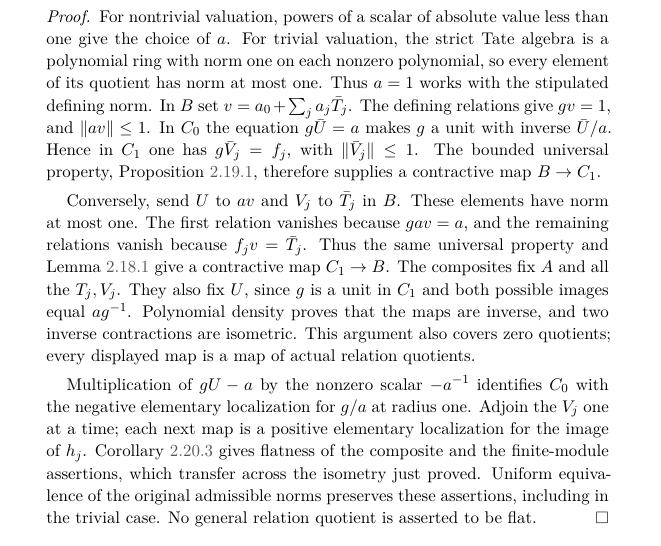
\bi{For nontrivial valuation, powers of a scalar of absolute value less than one give the choice of $a$. For trivial valuation, the strict Tate algebra is a polynomial ring with norm one on each nonzero polynomial, so every element of its quotient has norm at most one. Thus $a=1$ works with the stipulated defining norm. In $B$ set $v=a_0+\sum_j a_j\bar T_j$. The defining relations give $gv=1$, and $\|av\|\leq1$. In $C_0$ the equation $g\bar U=a$ makes $g$ a unit with inverse $\bar U/a$. Hence in $C_1$ one has $g\bar V_j=f_j$, with $\|\bar V_j\|\leq1$. The bounded universal property, Proposition~\ref{fnd:strictquotientboundedup}, therefore supplies a contractive map $B\to C_1$.}
{赋值非平凡时,取绝对值小于一的标量的高次幂,即可作出 $a$ 的选择。赋值平凡时,strict Tate 代数就是多项式环,且每个非零多项式范数为一,因此其商中的每个元素范数至多为一。故在所指定的定义范数下可取 $a=1$。在 $B$ 中令 $v=a_0+\sum_j a_j\bar T_j$。定义关系给出 $gv=1$,且 $\|av\|\leq1$。在 $C_0$ 中,等式 $g\bar U=a$ 使 $g$ 成为单位,其逆为 $\bar U/a$。于是 $C_1$ 中有 $g\bar V_j=f_j$,并且 $\|\bar V_j\|\leq1$。因此由 bounded universal property,即 Proposition~\ref{fnd:strictquotientboundedup},得到 contractive 映射 $B\to C_1$。}

\bi{Conversely, send $U$ to $av$ and $V_j$ to $\bar T_j$ in $B$. These elements have norm at most one. The first relation vanishes because $gav=a$, and the remaining relations vanish because $f_jv=\bar T_j$. Thus the same universal property and Lemma~\ref{fnd:iteratedstrictquotients} give a contractive map $C_1\to B$. The composites fix $A$ and all the $T_j,V_j$. They also fix $U$, since $g$ is a unit in $C_1$ and both possible images equal $ag^{-1}$. Polynomial density proves that the maps are inverse, and two inverse contractions are isometric. This argument also covers zero quotients; every displayed map is a map of actual relation quotients.}
{反方向,将 $U$ 送到 $B$ 中的 $av$,并将 $V_j$ 送到 $\bar T_j$。这些元素的范数均至多为一。由 $gav=a$,第一个关系被零化;由 $f_jv=\bar T_j$,其余关系也被零化。因此由同一 universal property 及 Lemma~\ref{fnd:iteratedstrictquotients},得到 contractive 映射 $C_1\to B$。两个复合固定 $A$ 和所有 $T_j,V_j$。它们也固定 $U$,因为 $g$ 在 $C_1$ 中为单位,而两个可能的像都等于 $ag^{-1}$。由多项式稠密性,两映射互逆;互逆的 contractions 必为等距同构。这个论证也包括零商,所列映射均定义在实际关系商上。}

\bi{Multiplication of $gU-a$ by the nonzero scalar $-a^{-1}$ identifies $C_0$ with the negative elementary localization for $g/a$ at radius one. Adjoin the $V_j$ one at a time; each next map is a positive elementary localization for the image of $h_j$. Corollary~\ref{fnd:finiteelementaryflatness} gives flatness of the composite and the finite-module assertions, which transfer across the isometry just proved. Uniform equivalence of the original admissible norms preserves these assertions, including in the trivial case. No general relation quotient is asserted to be flat.}
{将 $gU-a$ 乘以非零标量 $-a^{-1}$,可将 $C_0$ 识别为 $g/a$ 在半径一处的负 elementary 局部化。再逐个添入 $V_j$;每一步都是相应 $h_j$ 的像所定义的正 elementary 局部化。Corollary~\ref{fnd:finiteelementaryflatness} 给出复合映射的平坦性和有限模断言,再通过刚证明的等距同构传递即可。原 admissible 范数的一致等价保持这些结论,包括平凡赋值情形。这里并未声称一般关系商都平坦。}
\end{proof}
Standing context 1 · exact TeX
\bi{We work over a complete non-Archimedean field $K$, allowing trivial valuation except in the small-scalar lemmas where nontriviality is stated. Every nonzero algebra has a strict norm-admissible Banach norm, and every relation quotient has its actual quotient norm. The zero algebra is admitted separately with its zero norm. All radii in this section are one; a radius in $|K^\times|$ can first be reduced to this convention by scaling the corresponding numerator. These conventions concern the displayed presentations, not a spectral norm.}
{本节在完备非阿基米德域 $K$ 上工作,允许赋值平凡;使用小标量的引理会明确要求赋值非平凡。每个非零代数配备 strict norm-admissible Banach 范数,每个关系商配备实际商范数。零代数另以零范数允许在内。本节所有半径均为一;值群 $|K^\times|$ 中的半径可先通过缩放相应分子化为这一约定。这些约定涉及所列表示,并不使用 spectral 范数。}

\bi{For a tuple $g,f_1,\ldots,f_s$ generating the unit ideal of $A$, write}
{对生成 $A$ 的单位理想的 tuple $g,f_1,\ldots,f_s$,记}
\[
 A\langle f/g\rangle
   =A\{T_1,\ldots,T_s\}/(gT_j-f_j)_{1\leq j\leq s}.
\]
\bi{For a unit-ideal tuple $f_0,\ldots,f_r$, its \emph{standard rational family} consists of the $r+1$ presentations}
{对生成单位理想的 tuple $f_0,\ldots,f_r$,其\emph{标准 rational 族}由以下 $r+1$ 个表示组成:}
\[
 R_i=A\{T_j:j\ne i\}/(f_iT_j-f_j)_{j\ne i},
 \qquad 0\leq i\leq r.
\]
\bi{We put $T_i=1$ when using a formula involving all indices. The joint presentation of a finite family means the quotient with disjoint variable blocks and all their relations. Theorem~\ref{fnd:strictpresentationpushout} identifies it with the separated completed tensor product. Its module attached to a finite $A$-module $M$ is its ordinary tensor with $M$, equipped with the quotient norm from a fixed finite free presentation of $M$. Theorem~\ref{fnd:strictquotientmodule} gives its comparison with the completed tensor. These choices specify the arrows and norms before a geometric sheaf is available.}
{若某个公式涉及全部指标,约定 $T_i=1$。有限族的联合表示,是指添入互不相交的变量组并施加全部关系后所得的商。Theorem~\ref{fnd:strictpresentationpushout} 将它与 separated completed tensor product 识别。对有限 $A$-模 $M$,相应模是该商与 $M$ 的普通张量积,并配备来自 $M$ 的一个固定有限自由表示的商范数。Theorem~\ref{fnd:strictquotientmodule} 给出它与 completed tensor 的比较。因此,在尚未构造几何层之前,所有箭头及范数已有明确含义。}
Typeset reader excerpt
Typed proof inputs
- CLAUSE:NAG-001442:strict_actual_quotient_bounded_substitution · selected scope (sealed exact native clause)
- NAG-001434 · selected whole (sealed native whole)
- NAG-001437 · selected whole (sealed native whole)
- NAG-001448 · selected whole (ordered native whole proposal)
- CLAUSE:NAG-001442:strict_actual_quotient_bounded_substitution · selected scope
- CLAUSE:NAG-001442:strict_actual_quotient_bounded_substitution · selected scope (requires)
- NAG-001434 · selected whole
- NAG-001434 · selected whole (requires)
- NAG-001437 · selected whole
- NAG-001437 · selected whole (requires)
- NAG-001448 · selected whole
- NAG-001448 · selected whole (requires)
Reader cross-references
Proof map
Verified map inputs · NAG-001465
AND · joint registered proof inputs
- CLAUSE:NAG-001442:strict_actual_quotient_bounded_substitution · strict actual quotient bounded substitution · selected scope Exact source window 43–47
- NAG-001434 · Strict weighted adjunction and relation quotients · accepted whole Exact source window 43–50
- NAG-001437 · Adjoining variables after a quotient · accepted whole Exact source window 46–47
- NAG-001448 · Finite compositions of elementary localizations · accepted whole Exact source window 49–50
NAG-001465 · A rational quotient as an elementary chain · Chapter argument