one closed presentation with finite extra radii
Scope in the English reader · PDF page 106
Statement and full selected proof · exact TeX
\begin{theorem}[\bi{Simultaneous strictification of closed presentations}{闭表示的同时 strictification}]\label{fnd:simultaneousstrictification}
\bi{Fix a finite family of norm-admissible generalized $K$-affinoids $A_j$, each with a specified presentation}
{固定有限族 norm-admissible generalized $K$-affinoids $A_j$,各自指定表示为}
\[
 D_j=K\{s_j^{-1}X_j\}\twoheadrightarrow A_j,
 \qquad I_j=\ker(D_j\to A_j)\text{ closed},
 \qquad 1\leq j\leq m.
\]
\bi{Also fix any finite list of additional positive radii $\eta_1,\ldots,\eta_t$. There is a finite $K$-free tuple $r$, with $L=K_r$, such that every entry of every $s_j$ and every $\eta_k$ belongs to $\Gamma_L^{\mathrm{div}}$. For this one extension, each $D_{j,r}=D_j\widehat\otimes_K L$ and each nonzero $A_{j,r}=A_j\widehat\otimes_K L$ is strict norm-admissible over $L$, and}
{另固定任意有限个正半径 $\eta_1,\ldots,\eta_t$。存在有限的 $K$-自由元组 $r$,令 $L=K_r$,使每个 $s_j$ 的所有分量以及每个 $\eta_k$ 都属于 $\Gamma_L^{\mathrm{div}}$。对这一共同扩张,每个 $D_{j,r}=D_j\widehat\otimes_K L$ 以及每个非零的 $A_{j,r}=A_j\widehat\otimes_K L$ 都在 $L$ 上 strict norm-admissible,并有}
\[
 \begin{gathered}
 D_{j,r}\simeq L\{s_j^{-1}X_j\},\\
 \ker(D_{j,r}\to A_{j,r})
    =\mathcal C_{r^\nu}(\mathbf Z^d,I_j)
    =\overline{I_jD_{j,r}}=I_jD_{j,r},\\
 A_{j,r}\simeq D_{j,r}/I_jD_{j,r}.
 \end{gathered}
\]
\bi{Here $I_jD_{j,r}$ is the actual algebraic extension ideal; it is finitely generated and closed. The last quotient has exactly the coefficient norm if $A_j$ has its displayed quotient norm, and uniformly equivalent norms otherwise. Zero quotients use the zero-norm convention and are detected by the isometric constant embedding. Any finite diagram of bounded maps between the $A_j$ extends over this same $L$. The theorem does not assume ordinary flatness of $A_j\to A_{j,r}$ or Noetherianity of the original $A_j$, and it makes neither conclusion part of the statement.}
{这里 $I_jD_{j,r}$ 是实际的代数扩张理想,有限生成且闭。若 $A_j$ 使用所列商范数,则最后这个商的范数恰为系数范数;否则两者一致等价。零商使用零范数约定,并可由等距常系数嵌入检测。$A_j$ 之间的任意有限有界映射图都在这一共同的 $L$ 上扩张。定理不假设 $A_j\to A_{j,r}$ 的普通平坦性,也不假设原 $A_j$ 的 Noetherianity,且不将这两个结论列入本定理。}
\end{theorem}
\begin{proof}
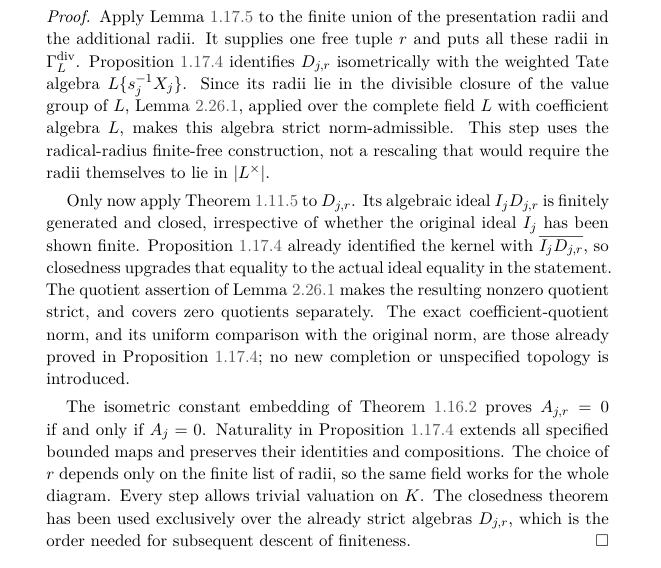
\bi{Apply Lemma~\ref{fnd:finitebatchradiuschoice} to the finite union of the presentation radii and the additional radii. It supplies one free tuple $r$ and puts all these radii in $\Gamma_L^{\mathrm{div}}$. Proposition~\ref{fnd:freeextensionpresentation} identifies $D_{j,r}$ isometrically with the weighted Tate algebra $L\{s_j^{-1}X_j\}$. Since its radii lie in the divisible closure of the value group of $L$, Lemma~\ref{fnd:radicalradiusaffinoid}, applied over the complete field $L$ with coefficient algebra $L$, makes this algebra strict norm-admissible. This step uses the radical-radius finite-free construction, not a rescaling that would require the radii themselves to lie in $|L^\times|$.}
{对所有表示半径以及额外半径组成的有限列表应用 Lemma~\ref{fnd:finitebatchradiuschoice}。它给出一个自由元组 $r$,使这些半径全属于 $\Gamma_L^{\mathrm{div}}$。由 Proposition~\ref{fnd:freeextensionpresentation},$D_{j,r}$ 与加权 Tate 代数 $L\{s_j^{-1}X_j\}$ 等距。其半径属于 $L$ 值群的可除闭包,因此在完备基域 $L$ 上、以 $L$ 为系数代数应用 Lemma~\ref{fnd:radicalradiusaffinoid},得到这个代数 strict norm-admissible。这一步使用可除闭包半径的有限自由构造,并非要求半径本身属于 $|L^\times|$ 的变量缩放。}

\bi{Only now apply Theorem~\ref{fnd:strictfinitemodules} to $D_{j,r}$. Its algebraic ideal $I_jD_{j,r}$ is finitely generated and closed, irrespective of whether the original ideal $I_j$ has been shown finite. Proposition~\ref{fnd:freeextensionpresentation} already identified the kernel with $\overline{I_jD_{j,r}}$, so closedness upgrades that equality to the actual ideal equality in the statement. The quotient assertion of Lemma~\ref{fnd:radicalradiusaffinoid} makes the resulting nonzero quotient strict, and covers zero quotients separately. The exact coefficient-quotient norm, and its uniform comparison with the original norm, are those already proved in Proposition~\ref{fnd:freeextensionpresentation}; no new completion or unspecified topology is introduced.}
{到此才对 $D_{j,r}$ 应用 Theorem~\ref{fnd:strictfinitemodules}。其代数理想 $I_jD_{j,r}$ 有限生成且闭,无论原理想 $I_j$ 是否已经证明有限。Proposition~\ref{fnd:freeextensionpresentation} 已将核识别为 $\overline{I_jD_{j,r}}$,故由闭合性将这个等式加强为陈述中的实际理想等式。Lemma~\ref{fnd:radicalradiusaffinoid} 的商结论说明所得非零商为 strict,并另涵盖零商。精确系数商范数以及与原范数的一致比较,均已在 Proposition~\ref{fnd:freeextensionpresentation} 中证明;这里没有引入新的完备化或未指定的拓扑。}

\bi{The isometric constant embedding of Theorem~\ref{fnd:freepolyradiuscoefficients} proves $A_{j,r}=0$ if and only if $A_j=0$. Naturality in Proposition~\ref{fnd:freeextensionpresentation} extends all specified bounded maps and preserves their identities and compositions. The choice of $r$ depends only on the finite list of radii, so the same field works for the whole diagram. Every step allows trivial valuation on $K$. The closedness theorem has been used exclusively over the already strict algebras $D_{j,r}$, which is the order needed for subsequent descent of finiteness.}
{由 Theorem~\ref{fnd:freepolyradiuscoefficients} 的等距常系数嵌入,$A_{j,r}=0$ 当且仅当 $A_j=0$。Proposition~\ref{fnd:freeextensionpresentation} 的自然性扩张所有指定有界映射,并保持其恒等式及复合。$r$ 的选择只依赖有限个半径,因此同一域适用于整个图。每一步都允许 $K$ 赋值平凡。闭合性定理只在已经 strict 的代数 $D_{j,r}$ 上使用,这正是随后下降有限性时所需的依赖次序。}
\end{proof}
- CLAUSE:NAG-001506:finite-free-strictness-and-first-actual-quotient · typed target unresolved in this export
- CLAUSE:NAG-001506:finite-free-strictness-and-first-actual-quotient · typed target unresolved in this export (requires)
- CLAUSE:NAG-001555:ambient-identification-and-defining-kernel · typed target unresolved in this export
- CLAUSE:NAG-001555:ambient-identification-and-defining-kernel · typed target unresolved in this export (requires)
- NAG-001403 · selected whole
- NAG-001403 · selected whole (requires)
- NAG-001549 · selected whole
- NAG-001549 · selected whole (requires)
- NAG-001556 · selected whole
- NAG-001556 · selected whole (requires)