NAG-001561 · Accepted whole
Canonical norms and exactness for finite modules
1 Valued fields, Banach algebras and analytic points
Open in the English reader · PDF page 110
Statement · exact TeX
\begin{theorem}[\bi{Canonical norms and exactness for finite modules}{有限模的典范范数与正合性}]\label{fnd:generalizedfinitemodules}
\bi{Let $A$ be a generalized $K$-affinoid algebra. Every finite algebraic $A$-module $M$ has a definite complete norm obtained from a surjection $q:A^m\twoheadrightarrow M$. These quotient norms are uniformly equivalent; a norm uniformly equivalent to one of them is called a canonical finite-module norm. Every algebraic submodule of $M$ is finite and closed, and its induced norm is canonical. Every $A$-linear map between finite modules with canonical norms is bounded, has closed image, and is norm-strict onto its image. In particular every short exact sequence of finite modules is a norm-strict exact sequence of Banach $K$-spaces. These assertions include trivially valued $K$.}
{设 $A$ 为 generalized $K$-affinoid 代数。每个代数有限 $A$-模 $M$ 都可由满射 $q:A^m\twoheadrightarrow M$ 获得正定完备的商范数。这些商范数一致等价;与其中一个商范数一致等价的范数称为典范有限模范数。$M$ 的每个代数子模都有限且闭,其诱导范数为典范范数。带典范范数的有限模之间的每个 $A$-线性映射都有界、具有闭像,并且到其像为 norm-strict。特别地,有限模的每个短正合列都是 Banach $K$-空间的 norm-strict 正合列。这些断言包括赋值平凡的 $K$。}
\end{theorem}
Full selected proof · exact TeX
\begin{proof}
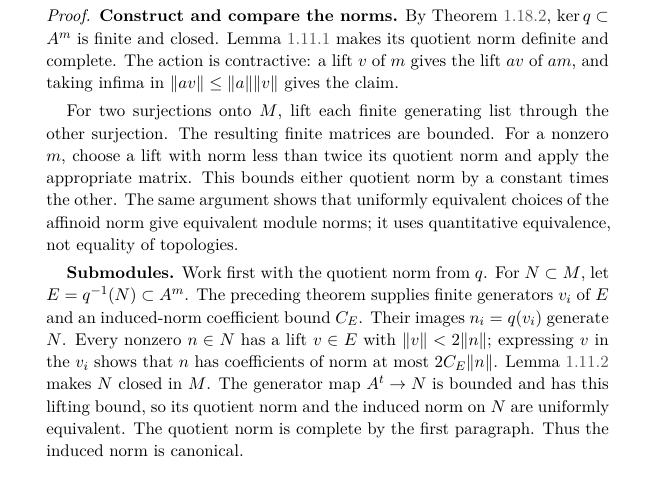
\bi{\textbf{Construct and compare the norms.} By Theorem~\ref{fnd:generalizedclosedsubmodules}, $\ker q\subset A^m$ is finite and closed. Lemma~\ref{fnd:completequotient} makes its quotient norm definite and complete. The action is contractive: a lift $v$ of $m$ gives the lift $av$ of $am$, and taking infima in $\|av\|\leq\|a\|\|v\|$ gives the claim.}
{\textbf{构造与比较范数。} 由 Theorem~\ref{fnd:generalizedclosedsubmodules},$\ker q\subset A^m$ 有限且闭。Lemma~\ref{fnd:completequotient} 保证商范数正定且完备。模作用为 contractive:$m$ 的提升 $v$ 给出 $am$ 的提升 $av$,对 $\|av\|\leq\|a\|\|v\|$ 取下确界即得结论。}

\bi{For two surjections onto $M$, lift each finite generating list through the other surjection. The resulting finite matrices are bounded. For a nonzero $m$, choose a lift with norm less than twice its quotient norm and apply the appropriate matrix. This bounds either quotient norm by a constant times the other. The same argument shows that uniformly equivalent choices of the affinoid norm give equivalent module norms; it uses quantitative equivalence, not equality of topologies.}
{对到 $M$ 的两个满射,将各自的有限生成元组通过另一个满射提升。所得有限矩阵有界。对非零 $m$,选择范数小于其商范数两倍的提升,再施加相应矩阵,就得到任一商范数不超过另一商范数乘以常数。同一论证说明:若 affinoid 范数一致等价,则所得模范数也一致等价;这里使用的是定量等价,而非仅仅拓扑相同。}

\bi{\textbf{Submodules.} Work first with the quotient norm from $q$. For $N\subset M$, let $E=q^{-1}(N)\subset A^m$. The preceding theorem supplies finite generators $v_i$ of $E$ and an induced-norm coefficient bound $C_E$. Their images $n_i=q(v_i)$ generate $N$. Every nonzero $n\in N$ has a lift $v\in E$ with $\|v\|<2\|n\|$; expressing $v$ in the $v_i$ shows that $n$ has coefficients of norm at most $2C_E\|n\|$. Lemma~\ref{fnd:controlledclosed} makes $N$ closed in $M$. The generator map $A^t\to N$ is bounded and has this lifting bound, so its quotient norm and the induced norm on $N$ are uniformly equivalent. The quotient norm is complete by the first paragraph. Thus the induced norm is canonical.}
{\textbf{子模。} 先使用由 $q$ 给出的商范数。对 $N\subset M$,令 $E=q^{-1}(N)\subset A^m$。前一定理给出 $E$ 的有限生成元 $v_i$ 及相对于诱导范数的系数界 $C_E$。其像 $n_i=q(v_i)$ 生成 $N$。每个非零 $n\in N$ 都有提升 $v\in E$,满足 $\|v\|<2\|n\|$;将 $v$ 用 $v_i$ 表示,即得到 $n$ 的系数范数至多为 $2C_E\|n\|$。由 Lemma~\ref{fnd:controlledclosed},$N$ 在 $M$ 中闭。生成映射 $A^t\to N$ 有界且具有上述提升界,所以其商范数与 $N$ 的诱导范数一致等价。由第一段,该商范数完备,因此诱导范数为典范范数。}

\bi{\textbf{Maps.} An algebraic map $u:M\to M'$ is bounded by expressing an element of $M$ through a controlled lift to a finite free presentation and bounding the images of its generators. Its image $P$ is a finite closed submodule of $M'$ by the preceding paragraph. Choose controlled generators $p_i$ of $P$ and arbitrary lifts $m_i\in M$. If $p=\sum_i a_ip_i$ with $\max_i\|a_i\|\leq C_P\|p\|$, then $\sum_i a_im_i$ lifts $p$ and has norm at most $C_P\max_i\|m_i\|\|p\|$. This proves norm-strictness. Its kernel is finite and closed as well. Replacing any chosen quotient norm by an equivalent canonical norm changes only the constants. Applying these statements to the arrows of a short exact sequence proves the last assertion.}
{\textbf{映射。} 对代数映射 $u:M\to M'$,通过有限自由表示中的有界提升来表示 $M$ 的元素,再控制有限个生成元的像,即证明 $u$ 有界。由上一段,其像 $P$ 是 $M'$ 的有限闭子模。为 $P$ 选取具有系数控制的生成元 $p_i$,并任取其提升 $m_i\in M$。若 $p=\sum_i a_ip_i$ 且 $\max_i\|a_i\|\leq C_P\|p\|$,则 $\sum_i a_im_i$ 提升 $p$,其范数至多为 $C_P\max_i\|m_i\|\|p\|$。这证明 norm-strictness。映射的核同样有限且闭。将任一所选商范数换成等价的典范范数只改变常数。对短正合列的箭头应用这些结论,即得最后的断言。}
\end{proof}
Typeset reader excerpt
Typed proof inputs
- NAG-001380 · selected whole (direct operational uses)
- NAG-001381 · selected whole (direct operational uses)
- NAG-001560 · selected whole (direct operational uses)
- BASE-LINEAR · standing context or base
- BASE-LINEAR · standing context or base (requires)
- BASE-REAL · standing context or base
- BASE-REAL · standing context or base (requires)
- BASE-RINGS · standing context or base
- BASE-RINGS · standing context or base (requires)
- BASE-SETS · standing context or base
- BASE-SETS · standing context or base (requires)
- BASE-TOPOLOGY · standing context or base
- BASE-TOPOLOGY · standing context or base (requires)
- NAG-001380 · selected whole
- NAG-001380 · selected whole (requires)
- NAG-001381 · selected whole
- NAG-001381 · selected whole (requires)
- NAG-001560 · selected whole
- NAG-001560 · selected whole (requires)
Reader cross-references
Proof map
Verified map inputs · NAG-001561
AND · joint registered proof inputs
- NAG-001380 · Complete quotients · accepted whole
- NAG-001381 · A closedness criterion · accepted whole
- NAG-001560 · Closed submodules and controlled matrix images · accepted whole
NAG-001561 · Canonical norms and exactness for finite modules · Chapter argument