NAG-001563 · Accepted whole
Finite presentations in weighted coefficient spaces
1 Valued fields, Banach algebras and analytic points
Open in the English reader · PDF page 111
Statement · exact TeX
\begin{theorem}[\bi{Finite presentations in weighted coefficient spaces}{加权系数空间中的有限表示}]\label{fnd:generalizedcoefficientpresentation}
\bi{Let $A$ be a generalized $K$-affinoid algebra and choose a finite presentation}
{设 $A$ 为 generalized $K$-affinoid 代数,并选取有限表示}
\[
 A^s\xrightarrow{D}A^m\xrightarrow{q}M\longrightarrow0,
 \qquad R=\ker q.
\]
\bi{Give $M$ the quotient norm from $q$ and $R$ the induced norm from $A^m$. For any countable set $I$ and positive weights $w_i$, let $\mathcal C_w(I,E)$ denote weighted $c_0$ coefficient families in a Banach space $E$. Then}
{给 $M$ 配备来自 $q$ 的商范数,给 $R$ 配备来自 $A^m$ 的诱导范数。对任意可数集合 $I$ 和正权重 $w_i$,以 $\mathcal C_w(I,E)$ 表示 Banach 空间 $E$ 中的加权 $c_0$ 系数族。则}
\[
 \mathcal C_w(I,A)^s\xrightarrow{D_w}
 \mathcal C_w(I,A)^m\xrightarrow{q_w}
 \mathcal C_w(I,M)\longrightarrow0
\]
\bi{is exact, with}
{为正合列,且}
\[
 \operatorname{im}D_w=\mathcal C_w(I,R)=\ker q_w.
\]
\bi{This image is closed. If $C_D>0$ is an actual lifting bound for $D:A^s\to R$, the same bound works for $D_w$. The map $q_w$ induces an isometry from its normed quotient onto $\mathcal C_w(I,M)$; for every fixed $\lambda>1$, it admits actual lifts with bound $\lambda$. The constants are independent of $I$ and $w$.}
{这个像是闭的。若 $C_D>0$ 是 $D:A^s\to R$ 的实际提升界,则同一常数也适用于 $D_w$。映射 $q_w$ 从其赋范商到 $\mathcal C_w(I,M)$ 诱导等距同构;对每个固定 $\lambda>1$,它都有界为 $\lambda$ 的实际提升。这些常数不依赖 $I$ 和 $w$。}
\end{theorem}
Full selected proof · exact TeX
\begin{proof}
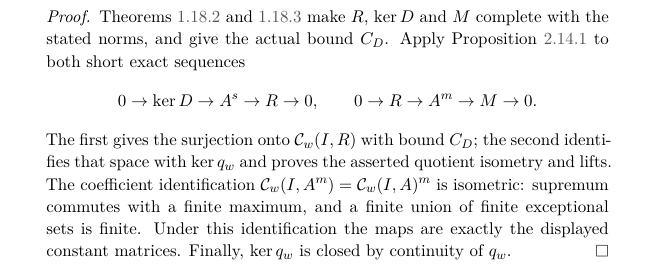
\bi{Theorems~\ref{fnd:generalizedclosedsubmodules} and~\ref{fnd:generalizedfinitemodules} make $R$, $\ker D$ and $M$ complete with the stated norms, and give the actual bound $C_D$. Apply Proposition~\ref{fnd:weightedc0exact} to both short exact sequences}
{由 Theorems~\ref{fnd:generalizedclosedsubmodules} 和~\ref{fnd:generalizedfinitemodules},$R$、$\ker D$ 和 $M$ 对所述范数均完备,并有实际提升界 $C_D$。对下列两个短正合列应用 Proposition~\ref{fnd:weightedc0exact}:}
\[
 0\to\ker D\to A^s\to R\to0,
 \qquad 0\to R\to A^m\to M\to0.
\]
\bi{The first gives the surjection onto $\mathcal C_w(I,R)$ with bound $C_D$; the second identifies that space with $\ker q_w$ and proves the asserted quotient isometry and lifts. The coefficient identification $\mathcal C_w(I,A^m)=\mathcal C_w(I,A)^m$ is isometric: supremum commutes with a finite maximum, and a finite union of finite exceptional sets is finite. Under this identification the maps are exactly the displayed constant matrices. Finally, $\ker q_w$ is closed by continuity of $q_w$.}
{第一个序列给出到 $\mathcal C_w(I,R)$ 的满射,提升界为 $C_D$;第二个序列将该空间识别为 $\ker q_w$,并证明所述商等距同构及提升。系数识别 $\mathcal C_w(I,A^m)=\mathcal C_w(I,A)^m$ 等距,因为上确界与有限最大值可交换,有限个有限例外集合的并仍有限。在此识别下,映射恰为所列常系数矩阵。最后,由 $q_w$ 连续,$\ker q_w$ 为闭子空间。}
\end{proof}
Typeset reader excerpt
Typed proof inputs
- NAG-001419 · selected whole (native applications)
- NAG-001560 · selected whole (native applications)
- NAG-001561 · selected whole (native applications)
- BASE-LINEAR · standing context or base
- BASE-LINEAR · standing context or base (requires)
- BASE-REAL · standing context or base
- BASE-REAL · standing context or base (requires)
- BASE-RINGS · standing context or base
- BASE-RINGS · standing context or base (requires)
- BASE-SETS · standing context or base
- BASE-SETS · standing context or base (requires)
- BASE-TOPOLOGY · standing context or base
- BASE-TOPOLOGY · standing context or base (requires)
- NAG-001419 · selected whole
- NAG-001419 · selected whole (requires)
- NAG-001560 · selected whole
- NAG-001560 · selected whole (requires)
- NAG-001561 · selected whole
- NAG-001561 · selected whole (requires)
Reader cross-references
Proof map
Verified map inputs · NAG-001563
AND · joint registered proof inputs
- NAG-001419 · Strict exactness with unchanged lifting bounds · accepted whole
- NAG-001560 · Closed submodules and controlled matrix images · accepted whole
- NAG-001561 · Canonical norms and exactness for finite modules · accepted whole
NAG-001563 · Finite presentations in weighted coefficient spaces · Chapter argument