NAG-001643 · Accepted whole
Bounded universal differentials
2 Analytic spaces, morphisms and fibres
Open in the English reader · PDF page 394
Statement · exact TeX
\begin{theorem}[\bi{Bounded universal differentials}{有界泛微分}]
\label{fnd:boundeduniversaldifferentials}
\bi{Let $A\to B$ be a bounded affinoid homomorphism and choose a norm-admissible relative presentation}
{设 $A\to B$ 为有界 affinoid 同态,选取 norm-admissible 相对表示}
\[
 P=A\{r^{-1}T\}\twoheadrightarrow B=P/I,\qquad
 I=(f_1,\ldots,f_m).
\]
\bi{The finite $B$-module}
{有限 $B$-模}
\[
 \Omega^{\mathrm{an}}_{B/A}
   =\left(\bigoplus_{j=1}^n B\,dT_j\right)
       \big/\left(\sum_{j=1}^n
              \frac{\partial f_i}{\partial T_j}\,dT_j:
              1\le i\le m\right)
\]
\bi{has a bounded $A$-derivation $d:B\to\Omega^{\mathrm{an}}_{B/A}$ which represents bounded $A$-derivations from $B$ to every complete Banach $B$-module whose action $B\times N\to N$ is bounded. In particular this applies to finite $B$-modules, and its canonical pair $(\Omega^{\mathrm{an}}_{B/A},d)$ is independent of the presentation.}
{具有有界 $A$-导子 $d:B\to\Omega^{\mathrm{an}}_{B/A}$,并代表从 $B$ 到任意作用 $B\times N\to N$ 有界的完备 Banach $B$-模的有界 $A$-导子。特别地,这适用于有限 $B$-模。因此,典范对 $(\Omega^{\mathrm{an}}_{B/A},d)$ 与表示选择无关。}
\end{theorem}
Full selected proof · exact TeX
\begin{proof}
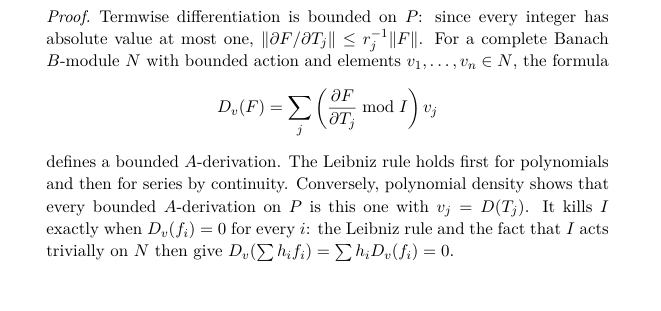
\bi{Termwise differentiation is bounded on $P$: since every integer has absolute value at most one, $\|\partial F/\partial T_j\|\le r_j^{-1}\|F\|$. For a complete Banach $B$-module $N$ with bounded action and elements $v_1,\ldots,v_n\in N$, the formula}
{逐项微分在 $P$ 上有界:每个整数的绝对值至多为一,故 $\|\partial F/\partial T_j\|\le r_j^{-1}\|F\|$。给定作用有界的完备 Banach $B$-模 $N$ 及元素 $v_1,\ldots,v_n\in N$,公式}
\[
 D_v(F)=\sum_j\left(\frac{\partial F}{\partial T_j}\bmod I\right)v_j
\]
\bi{defines a bounded $A$-derivation. The Leibniz rule holds first for polynomials and then for series by continuity. Conversely, polynomial density shows that every bounded $A$-derivation on $P$ is this one with $v_j=D(T_j)$. It kills $I$ exactly when $D_v(f_i)=0$ for every $i$: the Leibniz rule and the fact that $I$ acts trivially on $N$ then give $D_v(\sum h_if_i)=\sum h_iD_v(f_i)=0$.}
{定义一个有界 $A$-导子。Leibniz 法则先对多项式成立,再由连续性推广到级数。反之,多项式稠密性说明每个有界 $A$-导子均具有此形式,其中 $v_j=D(T_j)$。它消灭 $I$ 当且仅当对所有 $i$ 有 $D_v(f_i)=0$:由 Leibniz 法则及 $I$ 在 $N$ 上作用为零,得到 $D_v(\sum h_if_i)=\sum h_iD_v(f_i)=0$。}

\bi{A bounded map killing $I$ induces a bounded map on $B$ because the quotient is norm-admissible. The relation module in the displayed definition is closed by Theorem~\ref{fnd:generalizedclosedsubmodules}. Thus the quotient is a finite complete module. Every $B$-linear map from it to $N$ is bounded: take controlled coefficient lifts along a finite free presentation, and bound the images of the finitely many generators using the bounded action on $N$. We have therefore proved the natural bijection}
{由于商映射为 norm-admissible,消灭 $I$ 的有界映射在 $B$ 上诱导有界映射。由 Theorem~\ref{fnd:generalizedclosedsubmodules},所列定义中的关系子模闭,因此所得商为有限完备模。它到 $N$ 的每个 $B$-线性映射都有界:沿一个有限自由表示对系数作受控提升,再利用 $N$ 上作用的有界性,控制有限个生成元的像。于是得到自然双射}
\[
 \operatorname{Hom}_B(\Omega^{\mathrm{an}}_{B/A},N)
       \simeq\operatorname{Der}^{\mathrm{bd}}_A(B,N).
\]
\bi{Taking $N$ to be the two differential modules constructed from two presentations gives mutually inverse maps commuting with $d$. Uniqueness also proves compatibility with every further presentation change.}
{令 $N$ 分别为由两个表示构造的微分模,得到与 $d$ 相容的互逆映射。唯一性也证明它们与进一步改变表示相容。}
\end{proof}
Typeset reader excerpt
Typed proof inputs
- BASE-RINGS · standing context or base
- BASE-RINGS · standing context or base (requires)
- NAG-001560 · selected whole
- NAG-001560 · selected whole (requires)
- NAG-001561 · selected whole
- NAG-001561 · selected whole (requires)
- NAG-001687 · selected whole
- NAG-001687 · selected whole (requires)
Reader cross-references
Proof map
Verified map inputs · NAG-001643
AND · joint registered proof inputs
- NAG-001560 · Closed submodules and controlled matrix images · accepted whole
- NAG-001561 · Canonical norms and exactness for finite modules · accepted whole
- NAG-001687 · Generalized relative presentations · accepted whole
Standing context and base inputs
BASE-RINGS
NAG-001643 · Bounded universal differentials · Chapter argument