NAG-001660 · Accepted whole
The spectral kernel and free scalar extension
3 Reduction, formal models and residual geometry
Open in the English reader · PDF page 597
Statement · exact TeX
\begin{proposition}[\bi{The spectral kernel and free scalar extension}
{谱核与自由标量扩张}]
\label{fnd:spectralnilradicalinternal}
\bi{For every generalized $K$-affinoid algebra $A$, the kernel of its
spectral seminorm $\rho_A$ is its nilradical. If $A$ is reduced, every
free-radius scalar extension $A_r$ is reduced as well.}
{对每个 generalized $K$-affinoid 代数 $A$,谱半范数
$\rho_A$ 的核恰为其幂零根。若 $A$ 约化,则每个自由半径标量扩张
$A_r$ 也约化。}
\end{proposition}
Full selected proof · exact TeX
\begin{proof}
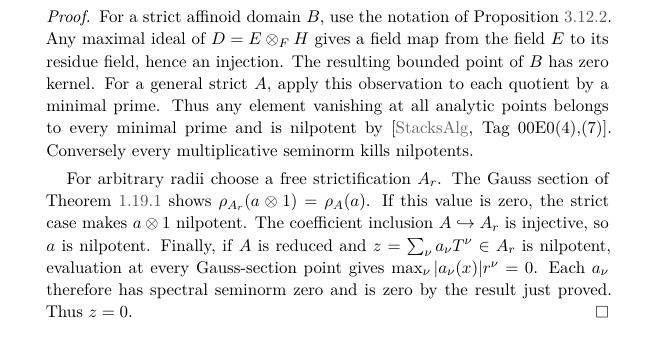
\bi{For a strict affinoid domain $B$, use the notation of
Proposition~\ref{fnd:normalizationfiniteboundary}. Any maximal ideal
of $D=E\otimes_F H$ gives a field map from the field $E$ to its
residue field, hence an injection. The resulting bounded point
of $B$ has zero kernel. For a general strict $A$, apply this
observation to each quotient by a minimal prime. Thus any element
vanishing at all analytic points belongs to every minimal prime
and is nilpotent by \cite[Tag 00E0(4),(7)]{StacksAlg}.
Conversely every multiplicative seminorm kills nilpotents.}
{对 strict affinoid 整环 $B$,采用
Proposition~\ref{fnd:normalizationfiniteboundary} 的记号。
$D=E\otimes_F H$ 的任一极大理想给出从域 $E$ 到其剩余域的域
同态,因而是单射。所以对应的 $B$ 的有界谱点具有零核。
对一般 strict $A$,将此论证应用于每个极小素理想商。
于是在全部解析点处为零的元素属于每个极小素理想,由
\cite[Tag 00E0(4),(7)]{StacksAlg} 为幂零元素。
反之,乘性半范数均消去幂零元素。}

\bi{For arbitrary radii choose a free strictification $A_r$.
The Gauss section of Theorem~\ref{fnd:freepolyradiusgausssection}
shows $\rho_{A_r}(a\otimes1)=\rho_A(a)$. If this value is zero,
the strict case makes $a\otimes1$ nilpotent. The coefficient
inclusion $A\hookrightarrow A_r$ is injective, so $a$ is nilpotent.
Finally, if $A$ is reduced and $z=\sum_\nu a_\nu T^\nu\in A_r$
is nilpotent, evaluation at every Gauss-section point gives
$\max_\nu|a_\nu(x)|r^\nu=0$. Each $a_\nu$ therefore has spectral
seminorm zero and is zero by the result just proved. Thus $z=0$.}
{对任意半径,选择自由 strictification $A_r$。
Theorem~\ref{fnd:freepolyradiusgausssection} 的 Gauss 截面给出
$\rho_{A_r}(a\otimes1)=\rho_A(a)$。若此值为零,strict 情形说明
$a\otimes1$ 幂零;系数包含 $A\hookrightarrow A_r$ 为单射,
故 $a$ 幂零。最后,设 $A$ 约化且
$z=\sum_\nu a_\nu T^\nu\in A_r$ 幂零。在每个 Gauss 截面点求值,
得到 $\max_\nu|a_\nu(x)|r^\nu=0$。每个 $a_\nu$ 的谱半范数均为
零,由刚证结果,$a_\nu=0$。于是 $z=0$。}
\end{proof}
Typeset reader excerpt
Typed proof inputs
- APP-STACKS-00E0@NAG-001660:Gauss-original-site-4 · named external application
- APP-STACKS-00E0@NAG-001660:Gauss-original-site-4 · named external application (requires)
- NAG-001403 · selected whole
- NAG-001403 · selected whole (requires)
- NAG-001434 · selected whole
- NAG-001434 · selected whole (requires)
- NAG-001451 · selected whole
- NAG-001451 · selected whole (requires)
- NAG-001549 · selected whole
- NAG-001549 · selected whole (requires)
- NAG-001557 · selected whole
- NAG-001557 · selected whole (requires)
- NAG-001569 · selected whole
- NAG-001569 · selected whole (requires)
- NAG-001902 · selected whole
- NAG-001902 · selected whole (requires)
- SUPPORT:NAG-001574:spectral_limit_and_bounded_point_max · typed target unresolved in this export
- SUPPORT:NAG-001574:spectral_limit_and_bounded_point_max · typed target unresolved in this export (requires)
Named external registrations
Reader cross-references
Proof map
Verified map inputs · NAG-001660
AND · joint registered proof inputs
- NAG-001403 · Finite modules over strict affinoids · accepted whole
- NAG-001434 · Strict weighted adjunction and relation quotients · accepted whole
- NAG-001451 · Finite normalization for strict affinoid algebras · accepted whole
- NAG-001549 · The coefficient description of completed scalar extension · accepted whole
- NAG-001557 · Simultaneous strictification of closed presentations · accepted whole
- NAG-001569 · The Gauss section · accepted whole
- NAG-001902 · A boundary above a normalization Gauss point · accepted whole
Unlinked source pointers
These pointers have no operative linked edge in this map.
APP-STACKS-00E0@NAG-001660:Gauss-original-site-4SUPPORT:NAG-001574:spectral_limit_and_bounded_point_max
NAG-001660 · The spectral kernel and free scalar extension · Chapter argument