NAG-001724 · Accepted whole
Finiteness of coherent cohomology on projective space
2 Analytic spaces, morphisms and fibres
Open in the English reader · PDF page 296
Statement · exact TeX
\begin{theorem}[\bi{Finiteness of coherent cohomology on projective space}{射影空间上凝聚上同调的有限性}]
\label{fnd:projectivecoherentfiniteness}
\bi{For every complete non-Archimedean field $K$, every integer $n\ge0$, and every coherent module $\mathcal F$ on $P_G$, where $P=(\mathbf P^n_K)^{\an}$, the groups $H^q(P_G,\mathcal F)$ are finite-dimensional $K$-vector spaces and vanish for $q>n$. On the standard unit-polydisc cover, the coboundary images are closed in the canonical Banach spaces.}
{对每个完备非阿基米德域 $K$、整数 $n\ge0$,以及 $P_G$ 上的每个凝聚模 $\mathcal F$,其中 $P=(\mathbf P^n_K)^{\an}$,各群 $H^q(P_G,\mathcal F)$ 都是有限维 $K$-向量空间,且在 $q>n$ 时为零。在标准单位多圆盘覆盖上,各上边缘像在典范 Banach 空间中闭。}
\end{theorem}
Full selected proof · exact TeX
\begin{proof}
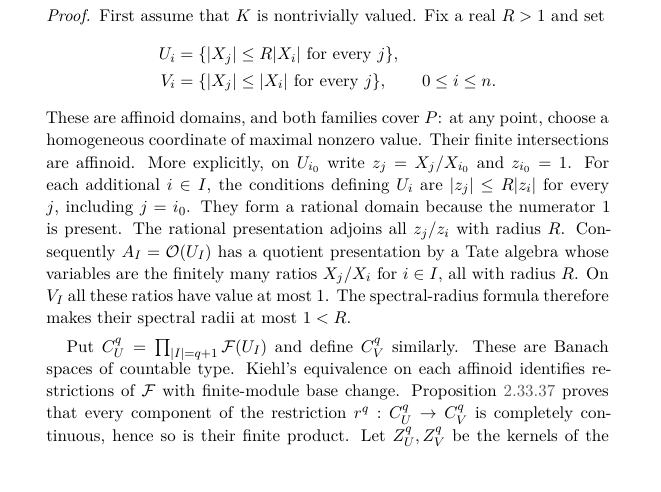
\bi{First assume that $K$ is nontrivially valued. Fix a real $R>1$ and set}
{先设 $K$ 的赋值非平凡。固定实数 $R>1$,并令}
\[
 \begin{aligned}
 U_i&=\{|X_j|\le R|X_i|\text{ for every }j\},\\
 V_i&=\{|X_j|\le |X_i|\text{ for every }j\},
 \qquad 0\le i\le n.
 \end{aligned}
\]
\bi{These are affinoid domains, and both families cover $P$: at any point, choose a homogeneous coordinate of maximal nonzero value. Their finite intersections are affinoid. More explicitly, on $U_{i_0}$ write $z_j=X_j/X_{i_0}$ and $z_{i_0}=1$. For each additional $i\in I$, the conditions defining $U_i$ are $|z_j|\le R|z_i|$ for every $j$, including $j=i_0$. They form a rational domain because the numerator $1$ is present. The rational presentation adjoins all $z_j/z_i$ with radius $R$. Consequently $A_I=\mathcal O(U_I)$ has a quotient presentation by a Tate algebra whose variables are the finitely many ratios $X_j/X_i$ for $i\in I$, all with radius $R$. On $V_I$ all these ratios have value at most $1$. The spectral-radius formula therefore makes their spectral radii at most $1<R$.}
{这些集合均为 affinoid 域,且两族都覆盖 $P$:在任意点选择绝对值最大的非零齐次坐标即可。它们的有限交也为 affinoid。更明确地,在 $U_{i_0}$ 上记 $z_j=X_j/X_{i_0}$、$z_{i_0}=1$。对每个另加的 $i\in I$,定义 $U_i$ 的条件是对所有 $j$(包括 $j=i_0$)有 $|z_j|\le R|z_i|$。因为分子中出现 $1$,这些条件定义 rational 域。其 rational 表示以半径 $R$ 添入全部 $z_j/z_i$。所以 $A_I=\mathcal O(U_I)$ 具有 Tate 商表示,变量为有限个比值 $X_j/X_i$($i\in I$),半径全为 $R$。在 $V_I$ 上,这些比值的值均至多为 $1$;谱半径公式因此给出其谱半径至多为 $1<R$。}

\bi{Put $C_U^q=\prod_{|I|=q+1}\mathcal F(U_I)$ and define $C_V^q$ similarly. These are Banach spaces of countable type. Kiehl's equivalence on each affinoid identifies restrictions of $\mathcal F$ with finite-module base change. Proposition~\ref{fnd:shrinkingcompactrestriction} proves that every component of the restriction $r^q:C_U^q\to C_V^q$ is completely continuous, hence so is their finite product. Let $Z_U^q,Z_V^q$ be the kernels of the corresponding bounded differentials. They are closed, hence are Banach spaces of countable type by Lemma~\ref{fnd:countablebanachsplitting}. Projecting $C_V^q$ boundedly onto $Z_V^q$ shows that the induced map $r:Z_U^q\to Z_V^q$ is completely continuous.}
{令 $C_U^q=\prod_{|I|=q+1}\mathcal F(U_I)$,并类似定义 $C_V^q$。它们是可数型 Banach 空间。每个 affinoid 上的 Kiehl 等价将 $\mathcal F$ 的限制识别为有限模基变换。由 Proposition~\ref{fnd:shrinkingcompactrestriction},限制 $r^q:C_U^q\to C_V^q$ 的每个分量均完全连续,所以其有限乘积也如此。令 $Z_U^q,Z_V^q$ 为相应有界微分的核;它们闭,故由 Lemma~\ref{fnd:countablebanachsplitting} 为可数型 Banach 空间。取从 $C_V^q$ 到 $Z_V^q$ 的有界投影,即知诱导映射 $r:Z_U^q\to Z_V^q$ 完全连续。}

\bi{By Proposition~\ref{fnd:finiteaffinoidcohomology}, both complexes compute $H^q(P_G,\mathcal F)$, and restriction induces the identity on this derived-section group. Therefore}
{由 Proposition~\ref{fnd:finiteaffinoidcohomology},两个复形都计算 $H^q(P_G,\mathcal F)$,且限制在此导出截面群上诱导恒等映射。因此}
\[
 F_q:C_V^{q-1}\oplus Z_U^q\longrightarrow Z_V^q,\qquad
       (a,z)\longmapsto da+r(z)
\]
\bi{is surjective, with $C_V^{-1}=0$. The map $G_q(a,z)=-r(z)$ is completely continuous. Lemma~\ref{fnd:absoluteschwarzlemma} shows that $F_q+G_q$, whose image is $dC_V^{q-1}$, has closed image and finite-dimensional cokernel. That cokernel is exactly $H^q(P_G,\mathcal F)$. This proves finite dimensionality and closedness, without assuming closed coboundary images in advance. Vanishing above $n$ follows from the length of the ordered complex.}
{为满射,其中 $C_V^{-1}=0$。映射 $G_q(a,z)=-r(z)$ 完全连续。Lemma~\ref{fnd:absoluteschwarzlemma} 说明 $F_q+G_q$ 的像闭且余核有限维;其像正是 $dC_V^{q-1}$,余核恰为 $H^q(P_G,\mathcal F)$。由此同时证明有限维性和闭性,并未预先假设上边缘像闭。$n$ 次以上的消失来自有序复形的长度。}

\bi{Now suppose that $K$ is trivially valued. On the unit cover $(V_i)$, each algebra $\mathcal O(V_I)$ is the corresponding polynomial--Laurent algebra with the norm which is $1$ on every nonzero element, by Lemma~\ref{fnd:unitlaurentnormalform}. Each finite module, with a quotient norm from a finite free presentation, has the same discrete $0/1$ norm. Thus every vector subspace of each $C_V^q$ is closed, and every exact sequence among its kernels, images and cohomology spaces is norm-strict. Choose a nontrivially valued complete extension $L/K$: for example, complete the fraction field of $K\{t^{-1}S\}$ in its Gauss norm for any $0<t<1$. The scalar-extension construction and finite-module base change identify $C_V^\bullet\widehat\otimes_K L$ with the unit-cover complex of the coherent pullback $\mathcal F_L$ on $(\mathbf P^n_L)^{\an}$. By Theorem~\ref{fnd:grusonstrictexact}, its cohomology is}
{现在设 $K$ 的赋值平凡。在单位覆盖 $(V_i)$ 上,由 Lemma~\ref{fnd:unitlaurentnormalform},各代数 $\mathcal O(V_I)$ 是相应的多项式--Laurent 代数,非零元素的范数均为 $1$。有限模配备来自有限自由表示的商范数后,也具有同样的离散 $0/1$ 范数。因此每个 $C_V^q$ 的每个向量子空间都闭,涉及其核、像和上同调空间的每个正合列均为范数严格。取非平凡赋值的完备扩域 $L/K$;例如对任意 $0<t<1$,将 $K\{t^{-1}S\}$ 的分式域关于 Gauss 范数完备化。扩标量构造及有限模基变换将 $C_V^\bullet\widehat\otimes_K L$ 识别为 $(\mathbf P^n_L)^{\an}$ 上凝聚拉回 $\mathcal F_L$ 的单位覆盖复形。由 Theorem~\ref{fnd:grusonstrictexact},其上同调为}
\[
 H^q(P_G,\mathcal F)\widehat\otimes_K L
       \simeq H^q((\mathbf P^n_L)^{\an}_G,\mathcal F_L).
\]
\bi{The right side is finite dimensional by the nontrivial case. If the left-hand source had arbitrarily many linearly independent vectors over $K$, their finite-dimensional spans would, by Theorem~\ref{fnd:grusonisometrictensor}, inject after tensoring into the displayed left side and have the same dimension over $L$. This contradicts finite dimensionality. Hence $H^q(P_G,\mathcal F)$ is finite dimensional over $K$, as required.}
{右边由非平凡赋值情形有限维。如果左边源空间在 $K$ 上含有任意多个线性无关向量,则由 Theorem~\ref{fnd:grusonisometrictensor},它们的有限维线性包在张量后仍单射到上式左边,且在 $L$ 上具有同样维数,这与有限维性矛盾。因此 $H^q(P_G,\mathcal F)$ 在 $K$ 上有限维。}
\end{proof}
Typeset reader excerpt
Typed proof inputs
- NAG-001548 · selected whole (sealed native whole)
- NAG-001574 · selected whole (sealed native whole)
- NAG-001576 · selected whole (sealed native whole)
- NAG-001577 · selected whole (sealed native whole)
- NAG-001616 · selected whole (sealed native whole)
- NAG-001624 · selected whole (sealed native whole)
- NAG-001681 · selected whole (sealed native whole)
- NAG-001682 · selected whole (sealed native whole)
- NAG-001685 · selected whole (sealed native whole)
- NAG-001686 · selected whole (sealed native whole)
- NAG-001707 · selected whole (sealed native whole)
- NAG-001714 · selected whole (sealed native whole)
- NAG-001721 · selected whole (sealed native whole)
- NAG-001722 · selected whole (sealed native whole)
- NAG-001723 · selected whole (sealed native whole)
- NAG-001891 · selected whole (earlier independently reviewed whole original in batch)
- NAG-001892 · selected whole (sealed native whole)
- NAG-001548 · selected whole
- NAG-001548 · selected whole (requires)
- NAG-001574 · selected whole
- NAG-001574 · selected whole (requires)
- NAG-001576 · selected whole
- NAG-001576 · selected whole (requires)
- NAG-001577 · selected whole
- NAG-001577 · selected whole (requires)
- NAG-001616 · selected whole
- NAG-001616 · selected whole (requires)
- NAG-001624 · selected whole
- NAG-001624 · selected whole (requires)
- NAG-001681 · selected whole
- NAG-001681 · selected whole (requires)
- NAG-001682 · selected whole
- NAG-001682 · selected whole (requires)
- NAG-001685 · selected whole
- NAG-001685 · selected whole (requires)
- NAG-001686 · selected whole
- NAG-001686 · selected whole (requires)
- NAG-001707 · selected whole
- NAG-001707 · selected whole (requires)
- NAG-001714 · selected whole
- NAG-001714 · selected whole (requires)
- NAG-001721 · selected whole
- NAG-001721 · selected whole (requires)
- NAG-001722 · selected whole
- NAG-001722 · selected whole (requires)
- NAG-001723 · selected whole
- NAG-001723 · selected whole (requires)
- NAG-001891 · selected whole
- NAG-001891 · selected whole (requires)
- NAG-001892 · selected whole
- NAG-001892 · selected whole (requires)
Reader cross-references
Proof map
Verified map inputs · NAG-001724
AND · joint registered proof inputs
- NAG-001548 · The free-polyradius field · accepted whole
- NAG-001574 · The spectral-radius formula in the affinoid category · accepted whole
- NAG-001576 · Points of an arbitrary-radius rational presentation · accepted whole
- NAG-001577 · Bounded and geometric rational factorization · accepted whole
- NAG-001616 · Arbitrary complete ground-field extension · accepted whole
- NAG-001624 · Kiehl and Theorem B on the analytic G-site · accepted whole
- NAG-001681 · Isometric tensor embeddings · accepted whole
- NAG-001682 · Exactness of completed tensors over a field · accepted whole
- NAG-001685 · Scalar extension and actual relation ideals · accepted whole
- NAG-001686 · Finite modules and faithful scalar extension · accepted whole
- NAG-001707 · Affine analytification and its mapping property · accepted whole
- NAG-001714 · Compactness of analytified projective maps · accepted whole
- NAG-001721 · Bounded splittings in countable type · accepted whole
- NAG-001722 · The completely continuous perturbation lemma · accepted whole
- NAG-001723 · Completely continuous restriction · accepted whole
- NAG-001891 · Cohomology on a finite acyclic cover · accepted whole
- NAG-001892 · Laurent coefficient normal form · accepted whole
NAG-001724 · Finiteness of coherent cohomology on projective space · Chapter argument