NAG-001800 · Accepted whole
Canonical reduction of the standard annulus
3 Reduction, formal models and residual geometry
Open in the English reader · PDF page 592
Statement · exact TeX
\begin{lemma}[\bi{Canonical reduction of the standard annulus}
{标准圆环的典范约化}]
\label{fnd:standardannuluscanonical}
\bi{Let $a\in K$ satisfy $0<|a|<1$, and put}
{设 $a\in K$ 满足 $0<|a|<1$,令}
\[
 A_0=O\langle U,V\rangle/(UV-a),\qquad
 A=K\langle U,V\rangle/(UV-a).
\]
\bi{Then $A_0$ is admissible, $A_0=A^\circ$, and}
{则 $A_0$ 为 admissible,$A_0=A^\circ$,且}
\[
 \widetilde A=A_0\otimes_O k=k[u,v]/(uv).
\]
\bi{The Shilov boundary consists of the Gauss points with
$|U|=1$ and $|U|=|a|$. Likewise the unit-circle algebra
$K\langle T,T^{-1}\rangle$ has canonical reduction
$k[t,t^{-1}]$ and a single Shilov point.}
{其 Shilov 边界由 $|U|=1$ 及 $|U|=|a|$ 处的 Gauss 点
组成。同样,单位圆环代数 $K\langle T,T^{-1}\rangle$ 的
典范约化为 $k[t,t^{-1}]$,且只有一个 Shilov 点。}
\end{lemma}
Full selected proof · exact TeX
\begin{proof}
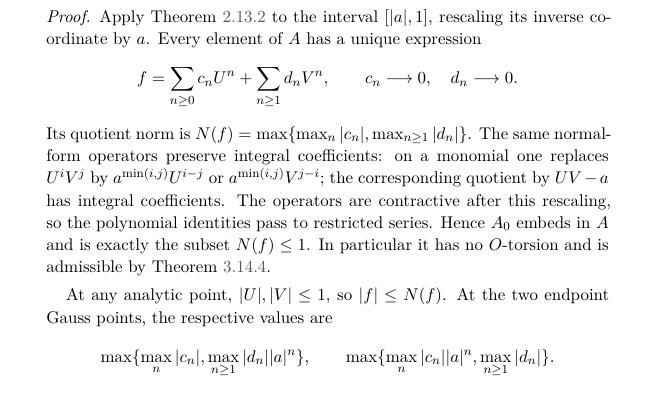
\bi{Apply Theorem~\ref{fnd:laurentcoefficientnormalform} to
the interval $[|a|,1]$, rescaling its inverse coordinate by $a$.
Every element of $A$ has a unique expression}
{对区间 $[|a|,1]$ 应用
Theorem~\ref{fnd:laurentcoefficientnormalform},并将其逆坐标
乘以 $a$。每个 $A$ 中元素都具有唯一表示}
\[
 f=\sum_{n\geq0}c_nU^n+\sum_{n\geq1}d_nV^n,
 \qquad c_n\longrightarrow0,\quad d_n\longrightarrow0.
\]
\bi{Its quotient norm is
$N(f)=\max\{\max_n|c_n|,\max_{n\geq1}|d_n|\}$.
The same normal-form operators preserve integral coefficients:
on a monomial one replaces $U^iV^j$ by
$a^{\min(i,j)}U^{i-j}$ or $a^{\min(i,j)}V^{j-i}$; the
corresponding quotient by $UV-a$ has integral coefficients.
The operators are contractive after this rescaling, so the
polynomial identities pass to restricted series. Hence $A_0$
embeds in $A$ and is exactly the subset $N(f)\leq1$. In
particular it has no $O$-torsion and is admissible by
Theorem~\ref{fnd:formaltorsionfreepresentation}.}
{其商范数为
$N(f)=\max\{\max_n|c_n|,\max_{n\geq1}|d_n|\}$。
同一正规形算子保留整系数:对单项式,将 $U^iV^j$ 替换为
$a^{\min(i,j)}U^{i-j}$ 或 $a^{\min(i,j)}V^{j-i}$;相应差
除以 $UV-a$ 后仍有整系数。上述缩放后的算子压缩范数,
故多项式恒等式延拓到受限级数。因此 $A_0$ 嵌入 $A$,
且恰为 $N(f)\leq1$ 的元素集合。特别地它没有 $O$-挠,
由 Theorem~\ref{fnd:formaltorsionfreepresentation} 为
admissible。}

\bi{At any analytic point, $|U|,|V|\leq1$, so $|f|\leq N(f)$.
At the two endpoint Gauss points, the respective values are}
{在任意解析点处,$|U|,|V|\leq1$,故 $|f|\leq N(f)$。
在两个端点 Gauss 点处,相应取值为}
\[
 \max\{\max_n|c_n|,\max_{n\geq1}|d_n||a|^n\},\qquad
 \max\{\max_n|c_n||a|^n,\max_{n\geq1}|d_n|\}.
\]
\bi{Their maximum is $N(f)$. Thus $N=\rho_A$ and
$A_0=A^\circ$. A nonzero element with $N(f)<1$ has a
coefficient attaining this maximum, so it is an element of
$K^{\circ\circ}A_0$; the converse is immediate. Therefore
$A^{\circ\circ}=K^{\circ\circ}A_0$. Reducing the unique
normal forms gives $k[u,v]/(uv)$. The endpoint pair is a
boundary, and neither point can be omitted from this pair:
$U$ attains its maximum only at the outer endpoint of the pair,
and $V$ only at the inner one. Lemma~\ref{fnd:minimalfiniteboundary}
therefore makes the pair the Shilov boundary. For the unit circle
the same normal form, now with interval $[1,1]$, gives the
multiplicative Laurent Gauss norm and reduction
$k[t,t^{-1}]$. Proposition~\ref{new:shilov_singleton} gives
its single Shilov point.}
{两者的最大值为 $N(f)$,所以 $N=\rho_A$ 且
$A_0=A^\circ$。若非零元素满足 $N(f)<1$,则有一个系数
达到此最大值,因此该元素属于 $K^{\circ\circ}A_0$;
反向包含显然。故 $A^{\circ\circ}=K^{\circ\circ}A_0$。
将唯一正规形约化,得到 $k[u,v]/(uv)$。端点对构成边界,
且其中任一点都不能省去:在此二点集中,$U$ 仅在外端点
达到最大值,$V$ 仅在内端点达到最大值。于是
Lemma~\ref{fnd:minimalfiniteboundary} 说明该端点对正是
Shilov 边界。对单位圆环,在区间 $[1,1]$ 上使用同一正规形,
得到具有乘性的 Laurent Gauss 范数及约化 $k[t,t^{-1}]$。
Proposition~\ref{new:shilov_singleton} 给出其唯一 Shilov 点。}
\end{proof}
Typeset reader excerpt
Typed proof inputs
- NAG-000657 · selected whole (earlier candidate whole in this reviewer batch)
- NAG-001415 · selected whole (accepted native whole)
- NAG-001904 · selected whole (accepted native whole)
- NAG-001915 · selected whole (accepted native whole)
Reader cross-references
Proof map
Verified map inputs · NAG-001800
AND · joint registered proof inputs
- NAG-000657 · Result 3.4.1 · accepted whole Exact source window 228–252
- NAG-001415 · The Laurent coefficient normal form · accepted whole Exact source window 189–227
- NAG-001904 · A minimal finite boundary is the smallest closed boundary · accepted whole Exact source window 228–252
- NAG-001915 · Torsion-free finite modules are finitely presented · accepted whole Exact source window 189–227
NAG-001800 · Canonical reduction of the standard annulus · Chapter argument