NAG-001907 · Accepted whole
Generic points of graded reduction
3 Reduction, formal models and residual geometry
Open in the English reader · PDF page 513
Statement · exact TeX
\begin{theorem}[\bi{Generic points of graded reduction}
{分次约化的泛点}]
\label{fnd:gradedgenericshilov}
\bi{Let $A$ be a nonzero affinoid algebra, let $\Gamma_A$ be its Shilov
boundary, and let $\widetilde A^{\mathrm{gr}}$ be its graded spectral
reduction. Evaluation at $\xi\in\Gamma_A$ induces a homogeneous prime}
{设 $A$ 为非零 affinoid 代数,$\Gamma_A$ 为其 Shilov 边界,
$\widetilde A^{\mathrm{gr}}$ 为其谱分次约化。在 $\xi\in\Gamma_A$
处取值诱导齐次素理想}
\[
 P_\xi=\ker\bigl(\widetilde A^{\mathrm{gr}}
             \longrightarrow\widetilde{\mathcal H(\xi)}^{\mathrm{gr}}\bigr).
\]
\bi{The ideals $P_\xi$ are precisely the minimal homogeneous prime ideals
of $\widetilde A^{\mathrm{gr}}$. They are distinct, their intersection
is zero, and each has exactly one analytic preimage under reduction,
namely $\xi$.}
{这些 $P_\xi$ 恰为 $\widetilde A^{\mathrm{gr}}$ 的极小齐次素理想。
它们两两不同,交为零,且每个在约化映射下都只有唯一的解析原像,
即 $\xi$ 本身。}
\end{theorem}
Full selected proof · exact TeX
\begin{proof}
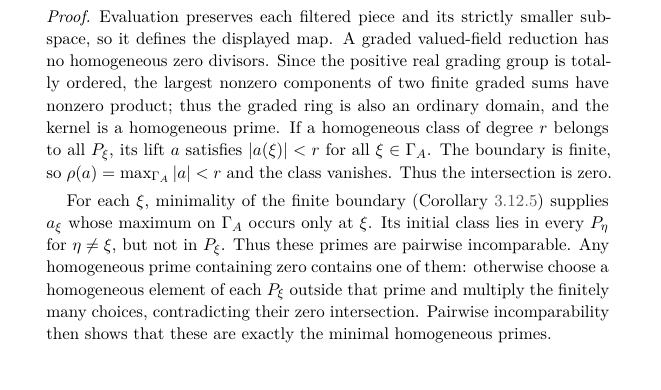
\bi{Evaluation preserves each filtered piece and its strictly smaller
subspace, so it defines the displayed map. A graded valued-field reduction
has no homogeneous zero divisors. Since the positive real grading group
is totally ordered, the largest nonzero components of two finite graded
sums have nonzero product; thus the graded ring is also an ordinary
domain, and the kernel is a homogeneous prime.
If a homogeneous class of degree $r$ belongs to all $P_\xi$, its lift $a$
satisfies $|a(\xi)|<r$ for all $\xi\in\Gamma_A$. The boundary is finite,
so $\rho(a)=\max_{\Gamma_A}|a|<r$ and the class vanishes. Thus the
intersection is zero.}
{取值保持各滤过子空间及其严格较小子空间,故定义所列映射。
赋值域的分次约化没有齐次零因子。正实数分次群全序,故两个有限分次和
的最大非零分量之积不为零;因此该分次环也是普通意义的整环,
所列核为齐次素理想。
若某个次数为 $r$ 的齐次类属于所有 $P_\xi$,则其提升 $a$ 满足
对所有 $\xi\in\Gamma_A$ 均有 $|a(\xi)|<r$。
边界有限,所以 $\rho(a)=\max_{\Gamma_A}|a|<r$,该类为零。
故这些素理想之交为零。}

\bi{For each $\xi$, minimality of the finite boundary (Corollary~\ref{fnd:affinoidshilovinternal}) supplies $a_\xi$
whose maximum on $\Gamma_A$ occurs only at $\xi$. Its initial class lies
in every $P_\eta$ for $\eta\ne\xi$, but not in $P_\xi$.
Thus these primes are pairwise incomparable. Any homogeneous prime
containing zero contains one of them: otherwise choose a homogeneous
element of each $P_\xi$ outside that prime and multiply the finitely many
choices, contradicting their zero intersection. Pairwise incomparability
then shows that these are exactly the minimal homogeneous primes.}
{对每个 $\xi$,有限边界的极小性(Corollary~\ref{fnd:affinoidshilovinternal})给出函数 $a_\xi$,使其在
$\Gamma_A$ 上的最大值只在 $\xi$ 处达到。
它的首项类属于所有 $\eta\ne\xi$ 对应的 $P_\eta$,但不属于
$P_\xi$,故这些素理想两两不可比较。
任何包含零的齐次素理想都包含其中一个:否则,可从每个 $P_\xi$
中选择一个不属于该素理想的齐次元素,有限相乘后与交为零矛盾。
再由两两不可比较性,可知它们恰为全部极小齐次素理想。}

\bi{It remains to identify the fibre. Suppose that an analytic point $y$
has reduction kernel $P_\xi$, and choose $a=a_\xi$ as above with
$m=|a(\xi)|>q=\max_{\eta\ne\xi}|a(\eta)|$. Since the initial class
of $a$ is not in $P_\xi$, we have $|a(y)|=m$.
If $|b(\xi)|>0$, then, for sufficiently large $n$,
$\rho(a^n b)=m^n|b(\xi)|$. The initial class of $a^n b$ does not lie
in $P_\xi$, so its value at $y$ equals this radius. Dividing by $m^n$
gives $|b(y)|=|b(\xi)|$.
If $b(\xi)=0$, the estimate
$m^n|b(y)|\leq q^n\max_{\eta\ne\xi}|b(\eta)|$ for all $n$
forces $b(y)=0$. Thus all evaluations agree and $y=\xi$.}
{最后识别纤维。设解析点 $y$ 的约化核为 $P_\xi$,取上述
$a=a_\xi$,使 $m=|a(\xi)|>q=\max_{\eta\ne\xi}|a(\eta)|$。
由于 $a$ 的首项类不属于 $P_\xi$,有 $|a(y)|=m$。
若 $|b(\xi)|>0$,则对足够大的 $n$ 有
$\rho(a^n b)=m^n|b(\xi)|$。$a^n b$ 的首项类不属于 $P_\xi$,
所以它在 $y$ 处的取值恰为该半径。除以 $m^n$ 得
$|b(y)|=|b(\xi)|$。
若 $b(\xi)=0$,则对所有 $n$ 的估计
$m^n|b(y)|\leq q^n\max_{\eta\ne\xi}|b(\eta)|$
迫使 $b(y)=0$。因此全部取值一致,即 $y=\xi$。}
\end{proof}
Typeset reader excerpt
Typed proof inputs
- NAG-000648 · selected whole
- NAG-001905 · selected whole
- NAG-000648 · selected whole (requires)
- NAG-001905 · selected whole (requires)
Reader cross-references
Proof map
Verified map inputs · NAG-001907
AND · joint registered proof inputs
- NAG-000648 · Result 1.6.2 · accepted whole
- NAG-001905 · The affinoid Shilov boundary · accepted whole
NAG-001907 · Generic points of graded reduction · Chapter argument