NAG-001914 · Accepted whole
Exact generators for Tate submodules
3 Reduction, formal models and residual geometry
Open in the English reader · PDF page 517
Statement · exact TeX
\begin{theorem}[\bi{Exact generators for Tate submodules}
{Tate 子模的精确生成元}]
\label{fnd:exactunitballgenerators}
\bi{Put $T=K\langle T_1,\ldots,T_n\rangle$ with its Gauss norm.
For every $T$-submodule $N\subset T^s$, there are finitely many
$v_1,\ldots,v_q\in N$ of norm one such that every $v\in N$ has an
expression}
{令 $T=K\langle T_1,\ldots,T_n\rangle$ 配备 Gauss 范数。
对每个 $T$-子模 $N\subset T^s$,存在有限个范数为一的元素
$v_1,\ldots,v_q\in N$,使每个 $v\in N$ 均可写成}
\[
 v=\sum_{j=1}^q a_jv_j,\qquad a_j\in T,
 \qquad \max_j\|a_j\|\leq\|v\|.
\]
\bi{Consequently $N\cap(K^\circ\langle T\rangle)^s$ is generated
by the same $v_j$ over $K^\circ\langle T\rangle$.}
{因而 $N\cap(K^\circ\langle T\rangle)^s$ 在
$K^\circ\langle T\rangle$ 上由同一组 $v_j$ 生成。}
\end{theorem}
Full selected proof · exact TeX
\begin{proof}
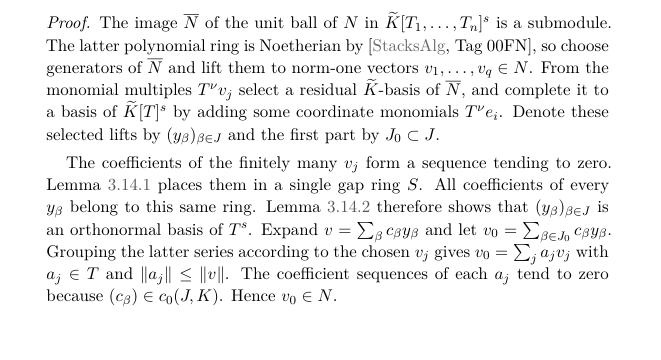
\bi{The image $\overline N$ of the unit ball of $N$ in
$\widetilde K[T_1,\ldots,T_n]^s$ is a submodule. The latter polynomial
ring is Noetherian by \cite[Tag 00FN]{StacksAlg}, so choose generators of $\overline N$ and lift
them to norm-one vectors $v_1,\ldots,v_q\in N$. From the monomial
multiples $T^\nu v_j$ select a residual $\widetilde K$-basis of
$\overline N$, and complete it to a basis of
$\widetilde K[T]^s$ by adding some coordinate monomials $T^\nu e_i$.
Denote these selected lifts by $(y_\beta)_{\beta\in J}$ and the
first part by $J_0\subset J$.}
{模 $N$ 的单位球在 $\widetilde K[T_1,\ldots,T_n]^s$ 中的像
$\overline N$ 是子模。由 \cite[Tag 00FN]{StacksAlg},该多项式环为
Noetherian 环,故可选取
$\overline N$ 的有限生成元,并提升为 $N$ 中范数为一的向量
$v_1,\ldots,v_q$。从单项式倍数 $T^\nu v_j$ 中选出
$\overline N$ 的剩余 $\widetilde K$-基,再添入若干坐标单项式
$T^\nu e_i$,将其补成 $\widetilde K[T]^s$ 的基。以
$(y_\beta)_{\beta\in J}$ 记所选提升,以 $J_0\subset J$ 记前一部分。}

\bi{The coefficients of the finitely many $v_j$ form a sequence
tending to zero. Lemma~\ref{fnd:baldcoefficientring} places them in
a single gap ring $S$. All coefficients of every $y_\beta$ belong
to this same ring. Lemma~\ref{fnd:gaporthonormallifting} therefore
shows that $(y_\beta)_{\beta\in J}$ is an orthonormal basis of $T^s$.
Expand $v=\sum_\beta c_\beta y_\beta$ and let
$v_0=\sum_{\beta\in J_0}c_\beta y_\beta$. Grouping the latter
series according to the chosen $v_j$ gives
$v_0=\sum_j a_jv_j$ with $a_j\in T$ and
$\|a_j\|\leq\|v\|$. The coefficient sequences of each $a_j$ tend
to zero because $(c_\beta)\in c_0(J,K)$. Hence $v_0\in N$.}
{有限个 $v_j$ 的系数组成趋于零的序列。
Lemma~\ref{fnd:baldcoefficientring} 将它们放入同一个间隙环 $S$,
于是每个 $y_\beta$ 的全部系数也属于 $S$。由
Lemma~\ref{fnd:gaporthonormallifting},$(y_\beta)_{\beta\in J}$
是 $T^s$ 的正交归一基。展开
$v=\sum_\beta c_\beta y_\beta$,并令
$v_0=\sum_{\beta\in J_0}c_\beta y_\beta$。按所选 $v_j$ 将后一个
级数分组,得到 $v_0=\sum_j a_jv_j$,其中 $a_j\in T$ 且
$\|a_j\|\leq\|v\|$。由于 $(c_\beta)\in c_0(J,K)$,每个
$a_j$ 的系数序列都趋于零。因此 $v_0\in N$。}

\bi{If $v-v_0$ were nonzero, divide it by one of its largest
coefficients in the orthonormal expansion. Its nonzero reduction
would lie both in $\overline N$ and in the span of the complementary
residual basis vectors. This is impossible. Thus $v=v_0$, which
proves the assertion and the unit-ball consequence.}
{若 $v-v_0\ne0$,将其除以正交展开中一个绝对值最大的系数。
其非零剩余类将同时属于 $\overline N$ 及补充剩余基向量的线性包,
产生矛盾。因此 $v=v_0$,从而得到所述表达式及单位球结论。}
\end{proof}
Typeset reader excerpt
Typed proof inputs
- STACKS-00FN:first_clause@NAG-001914 · named external application
- BASE-LINEAR · standing context or base (selected rule)
- BASE-REAL · standing context or base (selected rule)
- BASE-RINGS · standing context or base (selected rule)
- BASE-SETS · standing context or base (selected rule)
- BASE-TOPOLOGY · standing context or base (selected rule)
- NAG-001912 · selected whole (selected rule)
- NAG-001913 · selected whole (selected rule)
- STACKS-00FN:first_clause@NAG-001914 · named external application (selected rule)
- BASE-LINEAR · standing context or base
- BASE-LINEAR · standing context or base (requires)
- BASE-REAL · standing context or base
- BASE-REAL · standing context or base (requires)
- BASE-RINGS · standing context or base
- BASE-RINGS · standing context or base (requires)
- BASE-SETS · standing context or base
- BASE-SETS · standing context or base (requires)
- BASE-TOPOLOGY · standing context or base
- BASE-TOPOLOGY · standing context or base (requires)
- NAG-001912 · selected whole
- NAG-001912 · selected whole (requires)
- NAG-001913 · selected whole
- NAG-001913 · selected whole (requires)
- STACKS-00FN:first_clause@NAG-001914 · named external application (requires)
Reader cross-references
Proof map
Verified map inputs · NAG-001914
No addressable selected proof input is recorded in this projection.
NAG-001914 · Exact generators for Tate submodules · Chapter argument