NAG-002026 · Accepted whole
Extreme Laurent exponents
Open in the English reader · PDF page 644
Statement · exact TeX
\begin{lemma}[\bi{Extreme Laurent exponents}{Laurent 极端指数}]
\label{cand:annulusdominantexponents}
\bi{For $f,g\in A_{r,R}\setminus\{0\}$ and $r\leq\rho\leq R$,}
{对 $f,g\in A_{r,R}\setminus\{0\}$ 及 $r\leq\rho\leq R$,有}
\[
 m_{fg}(\rho)=m_f(\rho)+m_g(\rho),\qquad
 M_{fg}^{\mathrm{exp}}(\rho)
 =M_f^{\mathrm{exp}}(\rho)+M_g^{\mathrm{exp}}(\rho).
\]
\bi{If $r<\rho<R$ and $t_0=-\log\rho$, the one-sided derivatives satisfy}
{若 $r<\rho<R$ 且 $t_0=-\log\rho$,则单侧导数满足}
\[
 F'_{f,+}(t_0)=m_f(\rho),\qquad
 F'_{f,-}(t_0)=M_f^{\mathrm{exp}}(\rho).
\]
\end{lemma}
Full selected proof · exact TeX
\begin{proof}
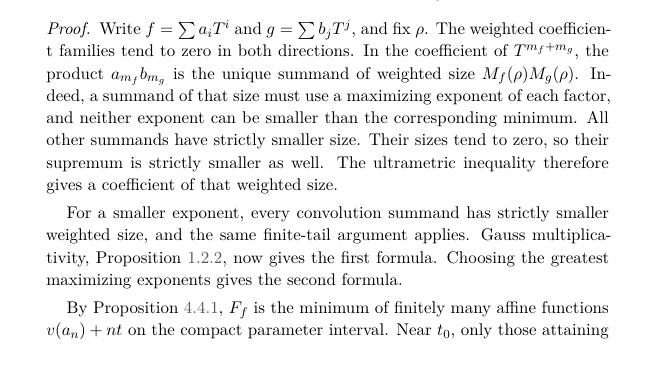
\bi{Write $f=\sum a_iT^i$ and $g=\sum b_jT^j$, and fix $\rho$. The weighted coefficient families tend to zero in both directions. In the coefficient of $T^{m_f+m_g}$, the product $a_{m_f}b_{m_g}$ is the unique summand of weighted size $M_f(\rho)M_g(\rho)$. Indeed, a summand of that size must use a maximizing exponent of each factor, and neither exponent can be smaller than the corresponding minimum. All other summands have strictly smaller size. Their sizes tend to zero, so their supremum is strictly smaller as well. The ultrametric inequality therefore gives a coefficient of that weighted size.}
{写 $f=\sum a_iT^i$、$g=\sum b_jT^j$,并固定 $\rho$。两个加权系数族在正、负两个方向均趋于零。在 $T^{m_f+m_g}$ 的系数中,乘积 $a_{m_f}b_{m_g}$ 是唯一具有加权大小 $M_f(\rho)M_g(\rho)$ 的项。事实上,达到此大小的项必须在两个因子中均取达到最大值的指数,而这两个指数均不能小于各自的最小指数。其余各项均严格较小,且其大小趋于零,所以其上确界也严格较小。Ultrametric inequality 因而给出具有该加权大小的系数。}

\bi{For a smaller exponent, every convolution summand has strictly smaller weighted size, and the same finite-tail argument applies. Gauss multiplicativity, Proposition~\ref{fnd:gaussnorm}, now gives the first formula. Choosing the greatest maximizing exponents gives the second formula.}
{对更小的指数,每个卷积项的加权大小都严格较小,同一有限尾项论证仍适用。结合 Proposition~\ref{fnd:gaussnorm} 的 Gauss 乘法性,得到第一个公式。改取达到最大值的最大指数,便得到第二个公式。}

\bi{By Proposition~\ref{fnd:annulusunitaffine}, $F_f$ is the minimum of finitely many affine functions $v(a_n)+nt$ on the compact parameter interval. Near $t_0$, only those attaining the minimum at $t_0$ can contribute. To the right their smallest slope is selected; to the left their greatest slope is selected. This proves both derivative formulas.}
{由 Proposition~\ref{fnd:annulusunitaffine},$F_f$ 在紧参数区间上是有限个仿射函数 $v(a_n)+nt$ 的最小值。在 $t_0$ 附近,只有在 $t_0$ 达到最小值的那些函数可能起作用。向右时取其中最小斜率,向左时取最大斜率,由此得到两个导数公式。}
\end{proof}
Typeset reader excerpt
Typed proof inputs
- BASE-RINGS · standing context or base
- BASE-RINGS · standing context or base (requires)
- NAG-000152 · selected whole
- NAG-000152 · selected whole (requires)
- NAG-000182 · selected whole
- NAG-000182 · selected whole (requires)
- NAG-001415 · selected whole
- NAG-001415 · selected whole (requires)
- NAG-001416 · selected whole
- NAG-001416 · selected whole (requires)
Reader cross-references
Proof map
Verified map inputs · NAG-002026
AND · joint registered proof inputs
- NAG-000152 · Result 4.4.1 · accepted whole
- NAG-000182 · Multiplicativity of the weighted Gauss norm · accepted whole
- NAG-001415 · The Laurent coefficient normal form · accepted whole
- NAG-001416 · Multiplication, module actions and naturality · accepted whole
Standing context and base inputs
BASE-RINGS