NAG-002067 · Accepted whole
The canonical germ of a separable smooth tube
Open in the English reader · PDF page 693
Statement · exact TeX
\begin{proposition}[\bi{The canonical germ of a separable smooth tube}
{可分光滑管域的典范芽}]
\label{cand:residualdirectiongerms}
\bi{In the setting of Proposition~\ref{cand:separablesmoothtubehomotopy},
write $D_q=]q[$ and $C_q=D_q\cup\{v\}$. There is a canonical
germ of an embedded Gauss ray approaching $v$ from $D_q$,
parametrized near $v$ by $\ell=-\log r\geq0$. There are also
path-connected open collars $B_q(r)\subset D_q$, for $r<1$
sufficiently close to $1$, such that
$\{v\}\cup B_q(r)$ form a neighborhood basis of $v$ in $C_q$.
The tube $D_q$ is path connected. The germ and its parameter
are independent of the finite residue-field lift and disc
coordinates used to construct them.}
{在 Proposition~\ref{cand:separablesmoothtubehomotopy} 的
设定下,写 $D_q=]q[$、$C_q=D_q\cup\{v\}$。存在从
$D_q$ 接近 $v$ 的典范嵌入 Gauss 射线芽,在 $v$ 附近以
$\ell=-\log r\geq0$ 为参数。还存在道路连通的开领形域
$B_q(r)\subset D_q$,其中 $r<1$ 充分接近 $1$,使
$\{v\}\cup B_q(r)$ 构成 $C_q$ 中 $v$ 的邻域基。管域
$D_q$ 道路连通。该芽及其参数与构造时所用有限剩余域
提升及圆盘坐标无关。}
\end{proposition}
Full selected proof · exact TeX
\begin{proof}
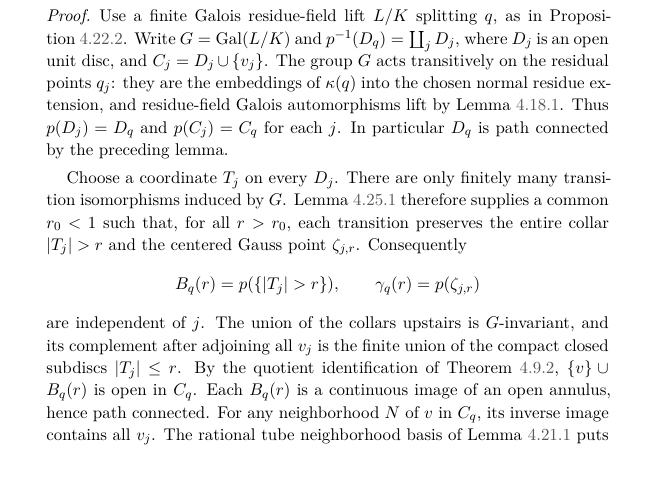
\bi{Use a finite Galois residue-field lift $L/K$ splitting $q$,
as in Proposition~\ref{cand:separablesmoothtubehomotopy}.
Write $G=\operatorname{Gal}(L/K)$ and
$p^{-1}(D_q)=\coprod_j D_j$, where $D_j$ is an open unit
disc, and $C_j=D_j\cup\{v_j\}$.
The group $G$ acts transitively on the residual points
$q_j$: they are the embeddings of $\kappa(q)$ into the
chosen normal residue extension, and residue-field Galois
automorphisms lift by Lemma~\ref{cand:galoisresidueextensionlift}.
Thus $p(D_j)=D_q$ and $p(C_j)=C_q$ for each $j$.
In particular $D_q$ is path connected by the preceding lemma.}
{使用 Proposition~\ref{cand:separablesmoothtubehomotopy}
中使 $q$ 分裂的有限 Galois 剩余域提升 $L/K$。写
$G=\operatorname{Gal}(L/K)$、
$p^{-1}(D_q)=\coprod_j D_j$,其中 $D_j$ 是开单位圆盘,
且 $C_j=D_j\cup\{v_j\}$。群 $G$ 在剩余点 $q_j$ 上
传递作用:这些点对应 $\kappa(q)$ 到所选正规剩余扩张的
嵌入,而由 Lemma~\ref{cand:galoisresidueextensionlift},
剩余域 Galois 自同构可以提升。因此每个 $j$ 都满足
$p(D_j)=D_q$ 及 $p(C_j)=C_q$。特别地,上一引理说明
$D_q$ 道路连通。}

\bi{Choose a coordinate $T_j$ on every $D_j$. There are only
finitely many transition isomorphisms induced by $G$.
Lemma~\ref{cand:discradialgerm} therefore supplies a common
$r_0<1$ such that, for all $r>r_0$, each transition preserves
the entire collar $|T_j|>r$ and the centered Gauss point
$\zeta_{j,r}$. Consequently}
{在每个 $D_j$ 上选择坐标 $T_j$。$G$ 所诱导的过渡同构
只有有限个,因此 Lemma~\ref{cand:discradialgerm} 给出
共同的 $r_0<1$,使对所有 $r>r_0$,每个过渡同构都
保持整个领形域 $|T_j|>r$ 及中心 Gauss 点
$\zeta_{j,r}$。于是}
\[
 B_q(r)=p(\{|T_j|>r\}),\qquad
 \gamma_q(r)=p(\zeta_{j,r})
\]
\bi{are independent of $j$. The union of the collars upstairs
is $G$-invariant, and its complement after adjoining all
$v_j$ is the finite union of the compact closed subdiscs
$|T_j|\leq r$. By the quotient identification of
Theorem~\ref{cand:galoisanalyticquotient},
$\{v\}\cup B_q(r)$ is open in $C_q$.
Each $B_q(r)$ is a continuous image of an open annulus, hence
path connected. For any neighborhood $N$ of $v$ in $C_q$,
its inverse image contains all $v_j$. The rational tube
neighborhood basis of Lemma~\ref{cand:smoothrationaltubeclosure}
puts all their sufficiently thin collars inside $p^{-1}(N)$.
There are finitely many $j$, so one common $r$ works. This
proves the neighborhood-basis assertion.}
{两式与 $j$ 无关。上方各领形域之并为 $G$-不变集,添入
全部 $v_j$ 后,其补集为紧闭子圆盘 $|T_j|\leq r$ 的
有限并。由 Theorem~\ref{cand:galoisanalyticquotient} 的
商空间识别,$\{v\}\cup B_q(r)$ 在 $C_q$ 中开。每个
$B_q(r)$ 是开圆环的连续像,因而道路连通。对 $C_q$
中 $v$ 的任意邻域 $N$,其逆像包含全部 $v_j$。
Lemma~\ref{cand:smoothrationaltubeclosure} 的有理管域
邻域基把这些点处充分薄的领形域都放入 $p^{-1}(N)$。
由于 $j$ 只有有限个,一个共同的 $r$ 即可,从而得到
邻域基断言。}

\bi{Set $\gamma_q(1)=v$. The endpoint result makes
$\gamma_q:(r_0,1]\to C_q$ continuous.
If two of its values with parameters greater than $r_0$
coincide, the orbit description of analytic fibres in
Theorem~\ref{cand:galoisanalyticquotient} sends one chosen
Gauss point to the other. Every such group element preserves
its radius on these collars, so the two parameters agree.
The function $|T_j|$ descends to a continuous function on
$B_q(r_0)$ and extends by value $1$ at $v$, by the collar
neighborhood basis. Its restriction is the inverse parameter
of $\gamma_q$, proving that the ray is embedded.}
{置 $\gamma_q(1)=v$。端点结论使
$\gamma_q:(r_0,1]\to C_q$ 连续。若两个大于 $r_0$ 的
参数给出相同点,则由
Theorem~\ref{cand:galoisanalyticquotient} 中解析纤维的
轨道描述,某个群元素将一个所选 Gauss 点映到另一个。
这些群元素在上述领形域上都保持半径,故两个参数相同。
函数 $|T_j|$ 下降为 $B_q(r_0)$ 上的连续函数,并由领形域
邻域基在 $v$ 处延伸为值 $1$。它在射线上的限制正是
$\gamma_q$ 的逆参数,从而射线嵌入。}

\bi{Changing the finitely many disc coordinates preserves
these radii and rays after increasing $r_0$, by
Lemma~\ref{cand:discradialgerm}. Two residue-field lifts
embed into a common such lift as in the proof of
Proposition~\ref{cand:separablesmoothtubehomotopy}.
Gauss points and collars commute with scalar projection,
so the germs agree in that common comparison. The length
parameter is $\ell=-\log r$ throughout; the residue extension
does not alter the fixed absolute value.}
{由 Lemma~\ref{cand:discradialgerm},改变有限个圆盘坐标后,
只需提高 $r_0$,这些半径及射线就保持不变。按照
Proposition~\ref{cand:separablesmoothtubehomotopy} 的证明,
两个剩余域提升都可嵌入一个共同提升。Gauss 点和领形域
与标量投影相容,因此两个芽在该共同比较中一致。长度
参数始终为 $\ell=-\log r$;剩余扩张不改变固定的绝对值。}
\end{proof}
Typeset reader excerpt
Typed proof inputs
- NAG-002024 · selected whole (earlier reviewed original candidate in this packet)
- NAG-002052 · selected whole (sealed native whole)
- NAG-002058 · selected whole (sealed native whole)
- NAG-002061 · selected whole (earlier reviewed original candidate in this packet)
- SUPPORT:NAG-002066:nontrivially_valued_disc_coordinate_collars · typed target unresolved in this export (proposed exact zero-credit native support)
- NAG-002024 · selected whole
- NAG-002024 · selected whole (requires)
- NAG-002052 · selected whole
- NAG-002052 · selected whole (requires)
- NAG-002058 · selected whole
- NAG-002058 · selected whole (requires)
- NAG-002061 · selected whole
- NAG-002061 · selected whole (requires)
- SUPPORT:NAG-002060:separable_reducedness_and_tube_preimages · typed target unresolved in this export
- SUPPORT:NAG-002060:separable_reducedness_and_tube_preimages · typed target unresolved in this export (requires)
- SUPPORT:NAG-002066:nontrivially_valued_disc_coordinate_collars · typed target unresolved in this export
- SUPPORT:NAG-002066:nontrivially_valued_disc_coordinate_collars · typed target unresolved in this export (requires)
Reader cross-references
Proof map
Verified map inputs · NAG-002067
AND · joint registered proof inputs
- NAG-002024 · The scalar-extension quotient · accepted whole
- NAG-002052 · Lifting a finite Galois residue extension · accepted whole
- NAG-002058 · The compactification of a rational smooth tube · accepted whole
- NAG-002061 · Descent of the smooth-tube contraction · accepted whole
Unlinked source pointers
These pointers have no operative linked edge in this map.
SUPPORT:NAG-002060:separable_reducedness_and_tube_preimagesSUPPORT:NAG-002066:nontrivially_valued_disc_coordinate_collars
NAG-002067 · The canonical germ of a separable smooth tube · Chapter argument