NAG-002128 · Accepted whole
Comparison of annular collars at one direction
Open in the English reader · PDF page 707
Statement · exact TeX
\begin{lemma}[\bi{Comparison of annular collars at one direction}
{同一方向的圆环领形域比较}]
\label{cand:commonannularcollars}
\bi{Suppose two nodal models of the same analytic curve
satisfy Theorem~\ref{cand:residualbranchstar},
have $x$ as a component vertex, and $d\in T_xX$ corresponds
in each model to a rational point of the normalized residual
component. Their outgoing Gauss-ray germs and parameters
$\ell=-\log r$ coincide. More precisely, if $z,w$ are their
outward-normalized collar coordinates, there is $r_0<1$
such that the two collars of inner radius $r>r_0$ are the
same analytic domain and $|z|=|w|$ there.}
{设同一解析曲线的两个节点模型均满足
Theorem~\ref{cand:residualbranchstar},并以 $x$ 为分量顶点,
且 $d\in T_xX$ 在两个模型中均对应正规化剩余分量的
有理点。则两者的出射 Gauss 射线芽及参数
$\ell=-\log r$ 相同。更准确地,若 $z,w$ 为各自向外
归一化的领形坐标,则存在 $r_0<1$,使对每个
$r>r_0$,两者内半径为 $r$ 的领形域是同一个解析域,
且其上 $|z|=|w|$。}
\end{lemma}
Full selected proof · exact TeX
\begin{proof}
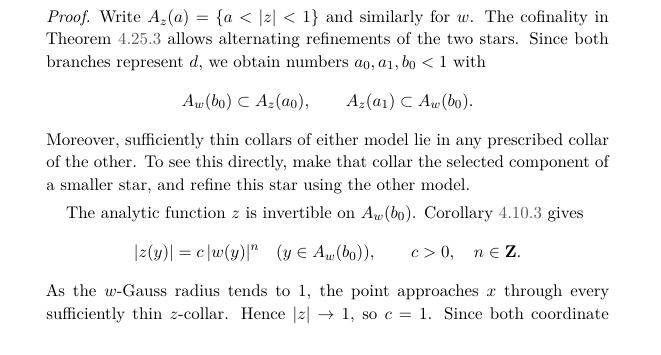
\bi{Write $A_z(a)=\{a<|z|<1\}$ and similarly for $w$.
The cofinality in Theorem~\ref{cand:residualbranchstar}
allows alternating refinements of the two stars. Since both
branches represent $d$, we obtain numbers $a_0,a_1,b_0<1$
with}
{写 $A_z(a)=\{a<|z|<1\}$,对 $w$ 使用同样记号。
Theorem~\ref{cand:residualbranchstar} 的共尾性允许交替
加细两组星形邻域。因为两个分支代表同一个 $d$,可找到
$a_0,a_1,b_0<1$,使}
\[
 A_w(b_0)\subset A_z(a_0),\qquad
 A_z(a_1)\subset A_w(b_0).
\]
\bi{Moreover, sufficiently thin collars of either model lie
in any prescribed collar of the other. To see this directly,
make that collar the selected component of a smaller star,
and refine this star using the other model.}
{而且,任一模型中充分薄的领形域都包含于另一模型的
任意指定领形域。直接地说,可让该指定领形域成为一个
较小星形邻域的所选分支,再用另一模型加细该星形邻域。}

\bi{The analytic function $z$ is invertible on $A_w(b_0)$.
Corollary~\ref{cand:standardopenunitnorms} gives}
{解析函数 $z$ 在 $A_w(b_0)$ 上可逆。由
Corollary~\ref{cand:standardopenunitnorms},有}
\[
 |z(y)|=c\,|w(y)|^n
 \quad(y\in A_w(b_0)),\qquad c>0,\quad n\in\mathbf Z.
\]
\bi{As the $w$-Gauss radius tends to $1$, the point approaches
$x$ through every sufficiently thin $z$-collar. Hence
$|z|\to1$, so $c=1$. Since both coordinate absolute values
lie strictly between zero and one, $n>0$. Applying the
same argument to $w$ on $A_z(a_1)$ gives
$|w|=|z|^m$ with $m>0$. On this nonempty collar, composition
gives $|z|=|z|^{mn}$; therefore $mn=1$ and $m=n=1$.}
{当 $w$-Gauss 半径趋于 $1$ 时,该点通过每个充分薄的
$z$-领形域趋于 $x$。因此 $|z|\to1$,故 $c=1$。
两个坐标的绝对值都严格位于零与一之间,所以 $n>0$。
对 $A_z(a_1)$ 上的 $w$ 作同样论证,得到
$|w|=|z|^m$,其中 $m>0$。在这个非空领形域上复合,
有 $|z|=|z|^{mn}$,故 $mn=1$、$m=n=1$。}

\bi{Choose $r_0>\max(a_0,a_1,b_0)$. For $r>r_0$ the
first inclusion and $|z|=|w|$ give
$A_w(r)\subset A_z(r)$; the second gives the converse.
The analytic-domain universal property identifies their
analytic structures. The identity between these two standard
annulus presentations is now an analytic isomorphism
preserving radius. Corollary~\ref{cand:openannuluscoordinateisometry}
identifies the Gauss points and their radial homotopies.
In particular the ray germs and the parameter $-\log r$
agree, with the original absolute value unchanged.}
{选择 $r_0>\max(a_0,a_1,b_0)$。对 $r>r_0$,第一
包含关系及 $|z|=|w|$ 给出
$A_w(r)\subset A_z(r)$,第二包含关系给出反向包含。
解析域的泛性质识别它们的解析结构。于是,这两个标准
圆环表示之间的恒等映射为保持半径的解析同构。
Corollary~\ref{cand:openannuluscoordinateisometry}
识别其 Gauss 点及径向同伦。特别地,射线芽及参数
$-\log r$ 相同,原绝对值保持不变。}
\end{proof}
Typeset reader excerpt
Typed proof inputs
- NAG-001609 · selected whole (accepted native whole)
- NAG-002028 · selected whole (accepted native whole)
- NAG-002032 · selected whole (accepted native whole)
- NAG-002068 · selected whole (accepted native whole)
Reader cross-references
Proof map
Verified map inputs · NAG-002128
AND · joint registered proof inputs
- NAG-001609 · Local calculus of analytic domains · accepted whole Exact source window 63–104
- NAG-002028 · Units on standard open domains · accepted whole Exact source window 63–104
- NAG-002032 · Open annuli and their radial homotopies · accepted whole Exact source window 63–104
- NAG-002068 · The residual branch star · accepted whole Exact source window 44–62
NAG-002128 · Comparison of annular collars at one direction · Chapter argument