NAG-002068 · Accepted whole
The residual branch star
Open in the English reader · PDF page 694
Statement · exact TeX
\begin{theorem}[\bi{The residual branch star}
{剩余分支的星形邻域}]
\label{cand:residualbranchstar}
\bi{Assume Theorem~\ref{cand:splitmodelskeleton}. Let $C$ be
a special-fibre component, let $v=v_C$, and let $C^\nu$ be
its normalization. There is an ordinary open neighborhood
$W_v$ of $v$ whose punctured connected components are in
natural bijection with the closed points of $C^\nu$.
At a smooth point of the special fibre the corresponding
component is its whole open tube. At a point above a node
it is a thin annular collar of the selected node branch.
A self-node contributes two distinct components.}
{假设 Theorem~\ref{cand:splitmodelskeleton} 的条件成立。
设 $C$ 为特殊纤维的一个分量,$v=v_C$,并以 $C^\nu$
表示其正规化。存在 $v$ 的通常开邻域 $W_v$,使去掉
$v$ 后的连通分支与 $C^\nu$ 的闭点自然一一对应。在特殊
纤维的光滑点处,相应分支是其整个开管域;在结点上方的
点处,它是所选结点分支的薄圆环领形域。自结点贡献两个
不同的分支。}

\bi{These components remain naturally indexed by the same
closed points in a cofinal system of neighborhoods of $v$,
obtained by making the finitely many nodal collars thinner
and replacing finitely many smooth tubes by outer collars.
Thus the germs of punctured-neighborhood components,
or outgoing directions at $v$, identify canonically with
the closed points of $C^\nu$. Each has the coordinate-
independent Gauss-ray representative described above.}
{通过缩薄有限个结点领形域,并把有限个光滑管域换成外侧
领形域,可得到 $v$ 的共尾邻域系统;其去点连通分支仍由
相同的闭点自然标记。因此,去点邻域连通分支的芽,即
$v$ 处的出射方向,典范地对应 $C^\nu$ 的闭点。每个方向
都有上述与坐标无关的 Gauss 射线代表。}
\end{theorem}
Full selected proof · exact TeX
\begin{proof}
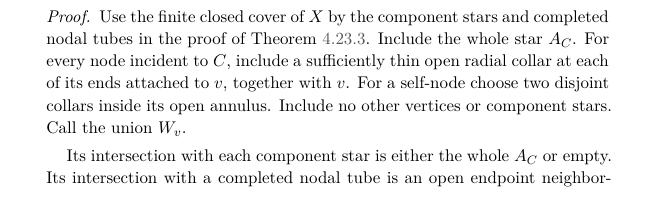
\bi{Use the finite closed cover of $X$ by the component
stars and completed nodal tubes in the proof of
Theorem~\ref{cand:splitmodelskeleton}. Include the whole
star $A_C$. For every node incident to $C$, include a
sufficiently thin open radial collar at each of its ends
attached to $v$, together with $v$. For a self-node choose
two disjoint collars inside its open annulus. Include
no other vertices or component stars. Call the union $W_v$.}
{使用 Theorem~\ref{cand:splitmodelskeleton} 证明中由分量
星形空间与完备结点管域组成的有限闭覆盖。先纳入整个
星形空间 $A_C$。对每个与 $C$ 入射的结点,在其每个
附着于 $v$ 的端点处纳入充分薄的开径向领形域及 $v$。
对自结点,在其开圆环内部选取两个互不相交的领形域。
不纳入其余顶点或分量星形空间。将所得并集记为 $W_v$。}

\bi{Its intersection with each component star is either
the whole $A_C$ or empty. Its intersection with a completed
nodal tube is an open endpoint neighborhood, the union of
two disjoint endpoint neighborhoods after their common
vertex is identified, or empty. These sets are relatively
open by Proposition~\ref{cand:nodaltubeendpoints} and the
compact quotient in Corollary~\ref{cand:nodaltubehomotopy}.
A subset whose intersections with every member of a finite
closed cover are relatively open is open: its complement
is a finite union of closed subsets. Hence $W_v$ is open.}
{它与每个分量星形空间的交,要么是整个 $A_C$,要么是
空集。它与完备结点管域的交,要么是开端点邻域,要么
是在共同顶点识别后两个互不相交端点邻域的并,要么是
空集。由 Proposition~\ref{cand:nodaltubeendpoints} 及
Corollary~\ref{cand:nodaltubehomotopy} 中的紧商空间,
这些集合都相对开。若一个子集与有限闭覆盖的每个成员
之交都相对开,那么其补集是有限个闭子集的并,故该
子集开。因此 $W_v$ 开。}

\bi{After deleting $v$, its pieces are precisely the smooth
tubes on $C$ and the chosen annular collars. Each piece is
open, and its complement is the union of the other open
pieces, so it is also closed in $W_v\setminus\{v\}$.
Each is path connected by
Proposition~\ref{cand:residualdirectiongerms} and
Lemma~\ref{cand:discradialgerm}. They are therefore exactly
the connected components. Lemma~\ref{cand:normalizedmodelbranches}
identifies their labels with all closed points of $C^\nu$,
including two distinct normalization points for a self-node.}
{删去 $v$ 后,剩下的各块恰为 $C$ 上的光滑管域及所选
圆环领形域。每一块开,其补集是其余开块的并,所以
它也在 $W_v\setminus\{v\}$ 中闭。由
Proposition~\ref{cand:residualdirectiongerms} 和
Lemma~\ref{cand:discradialgerm},每一块道路连通,
因此它们恰为连通分支。
Lemma~\ref{cand:normalizedmodelbranches} 把其标记识别
为 $C^\nu$ 的全部闭点,自结点对应两个不同的正规化点。}

\bi{Finally let $N$ be any neighborhood of $v$ in $X$.
Lemma~\ref{cand:componentcofinitetubes} puts all but finitely
many smooth tubes on $C$ inside $N$. For each of the
remaining tubes use the collar neighborhood basis in
Proposition~\ref{cand:residualdirectiongerms}; for each
incident nodal end use the full radial tails of
Proposition~\ref{cand:nodaltubeendpoints}. Shrinking these
finitely many collars yields a neighborhood contained in
$N\cap W_v$. It is open by the same finite-cover argument,
since deleting a compact inner portion from finitely many
smooth tubes is open on $A_C$. Its punctured pieces are
again path connected, with unchanged labels. This proves
cofinality and makes all transition maps on component
labels the identity. The claimed direction correspondence
and Gauss-ray representatives follow.}
{最后取 $X$ 中 $v$ 的任意邻域 $N$。
Lemma~\ref{cand:componentcofinitetubes} 将 $C$ 上除有限个
以外的全部光滑管域放入 $N$。对剩余管域使用
Proposition~\ref{cand:residualdirectiongerms} 的领形域
邻域基;对每个入射结点端点,使用
Proposition~\ref{cand:nodaltubeendpoints} 的完整径向尾部。
缩小这有限个领形域,便得到包含于 $N\cap W_v$ 的邻域。
同一有限覆盖论证说明它开,因为从有限个光滑管域中
删去紧的内部部分,在 $A_C$ 上得到开集。其去点各块
仍道路连通,且标记不变。这证明共尾性,并使各连通
分支标记之间的过渡映射均为恒等映射。所需方向对应
及 Gauss 射线代表于是得到。}
\end{proof}
Typeset reader excerpt
Typed proof inputs
- NAG-002056 · selected whole (native proof input)
- NAG-002057 · selected whole (native proof input)
- NAG-002062 · selected whole (native proof input)
- NAG-002064 · selected whole (native proof input)
- NAG-002067 · selected whole (native proof input)
- NAG-002069 · selected whole (native proof input)
- SUPPORT:NAG-002066:nontrivially_valued_disc_coordinate_collars · typed target unresolved in this export (native proof input)
- NAG-002056 · selected whole
- NAG-002056 · selected whole (requires)
- NAG-002057 · selected whole
- NAG-002057 · selected whole (requires)
- NAG-002062 · selected whole
- NAG-002062 · selected whole (requires)
- NAG-002064 · selected whole
- NAG-002064 · selected whole (requires)
- NAG-002067 · selected whole
- NAG-002067 · selected whole (requires)
- NAG-002069 · selected whole
- NAG-002069 · selected whole (requires)
- SUPPORT:NAG-002066:nontrivially_valued_disc_coordinate_collars · typed target unresolved in this export
- SUPPORT:NAG-002066:nontrivially_valued_disc_coordinate_collars · typed target unresolved in this export (requires)
Reader cross-references
Proof map
Verified map inputs · NAG-002068
AND · joint registered proof inputs
- NAG-002056 · Attaching the two ends of a nodal tube · accepted whole
- NAG-002057 · The complete nodal homotopy · accepted whole
- NAG-002062 · Cofinitely many whole tubes in a vertex neighborhood · accepted whole
- NAG-002064 · The skeleton of a split curve model · accepted whole
- NAG-002067 · The canonical germ of a separable smooth tube · accepted whole
- NAG-002069 · Normalization points and model branches · accepted whole
Unlinked source pointers
These pointers have no operative linked edge in this map.
SUPPORT:NAG-002066:nontrivially_valued_disc_coordinate_collars